How to Advertise on ChatGPT: A Small Business Guide to ChatGPT Ads (November 2026)
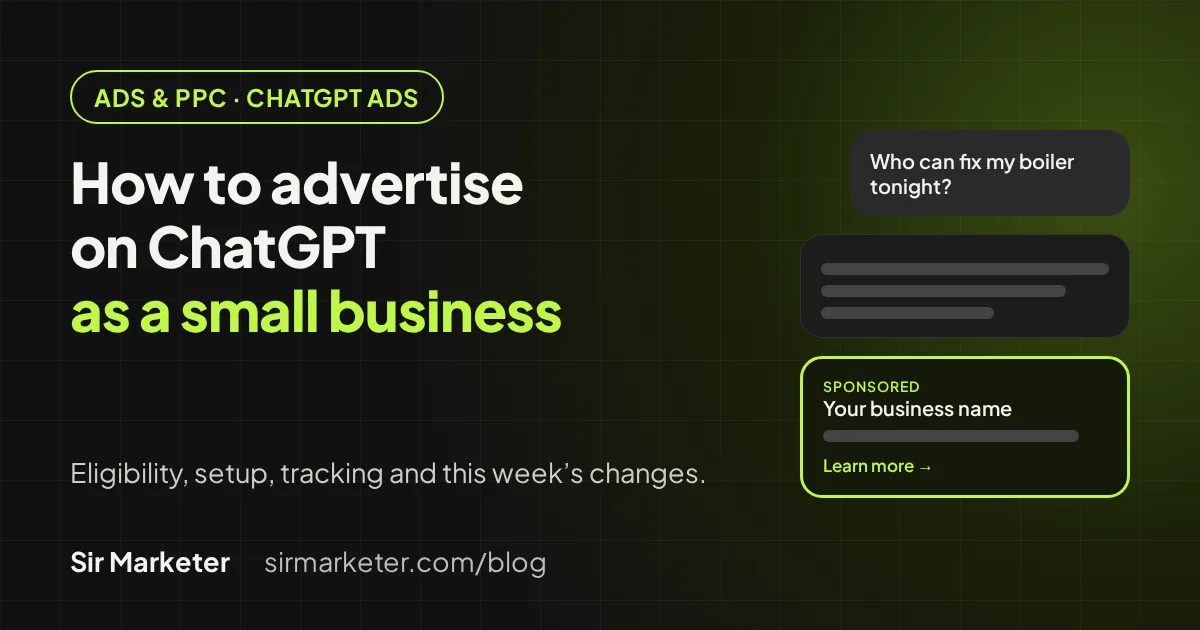
Quick answer: To advertise on ChatGPT, sign up at ads.openai.com, pick a Views, Clicks or Conversions objective, describe your customers in context hints instead of keywords, and send clicks to a specific landing page. Self-serve Ads Manager is open in the US, Canada, the UK, Australia and Singapore, but health, finance and legal ads are restricted outside the US.
What changed for ChatGPT advertisers this week
On 25 November 2026 OpenAI emailed ChatGPT Ads advertisers five product updates, reported by Search Engine Roundtable and Search Engine Land (Search Engine Roundtable; Search Engine Land):
- A “Learn more” link on single image ads. It now shows below the description by default and opens the landing page you already set, so there is nothing to change.
- Business Agents outside the US. Eligible ecommerce and online service businesses in supported markets can now publish a Business Agent in ChatGPT’s Business Hub, and advertisers with access can use it as a Sponsored Business Agent in a campaign. Search Engine Land notes the announcement doesn’t list which markets.
- Audience metrics. Reach, Frequency, Click Reach, Unique CTR, Unique CPC, Cost per 1,000 Reached and more, under Edit columns → Ad Viewers.
- Hide sale prices when a promotion ends, for product-feed ad groups. Useful after Black Friday and Cyber Monday.
- Clearer rejection messages, with a Policy Center link. OpenAI said the approval guidelines haven’t changed.
The same week, Search Engine Journal reported that OpenAI doesn’t plan to give advertisers reports showing the prompts or inferred intent behind their ads (Search Engine Journal). And OpenAI told advertisers that from 9 December approved third-party partner apps will be allowed to connect to ChatGPT Ads accounts by default, with 8 December as the opt-out date. Nobody gets access automatically: an authorised user still has to connect an app and grant it permission (Search Engine Land).
Searches like “how to advertise on ChatGPT”, “ChatGPT ads manager” and “ChatGPT ads for small business” are now showing in Google autocomplete in all five of our markets. Here is what a small business needs to know before spending anything.
How ChatGPT ads work
Who sees them, and where
Ads may appear for people on ChatGPT’s Free and Go plans. Plus, Pro, Business, Enterprise and Edu accounts don’t get ads, and OpenAI says it doesn’t show ads to accounts it identifies as belonging to under-18s. People see one ad unit below a ChatGPT response. It is labelled and kept separate from the answer (OpenAI Help Center).
OpenAI says ads don’t influence ChatGPT’s answers, and that advertisers can’t see users’ chats, chat history, memories or personal details. Advertisers only get aggregated performance data (OpenAI Help Center). So buying ads won’t get you recommended in ChatGPT’s answers. That is a separate job, covered in our guide to getting found by ChatGPT, Google AI and Perplexity.
How an ad gets matched
There are no keywords to bid on. OpenAI says its system considers the context and intent of the conversation, your landing page, title and copy, the context hints you write, and, when the user has ads personalisation turned on, select signals from their wider ChatGPT use (OpenAI Help Center). Search Engine Journal reports that the system writes its own search queries from the buying intent in a conversation, and advertisers can’t see those queries (Search Engine Journal).
When more than one ad is eligible, OpenAI weighs relevance and advertiser bids (OpenAI Help Center). In practice, a clear, specific ad that matches a specific landing page has a better chance of being chosen than a vague one.
How you pay
You choose a campaign objective. Views is billed per 1,000 impressions, Clicks per valid click, and Conversions optimises toward an event such as a lead or purchase, but is still billed per click or per 1,000 impressions, not per conversion (OpenAI Help Center). You can set a total or daily budget. OpenAI says the minimum daily budget depends on your billing currency.
Can your business advertise on ChatGPT?
Check two things first: where your business is based, and what you sell.
Country
To use self-serve Ads Manager, the legal entity that advertises and is billed must be based in a listed country. The United States, Canada, the United Kingdom, Australia and Singapore are all listed as available (OpenAI Help Center). OpenAI says ads now run in 89 countries and more than 100,000 advertisers have used the platform (OpenAI).
Some new self-serve accounts can at first advertise only in their home country. OpenAI says wider access depends on signals such as account history and builds over time (OpenAI Help Center). If you are a UK or Singapore business hoping to target US customers, plan for that limit.
What you sell
| Category | Status under OpenAI’s ad policies (updated 20 November 2026) |
|---|---|
| Local services, household and consumer goods, travel and entertainment, digital products and education | The current focus. OpenAI says early advertising is limited to these consumer categories, with more to come. |
| Healthcare, including dental services, cosmetic procedures and urgent care | Restricted. Selected, approved US advertisers only, case by case, and proof of licensure may be needed. Generally prohibited outside the US. |
| Financial services such as insurance, mortgages and credit cards | Restricted. Approved US advertisers, case by case. Prohibited outside the US unless OpenAI approves. |
| Legal services | Allowed for licensed US professionals. Currently prohibited outside the US. |
| Alcohol, tobacco and vaping, gambling, dating and adult, cannabis, political ads, individual job or housing listings, credit repair and debt settlement | Not allowed. Wellness products with unsupported health claims, such as detox programmes, diet pills and health coaching, are also excluded. |
Source: OpenAI Ad policies. Policies change often, so check the current version before you build a campaign.
The policy also covers your landing page. OpenAI reviews the title, copy, image and landing page, and rejects ads that don’t match their destination or that make misleading claims about pricing, results or comparisons (OpenAI Ad policies).
How to set up your first ChatGPT ad campaign
- Create the account at ads.openai.com with the OpenAI login you already use. Have one person create it and invite others. Check your country or region, currency and time zone before you submit: OpenAI says these three can’t be changed after the account is created (OpenAI Help Center).
- Decide whether to start from your website. Ads Manager can draft a first ad from your website URL during signup. Review it carefully, because ads go live once they pass review and billing is set up (OpenAI Help Center). If you are not ready, pause the campaign.
- Choose the objective and budget. For most local businesses, Clicks or Conversions is easier to judge than Views. Pick a total or daily budget (OpenAI Help Center).
- Set countries on purpose. OpenAI says that to target only the United States you must include the United States. Excluding other countries is not enough (OpenAI Help Center).
- Build ad groups around one service each, for example “emergency boiler repair” and “annual boiler service”, each with its own landing page.
- Write context hints in plain sentences. Describe what you offer, who it suits and when it helps, for example “after-hours residential plumbing in [your city]”. OpenAI says hints are not targeting rules and cannot enforce geography, schedules or exclusions (OpenAI Help Center).
- Write several distinct ads. Titles can be up to 50 characters (OpenAI suggests 16–24) and descriptions up to 100 (32–48 suggested). Use 1200 × 1200 px square or 1200 × 675 px landscape images (OpenAI Help Center). OpenAI recommends multiple title and copy variations, each with a different angle, and honest, benefit-led copy (OpenAI Help Center).
- Point each ad at the most relevant page, not your homepage, and make sure your site doesn’t block OpenAI’s OAI-AdsBot and OAI-SearchBot crawlers (OpenAI Help Center).
- Add UTM tags to each destination URL so your own analytics can separate ChatGPT ad traffic (OpenAI Help Center).
- Submit for review and check the campaign status in Ads Manager.
How to measure results without a search terms report
Ads Manager reports impressions, clicks, spend, CTR, average CPC, average CPM and conversions (OpenAI Help Center), plus this week’s reach and frequency metrics (Search Engine Roundtable). You will not see the conversations or queries behind each click (Search Engine Journal). That makes your own lead tracking more important, not less.
- Install the OpenAI Pixel, the Conversions API, or both. OpenAI adds a click reference called
opprefto the landing page URL. The Pixel stores it so later conversions can be matched to the ad click. If you use both methods, send the same event ID so OpenAI can de-duplicate (OpenAI Help Center). - Keep
opprefthrough redirects and booking steps. OpenAI lists this as a way to improve measurement (OpenAI Help Center). - Get consent where the law requires it. OpenAI says to send conversion data only after telling users what you collect and getting any consent the law requires (OpenAI Help Center).
- Allow for reporting delays. Impressions and clicks refresh about every 15 minutes, but spend can be 7–8 hours behind, so a spend of zero doesn’t mean nothing was charged (OpenAI Help Center).
- Expect different numbers in different tools. OpenAI says Ads Manager and your analytics may differ because of attribution windows, time zones, consent and modelled conversions (OpenAI Help Center).
For a service business, the honest test is simple: did ChatGPT ad clicks turn into calls, booked jobs or paid orders? Count them in your CRM. A cheap click that never calls is not a good result.
ChatGPT ads vs Google Ads: should a small business try both?
They work differently. Google Ads is built on keywords and search terms. On ChatGPT you describe your offer and customers in context hints, and OpenAI’s system decides when the ad is relevant (OpenAI Help Center; Search Engine Journal). Google’s own ads are also moving into AI answers, which we covered in Google Ads in AI Mode.
A sensible approach for most small businesses:
- Keep the channels that already bring you profitable leads running.
- Test ChatGPT ads with one well-defined service, one country and a budget you are comfortable treating as a test.
- Give it enough time to collect real leads, then compare cost per lead or booked job with your other channels.
- If you sell online, claim your business in ChatGPT first. Business Agents are only open to eligible ecommerce and online service businesses (OpenAI). See how to claim your business in ChatGPT.
If you are in a restricted category, such as a dental clinic in the UK or an Australian mortgage broker, ChatGPT ads are mostly closed to you for now (OpenAI Ad policies). Put that effort into Google Ads, local SEO and answer engine optimisation instead.
ChatGPT ads checklist for small businesses
- Confirm your business country is on OpenAI’s self-serve list (OpenAI).
- Check your category against the current ad policies.
- Pick the right country, currency and time zone at signup. They can’t be changed later.
- Start with one service, one landing page and one country.
- Choose Clicks or Conversions and a test budget you are comfortable with.
- Write 3–5 plain-English context hints: what, who and when.
- Write several distinct, honest ads within the character limits.
- Make sure the landing page loads fast, matches the ad, has a clear call or booking button and doesn’t block OAI-AdsBot.
- Add UTM tags and install the OpenAI Pixel. Keep
opprefthrough redirects. - Decide before 8 December whether partner apps should be able to connect to your ads account.
- After a promotion ends, hide sale prices on product-feed ads.
- Review results weekly in your CRM, by leads and booked jobs, not clicks.
Where Sir Marketer can help
- You want ads set up and tracked properly: our pay-per-click advertising team runs Google, Microsoft and AI-search ad campaigns with call and lead tracking. Check your numbers first with the free ROAS calculator or PPC checker.
- Your landing page isn’t ready: request a free live website preview and see a fast page built for one service before you decide anything.
- Ad clicks call after hours: an AI receptionist answers, books and texts back, so paid leads aren’t missed.
Thinking about testing ChatGPT ads? Sir Marketer helps small businesses in the US, Canada, the UK, Australia and Singapore decide whether a new ad channel fits, then set it up with proper tracking. Book a free call and we will look at your offer and landing page with you.
Frequently asked questions
Can small businesses advertise on ChatGPT?
Yes. Businesses based in a listed country, including the US, Canada, the UK, Australia and Singapore, can sign up for self-serve Ads Manager at ads.openai.com. OpenAI’s early focus is local services, consumer goods, travel and entertainment, and digital products and education.
How do ChatGPT ads work?
Ads show below a ChatGPT answer for Free and Go users. There are no keywords: OpenAI matches ads using the conversation’s context and intent, your ad and landing page, your context hints and, if the user allows it, personalisation signals. OpenAI says ads don’t change ChatGPT’s answers.
Who sees ads in ChatGPT?
People on the Free and Go plans. OpenAI says Plus, Pro, Business, Enterprise and Edu accounts have no ads, and it doesn’t show ads to accounts it identifies as under 18.
Can dentists, lawyers or financial advisers advertise on ChatGPT?
Only in limited cases. Healthcare and financial ads are restricted to selected, approved US advertisers, and legal services are allowed for licensed US professionals. Outside the US these categories are generally prohibited under OpenAI’s ad policies.
Can I see which prompts triggered my ChatGPT ad?
No. Advertisers get aggregate metrics such as impressions, clicks, spend, conversions, reach and frequency. Search Engine Journal reports OpenAI doesn’t plan prompt-level reports, so track leads with UTMs, the OpenAI Pixel and your CRM.
Do ChatGPT ads help my business appear in ChatGPT answers?
No. OpenAI says ads run on separate systems and advertisers can’t shape ChatGPT’s responses. To be recommended in answers, claim your business in ChatGPT and keep accurate, well-structured information on your website.
Sources
- Search Engine Roundtable: ChatGPT Ads new call-to-actions, Business Agents beyond US, more audience metrics (25 November 2026)
- Search Engine Land: ChatGPT Ads adds audience metrics and expands Business Agents (26 November 2026)
- Search Engine Journal: OpenAI has no plans for prompt-level ChatGPT Ads reports (25 November 2026)
- Search Engine Land: ChatGPT Ads to enable third-party partner app access by default (25 November 2026)
- OpenAI Help Center: Ads in ChatGPT, the basics
- OpenAI Help Center: Ads in ChatGPT (FAQ)
- OpenAI Help Center: Ads Manager availability
- OpenAI Help Center: Creating campaigns for ChatGPT Ads
- OpenAI Help Center: Ads Manager account setup
- OpenAI Help Center: Creating ads for ChatGPT Ads
- OpenAI Help Center: Writing context hints for ChatGPT Ads
- OpenAI Help Center: Conversion measurement
- OpenAI: Ad policies (updated 20 November 2026)
- OpenAI: ChatGPT Ads expands to 26 new countries (21 October 2026)
- OpenAI: Introducing Businesses in ChatGPT (updated 19 November 2026)
Written by Utkarsh Arora. Published 2026-11-28. Details are taken from OpenAI’s help pages and ad policies and the linked reporting on the date above. ChatGPT Ads is in beta and changes often; we will update this post when OpenAI changes eligibility or features.