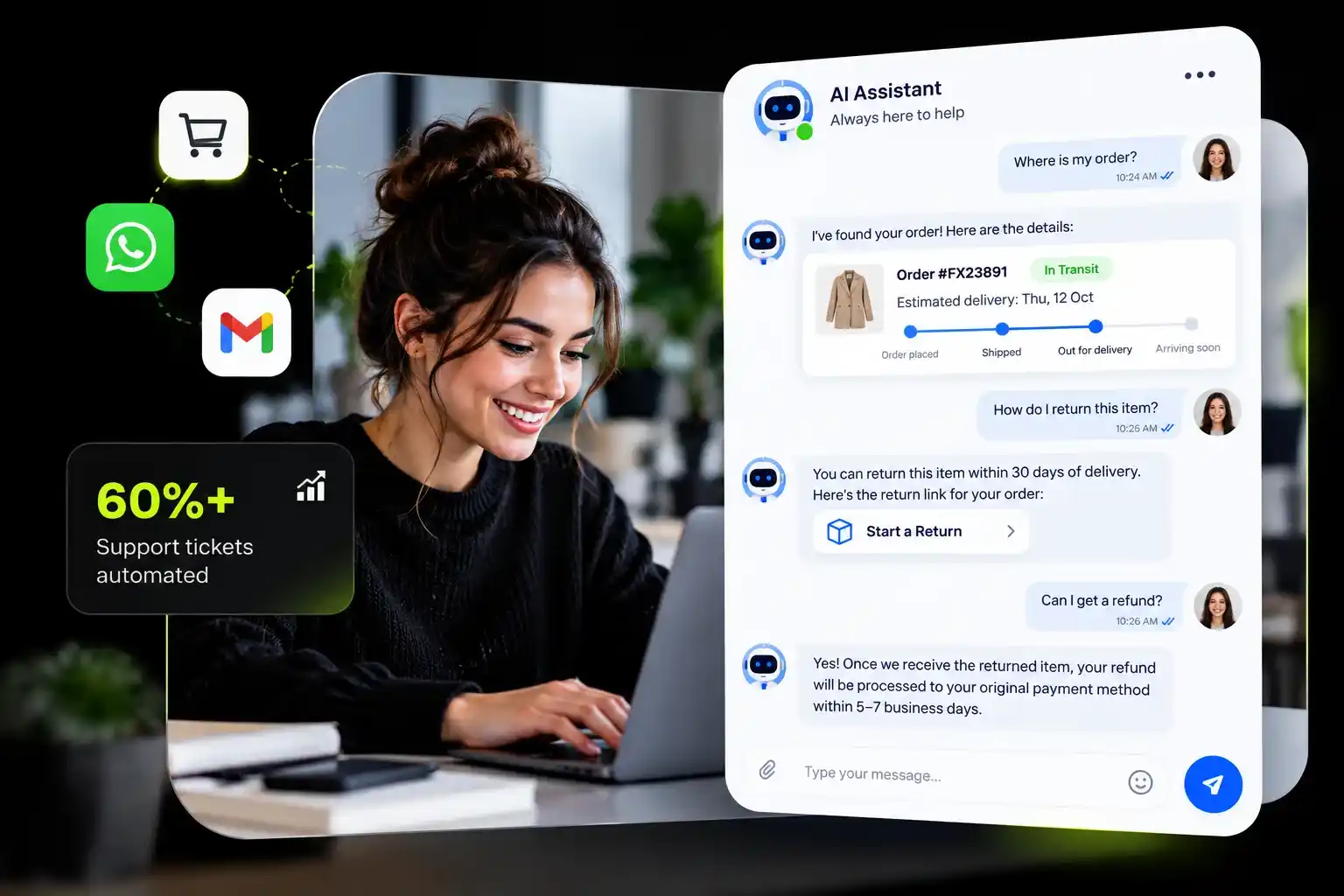
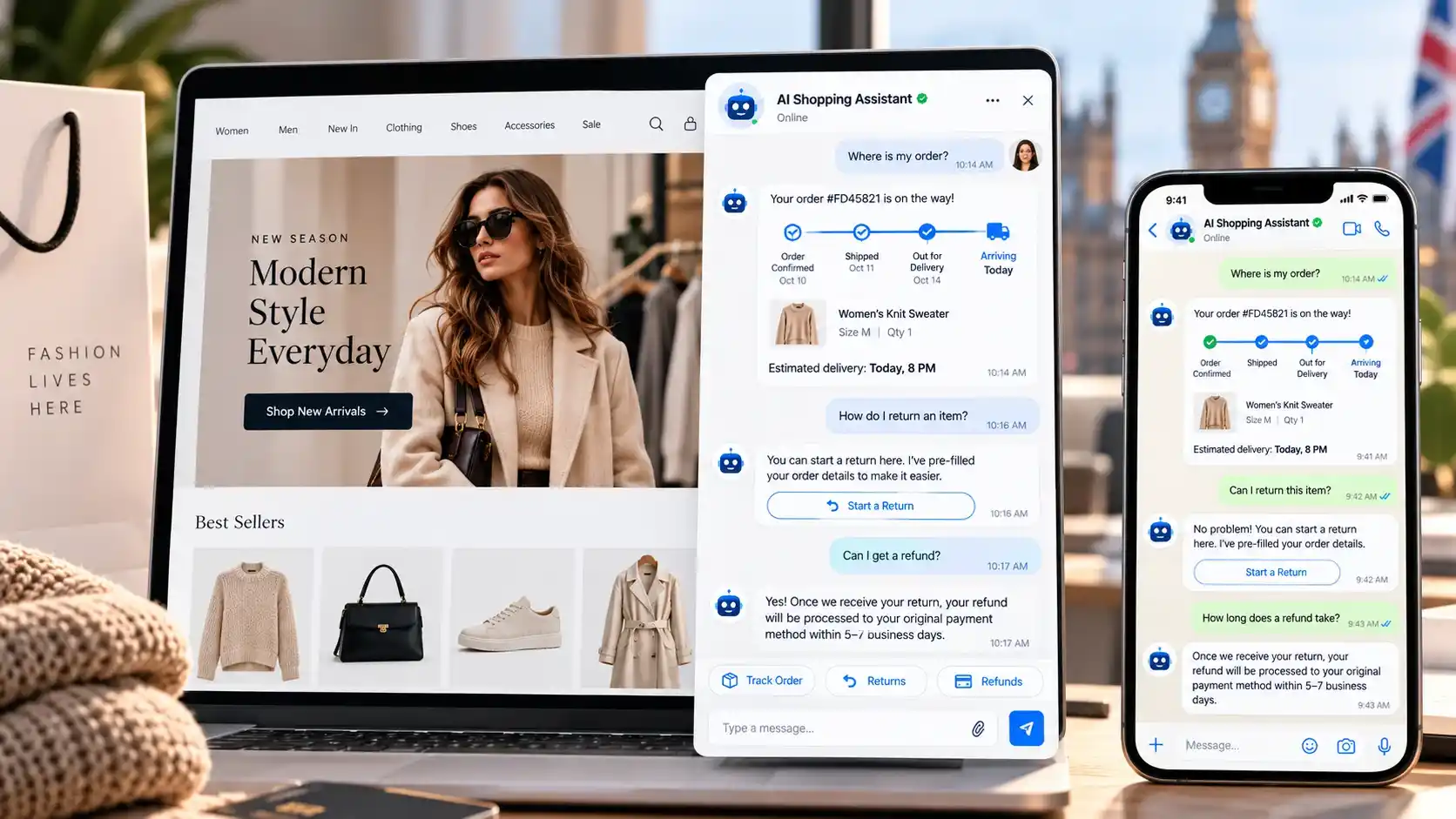
Instant answers. Lower support costs. Happier customers. We design and run complete AI customer support systems, from the first customer question to the resolved support ticket. Customers now expect 24/7 customer support on every channel. We help you deliver it with a customer service chatbot that can understand customer needs, builds trust, and makes it easy to get help with confidence. Every conversation also feeds your lead generation.
See how our AI chatbot customer service solutions cut ticket volume, shorten wait time, and lift customer satisfaction during peak support periods.
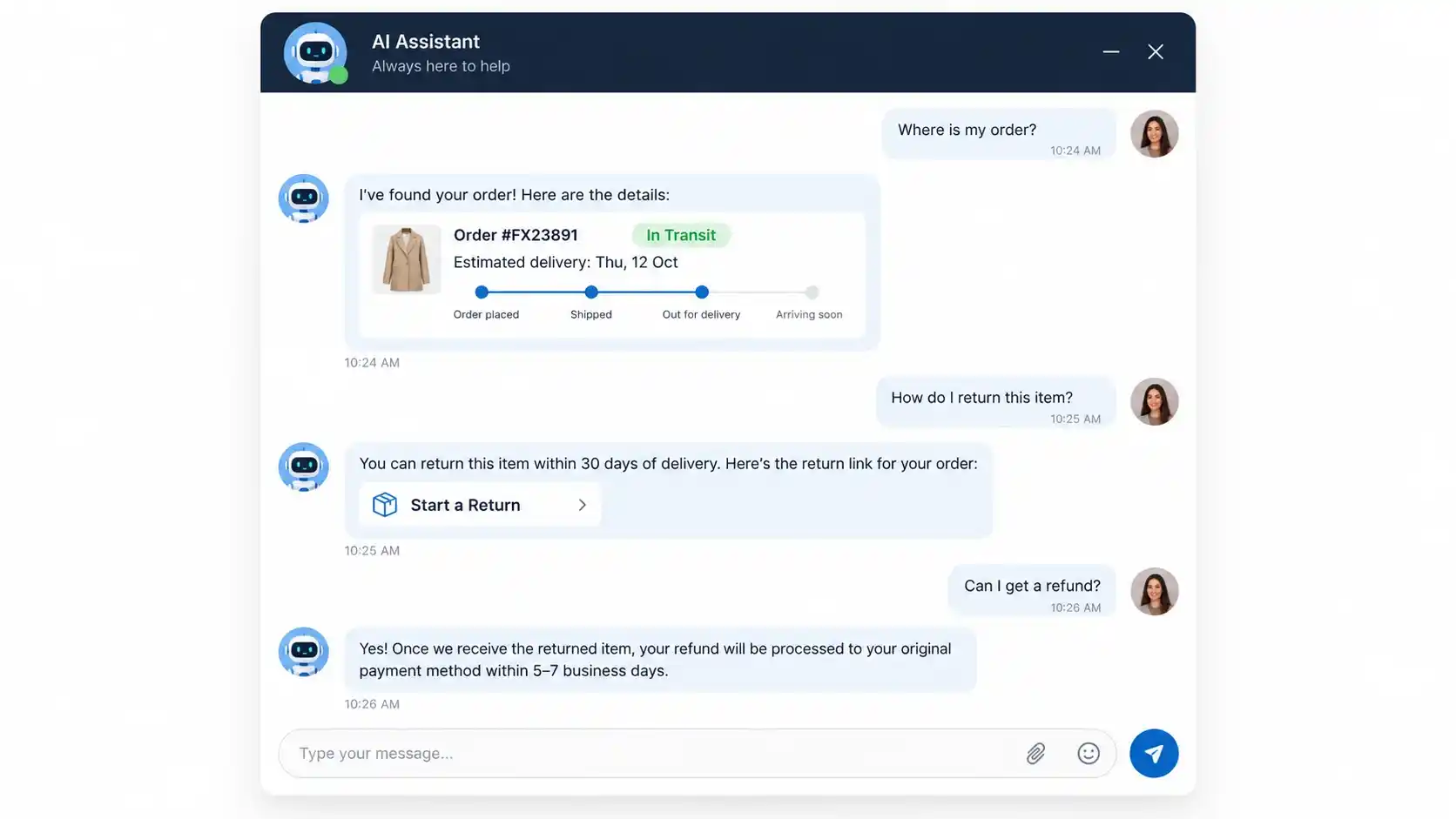
Before the chatbot, our team spent most of the day answering 'where is my order?' Now the customer service chatbot handles order tracking, returns, and refund requests on our website and WhatsApp, and more than 60% of those tickets never reach an agent. Customers get instant responses, and our team finally has time for the cases that need a person.
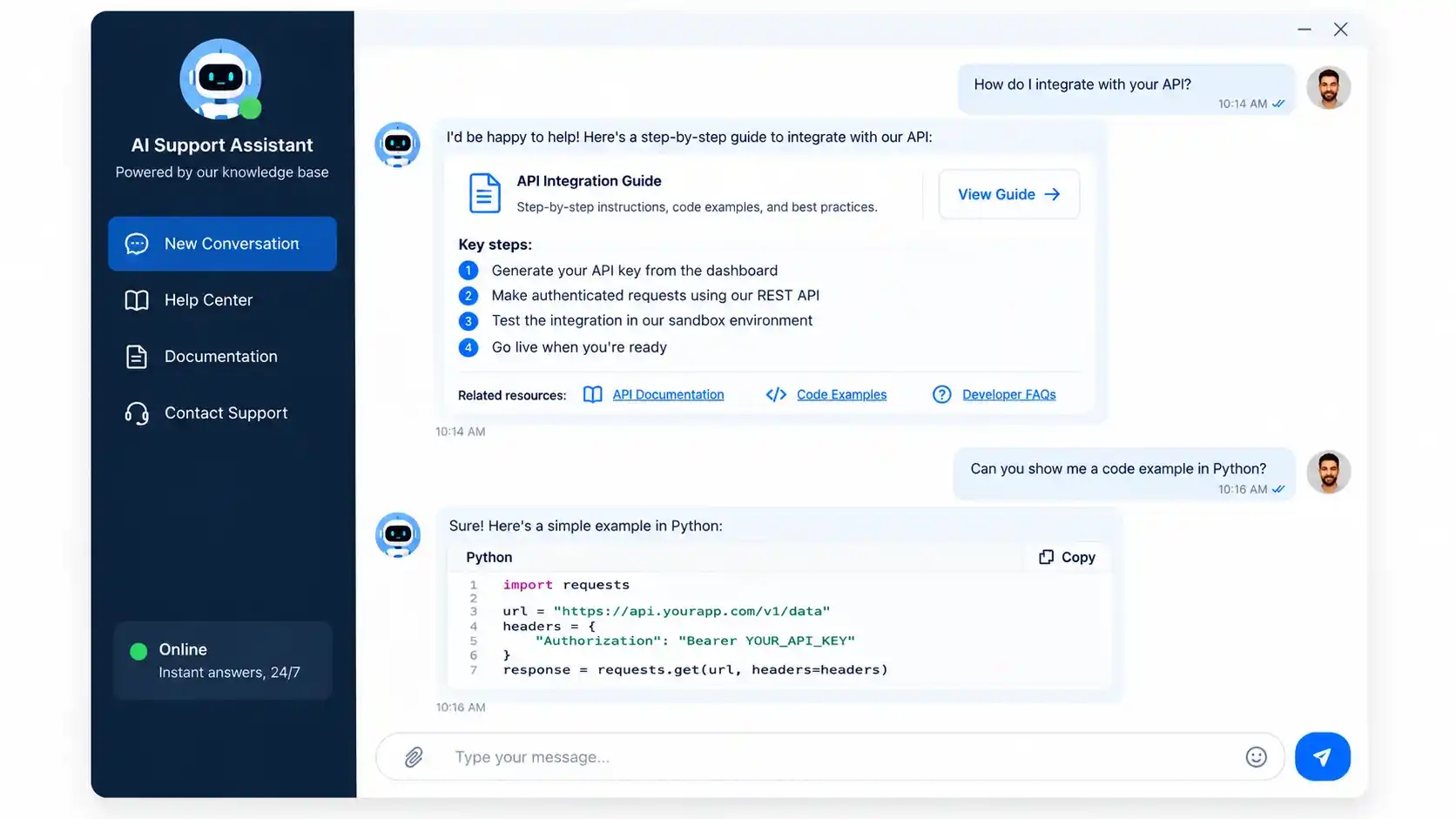
The bot answers from our knowledge base, so replies are accurate and match our documentation. Resolution time dropped by almost 40%, and each support agent got roughly a day and a half back every week. The human handoff is so smooth that customers rarely notice when a conversation moves to our team.
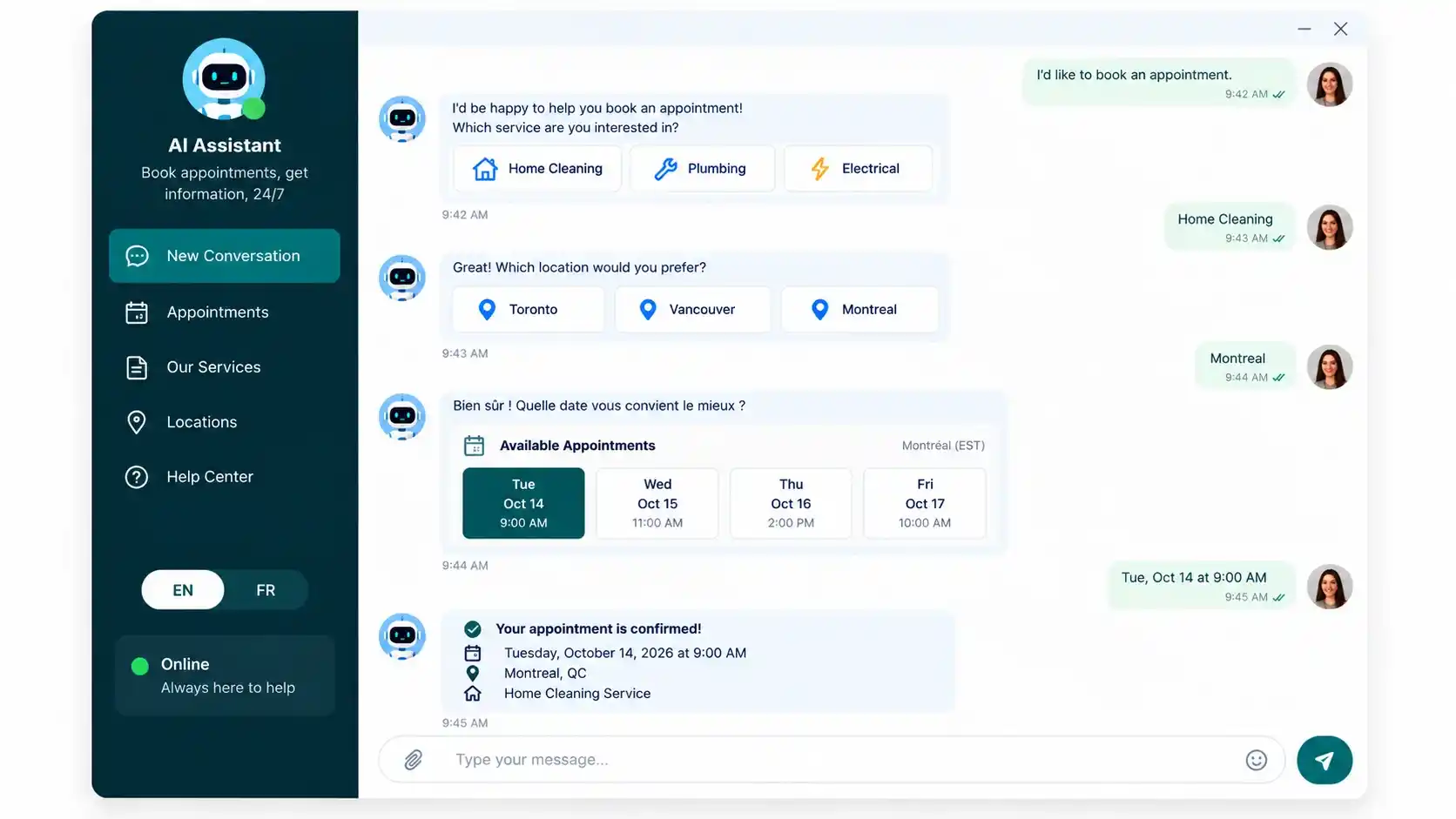
Most of our enquiries used to come in after hours, and we lost many of them by morning. The website chatbot now qualifies leads and books appointments at any time, in English and French. Qualified bookings are up 2.4x, and we didn't add a single person to the team.
Each solution is powerful on its own. Deployed as a system, they form a customer support engine that runs 24/7 and improves every week.
Conversational AI trained on your products, policies, and tone of voice. Our AI chatbot for customer service understands customer questions in plain language, gives personalized responses, and works as a customer service virtual assistant around the clock, so customers get instant responses and your team gets time back.
A website chatbot, live chat, WhatsApp, email, and social inbox working as one omnichannel support system. Every customer conversation shares one conversation history, and multilingual support answers customers in their own language.
Ticket automation categorizes support tickets, sets priority, applies ticket routing rules, and triggers ticket escalation when a case needs a specialist. Customer support tickets never sit unassigned, and your help desk stays organized.
Turn your documentation into instant answers. FAQ automation and knowledge base integration let the bot resolve frequently asked questions and power customer self-service, so simple issues never reach a human agent.
Connect your customer support bot to your CRM, help desk, and e-commerce store through API integration and third-party integrations. Every reply draws on live customer data and a complete customer profile.
Chatbot analytics and conversation analytics dashboards show what customers ask, where the bot struggles, and how customer sentiment shifts. Track response time, resolution time, and customer feedback from the first message to the resolved issue.
Let’s build something that moves your support team forward. Get Free Chatbot Audit →
Customer support teams across industries are quietly dealing with a growing challenge. Ticket volume keeps climbing. Customer expectations are climbing faster. Hiring more support agents no longer keeps pace with demand. And the way people ask for help has fundamentally changed.
Ten years ago, a phone line and an email address were enough. Today, a customer’s first interaction with your business almost always happens on a screen, often at midnight, and often before they have spoken to a single human on your customer service team.
How We Solve This
Chatbot customer service makes support more scalable by improving how you answer and resolve customer inquiries. We combine smart strategy with conversational AI to deliver faster, more consistent support.
The landscape of customer support has compressed in ways that disadvantage teams running on legacy tools. Three structural forces are reshaping modern customer service:
Customer behavior has shifted for good. Shoppers start with a chat window, not a phone call, and they judge your wait time against the fastest brand they have ever used. A slow first reply can turn a simple question into a customer complaint and, eventually, a lost customer. Instant customer support is now the baseline, not a bonus.
Adding people to a call center or contact center is the traditional answer, but it is slow and expensive. Support costs rise in step with demand, and service quality varies from shift to shift. Customer service automation breaks that link. It absorbs repetitive volume so your customer service agents can focus on complex issues and a reduced workload.
A hidden contact form or a help desk that replies tomorrow tells customers your operation is outdated. Customer experience is shaped in the first few messages, long before a human agent joins the conversation, and it carries through the whole customer journey into customer retention.
These dynamics do not favor passive teams. They favor businesses that treat customer support as an operating discipline, one that requires strategy, systems, and consistent execution.
Buyers comparing options usually ask four questions, so here are straight answers:
1. Chatbot vs live chat.
A live chat window staffed by people is warm but limited by shift hours and headcount. A chatbot answers instantly at any scale, then brings in a live agent when a conversation needs one.
2.Chatbot vs human customer service.
Bots win on speed, availability, and repetition. People win on empathy, negotiation, and judgment. Good design gives each the work it does best.
3. AI chatbot vs traditional chatbot.
Traditional bots follow rigid decision trees and fail when a customer says something unexpected. An AI chatbot uses natural language understanding to grasp meaning and context.
4. AI customer support vs human support.
The strongest model is hybrid: AI handles volume, and your people handle nuance.
AI customer service chatbots are among the highest-return investments a support team can make, because customers now ask for help in conversation, and automated conversations scale without losing quality. A customer typing “where is my order?”They aren’t just browsing; they’re actively looking for an answer. Here is how a well-built bot delivers it:
1. Natural Language Processing & Understanding
Natural language processing (NLP) lets the bot read what customers type or say. Natural language understanding works out what they mean, and natural language generation writes a clear, on-brand reply. Together they turn chatbot interactions into real conversations instead of menu clicks.
2. Large Language Models & Generative AI
A large language model (LLM) gives our AI agents fluent, flexible replies. Generative AI is powerful but can invent answers, so we never let it run unsupervised. Our advanced AI capabilities are paired with:
3. Knowledge Base Integration & RAG
Retrieval-augmented generation (RAG) lets the bot look up answers in your approved knowledge base before it replies, so answers stay accurate and traceable. With knowledge base integration, the bot updates whenever your documentation changes.
4. Intent Recognition & Sentiment Analysis
Intent recognition identifies customer intent in a fraction of a second, whether it is a refund, a delivery check, or a pricing question. Sentiment analysis reads tone and urgency, so frustrated customers reach a person sooner. Contextual understanding makes context-aware conversations possible, so returning customers never repeat their story.
5. Chatbot Training & Continuous Learning
We run chatbot training on real transcripts and review them weekly. Machine learning and conversation analytics refine answers over time, so the bot improves instead of drifting.
Timeline Expectation
A focused chatbot customer service launch typically takes 3 to 6 weeks. It is not instant, but it becomes a compounding support asset. Every conversation feeds the next round of training, so containment rate, resolution time, and customer satisfaction improve month after month without adding headcount.
A chatbot that cannot access your systems can only guess. Ours connect to them. CRM integration gives the bot customer profiles and purchase history, while help desk integration creates and updates tickets automatically. E-commerce and API integrations connect order tracking, billing, shipping, scheduling, and internal tools.
Whether you use a leading customer service platform, custom software, or multiple tools, we connect everything so information flows both ways. Your CRM remains the source of truth, while workflow automation handles tagging, routing, and follow-ups.
We also support multiple channels, including your website, WhatsApp, email, and social media, with the same AI logic across each. Multilingual support helps customers communicate in their preferred language, delivering consistent, scalable support.
Lead Generation Benchmark
Most businesses see their first chatbot-qualified leads within the first few weeks of launch, at a cost per lead well below paid channels. Results depend on traffic and offer, and we set targets after the free audit.
01
We begin by understanding your product, goals, and audience. This phase is about clarity—what you offer, who needs it, and where growth should come from. Research shapes every decision.


02
Once the strategy is clear, execution begins. Campaigns go live across SEO, ads, content, social, and funnels. Every channel works together, not in isolation.
03
Growth is not static. We test, refine, and adapt continuously. You stay involved, informed, and in control while we optimize what works and scale results.

Sir Marketer works with a growth-first mindset. Every strategy is built around clarity, speed, and measurable impact. Instead of focusing on surface-level metrics, the team looks at what actually moves a business forward—users, leads, and revenue. This approach makes Sir Marketer a strong fit for startups and growing businesses that need marketing to work in the real world.
Yes. Many founders come in with a product and a vision but no clear growth path. Sir Marketer helps turn that uncertainty into a structured plan—building visibility, validating demand, and creating the first working growth engine. Whether you are just starting out or already gaining traction, the strategies are shaped around your current stage.
A startup-focused approach is built around learning fast, adapting quickly, and tying every action to outcomes. Instead of following fixed playbooks, Sir Marketer adjusts strategies based on your market, goals, and resources. This ensures that marketing remains flexible, practical, and aligned with real business growth.
Timelines depend on the channel. Performance campaigns and lead generation can show early signals within weeks, while SEO and content usually take a few months to build momentum. The goal is always to create early clarity—so you know what is working and where growth is coming from as soon as possible.
Sir Marketer offers end-to-end growth support, including SEO, performance advertising, content and funnel strategy, branding, web design, analytics, and customer engagement systems. All services work together under one growth framework, so efforts are never scattered or disconnected.
Yes. Strategies are designed to respect your runway. The focus stays on efficiency, testing lean, and scaling only what proves effective. This helps founders grow without unnecessary spend or long-term commitments that do not deliver value.
Success is measured through outcomes that matter—qualified leads, active users, conversion rates, customer acquisition cost, and revenue impact. The goal is to create marketing that directly supports business growth, not just visibility.
Click “Get Free Growth Plan” and share a few details about your business. Sir Marketer will review your goals, challenges, and stage, then map out a clear growth direction that fits where you are and where you want to go.
Our team will answer all your questions, We ensure a quick response.
We specialize in AI automation for customer service teams, helping you answer faster, resolve more, and keep customers coming back.
We understand customer support workflows and customer service workflows from the inside: queues, SLAs, escalations, and QA. Generalist AI vendors don't.
We measure success in resolved issues, not chatbot launches. Every customer service chatbot has clear cost reduction and customer satisfaction tracking, so you always know what you're getting.
We deploy a customer support bot framework tested across 100+ support teams. You benefit from accumulated data and insight from day one.
We keep up with the best AI chatbots and platforms, including tools like Freddy AI, and recommend the AI platform that fits your stack, not one we resell.
A simple, proven framework that transforms your customer support into a reliable automated system, built to consistently resolve issues, improve customer experience, and cut support costs.
We review your ticket data, channels, common questions, and support operations, then create a 30-day action plan and 90-day roadmap focused on high-volume requests.
We build your bot, connect your knowledge base, and complete chatbot training on real conversations. We launch quietly on one channel, connect your CRM and help desk, and test every human handoff before scaling.
We review your support data weekly: containment rate, response time, resolution time, and customer sentiment. What drives resolutions gets scaled. What doesn't gets replaced.
Once your core system is proven, we extend AI automation into billing, onboarding, scheduling, and proactive outreach, building systems that compound and keep service quality consistent.
Outcomes from support teams on our full AI customer service programme, driving real drops in ticket volume and real gains in customer satisfaction.
( 40+ Reviews )


"Within just two months, our chatbot was efficiently handling more than half of all incoming customer support requests. By month six, we had our best customer satisfaction score in years. The AI chatbot alone saved us the cost of two full-time hires."
"The bot answers from our knowledge base, so replies are accurate and match our documentation. Resolution time dropped by almost 40%, and each support agent got roughly a day and a half back every week. The human handoff is so smooth that customers rarely notice when a conversation moves to our team."
"Most of our enquiries used to come in after hours, and we lost many of them by morning. The website chatbot now qualifies leads and books appointments at any time, in English and French. Qualified bookings are up 2.4x, and we didn't add a single person to the team."
Chatbot customer service uses AI-powered chatbots to answer customer questions, resolve issues, and route requests automatically.
The best time is before your next peak period. Launching 4 to 6 weeks ahead gives the bot time to learn from real conversations. If ticket volume is already rising, start now.
Most teams see ticket deflection within the first 2 to 4 weeks of launch. Containment rate and faster issue resolution keep improving as chatbot training continues.
We track first response time, resolution time, ticket deflection, customer satisfaction, and cost per resolved conversation, plus chatbot analytics on what customers ask.
No, and it shouldn't. AI chatbots handle repetitive customer inquiries while human agents handle complex, sensitive, or high-value conversations. The best results come from a hybrid model with clear human handoff rules.
Usually not. We integrate with your existing help desk and live chat, adding AI on top. If your tools are outdated, we'll recommend a better customer service platform. We never recommend replacing something unless it’s genuinely necessary.
The best AI chatbot for customer service is the one that fits your channels, data, and customers, integrates with your CRM and help desk, and escalates smoothly. Cost depends on conversation volume, channels, and integrations. We give an itemized quote after the free audit.
Book a free chatbot audit. We review your ticket data, channels, and goals, then send a clear roadmap and quote within a few business days.
Yes. We use encryption, access controls, and data minimization, and we never train public models on your customer data.