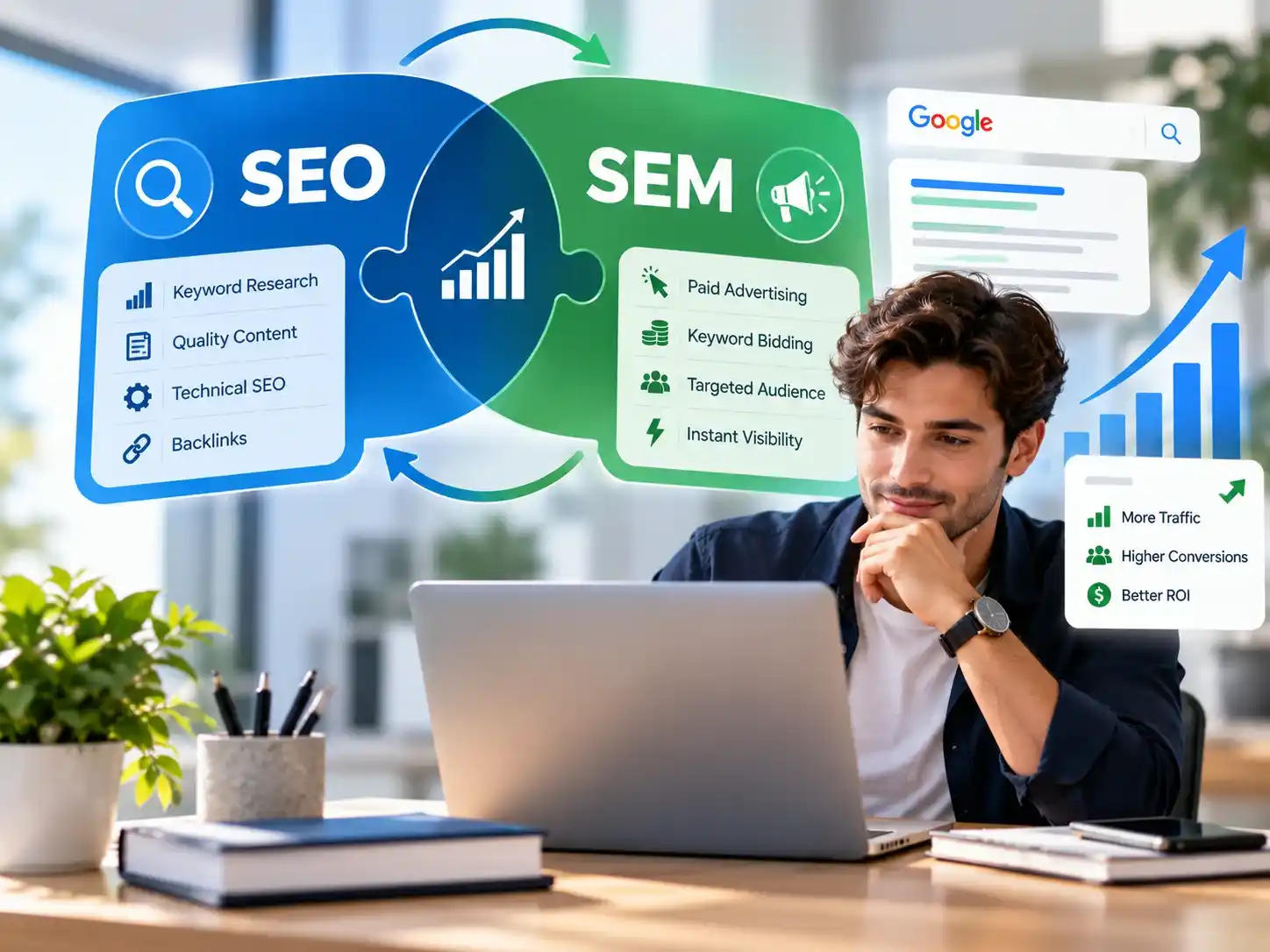
SEO and SEM work together by combining organic search and paid search into one search marketing system. Paid campaigns deliver immediate search visibility and keyword data, while SEO builds long-term organic growth and website authority. Shared keyword insights, landing pages, and conversion data help both channels improve traffic quality, website conversions, and return on investment.
Search engine optimization (SEO) earns visibility in organic search. It improves how well your pages match what people search for and how well search engines can understand them. The main parts are:
Search algorithms evaluate relevance, quality, and user experience (UX). No one can guarantee a ranking, but consistent work can build organic traffic over time.
Search engine marketing (SEM) is defined differently across the industry. Some use it for all search marketing, organic and paid. Most use it for paid search. This guide uses SEM for paid search, with pay-per-click (PPC) as its main model.
In Google Ads, advertisers choose keyword targeting and audience targeting, then compete in an auction. Your Ad Rank depends on your bid, ad quality, expected impact of assets, and the context of the search. Quality Score is a diagnostic that reflects expected click-through rate, ad relevance, and landing page experience. SEM is a measurable testing system, not just “buying traffic.”
Factor |
SEO |
SEM / Paid Search |
|---|---|---|
Visibility source
|
Earned organic listings
|
Paid ad placements
|
Traffic type
|
Organic traffic
|
Paid traffic
|
Cost model
|
Time, content, and expertise
|
Cost-per-click (CPC) or other bid models
|
Speed
|
Gradual
|
Fast once campaigns launch
|
Long-term impact
|
Compounds over time
|
Stops when spend stops
|
Targeting
|
Intent-based via content
|
Keywords, audiences, locations, devices
|
Keyword data
|
Aggregated in Google Search Console
|
Detailed search terms reports
|
Conversion data
|
Strong but slower
|
Fast, controlled tests
|
Scalability
|
Limited by content and authority
|
Limited by budget and demand
|
Main limitation
|
Slow, uncertain timeline
|
Ongoing cost
|
Best for
|
Evergreen demand
|
Launches, offers, competitive terms
|
In the SEO vs SEM debate, neither wins everywhere. SEO suits sustained demand. SEM suits speed and testing. The right mix depends on goals, budget, competition, and time horizon. Not every business needs both at all times.
Sem and seo working together creates organic and paid search synergy, because each channel fills the other’s blind spots.
Strong content, topical authority, and website authority earn organic rankings that keep producing organic traffic without per-click fees. This is long-term organic growth.
Paid search puts you in front of high-intent searchers quickly. It also lets you test offers and messages within days instead of months. That is immediate search visibility, as long as campaigns are active.
Organic data shows which queries already bring qualified visitors and which pages convert. Use those SEO insights for PPC to choose keywords, shape ad groups, and pick landing pages. Example: a page that earns steady organic traffic for “emergency plumber” suggests a paid campaign worth testing.
Google Ads shows which search terms convert, which ad messages earn clicks, and how competitive a keyword is. Use those PPC insights for SEO to prioritize new pages, rewrite title tags, and refine meta descriptions. Example: a long-tail term converts well in ads but has no dedicated page. That page becomes an SEO priority.
One caution: running ads does not directly raise organic rankings. The benefit is the shared learning, not a ranking boost.
This does not mean combined traffic or conversions automatically double. Results depend on execution.
Keyword research is the common foundation. It estimates search demand, keyword competition, and search intent. The same keyword can play different roles in each channel.
Bringing these services together under one strategy ensures a restaurant’s identity stays consistent, whether a customer encounters it on a menu, a delivery box, or a social feed.
Keyword Type |
SEO Approach |
SEM/PPC Approach |
|---|---|---|
Informational
|
Guides and explainers
|
Rarely bid, or use for remarketing lists
|
Commercial
|
Comparison and review content
|
Test ads to learn what persuades
|
Transactional
|
Service and product pages
|
Core bidding focus
|
High-intent keywords
|
Optimized money pages
|
Priority budget
|
Brand
|
Protect organic listings
|
Defend against competitors if data supports it
|
Competitive
|
Build authority slowly
|
Pay for visibility while SEO matures
|
Low-competition keywords
|
Quick organic wins
|
Often cheap, test first
|
Keyword mapping assigns each query to the best page and channel, so your teams don’t work against each other.
Search intent is why someone searches. It shapes everything else.
Matching intent matters more than inserting keywords. A mismatch hurts organic performance and also lowers ad relevance and conversion rate.
Yes, depending on the data. Overlap can make sense for high-value commercial keywords, competitive results pages, and brand terms when competitors bid on your name. It may be inefficient when you already rank first, the query has low value, and ads add little incremental revenue.
Neither “always bid” nor “never bid” is correct. Test, measure incrementality, and check conversion economics.
Funnel Stage |
Organic Search |
Paid Search |
|---|---|---|
Awareness
|
Educational content
|
Discovery and top-of-funnel tests
|
Consideration
|
Comparison and commercial content
|
Ads on commercial queries
|
Decision
|
Optimized service pages
|
Transactional ads and landing pages
|
Conversion
|
Clear calls to action
|
Message-matched pages
|
Retention
|
Helpful resources
|
Remarketing where appropriate
|
This is the marketing funnel viewed through the customer journey. Organic and paid can support each stage.
Landing pages connect both channels. SEO content pages target broad discovery. PPC landing pages focus on one offer and one action. Service or product pages often serve both.
Fast, mobile-friendly pages help everyone. Mobile SEO and Core Web Vitals support user experience for organic visitors. For ads, landing page experience is a Quality Score component. Organic SEO doesn’t directly set Quality Score, but a good site helps both. Keep your messaging consistent from query to click to action.
For local businesses, local SEO and Google Business Profile visibility pair with location-targeted Google Ads for nearby customers.
E-E-A-T (experience, expertise, authoritativeness, and trust) is a quality framework, not a ranking score. Helpful, trustworthy content also improves conversion.
Search is changing. AI Overviews, featured snippets, and other SERP features affect how people see results, and zero-click behavior is growing. Think of search visibility as broader than blue links, supported by organic content, paid placements, and brand visibility. Because search engine algorithms and features change often, verify current guidance in official Google documentation.
SEO and SEM aren’t rivals. SEO builds long-term organic growth. SEM provides immediate visibility and fast, actionable data. Shared keyword intelligence, landing page learning, and conversion data make both smarter.
The right balance depends on your goals, budget, competition, and timeline. Start with clear tracking, a shared keyword plan, and steady testing.
If you’d like help building an integrated search strategy, Sir Marketer can help you plan how organic and paid search fit your goals and measure what matters.
They share keyword data, landing page learnings, and conversion insights. Paid search offers speed; SEO offers durability.
SEO earns organic visibility. SEM, in this context, buys paid visibility.
Neither is universally better. It depends on goals, budget, and timeline.
Yes. They can share keyword and conversion data.
Combined insight improves targeting, content, and efficiency.
Not directly. It can inform SEO decisions.
Yes. Converting search terms reveal content opportunities.
Our team will answer all your questions, We ensure a quick response.