
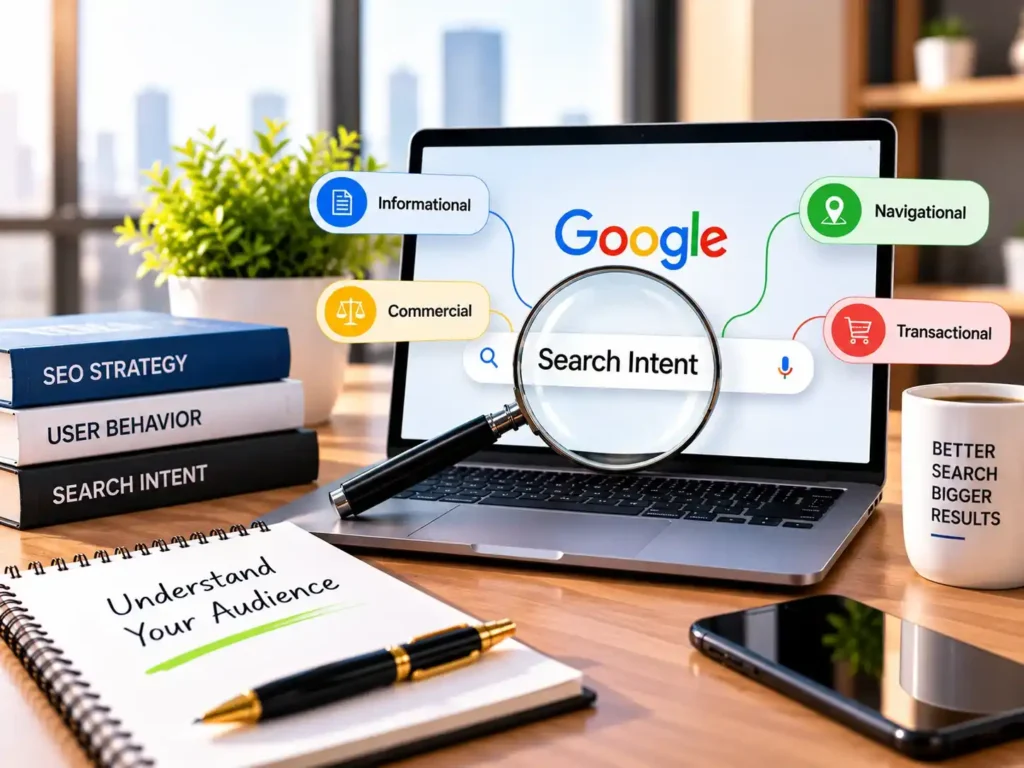

Understanding Search Intent and Its Importance in SEO
Search intent refers to what users hope to achieve when entering a search query. Recognizing this purpose enables marketers to develop content that aligns with users’ needs, whether they are seeking information, evaluating options, locating a specific page, or making a purchase. Aligned content can improve relevance, strengthen the search experience, and attract more qualified organic visitors. Rankings and results are never guaranteed.
Why Search Intent Matters More Than Keywords
Keywords indicate the terms people enter into search engines, whereas search intent explains the purpose or outcome they have in mind. For example, “What is CRM software” seeks information, “Best CRM software” compares options, and “Buy CRM software” signals purchase intent. Aligning content with these goals helps improve relevance, user experience, and qualified organic traffic. However, SEO results also depend on content quality, competition, and technical factors.
What Is Search Intent in SEO?
It is also called user intent and is the underlying purpose of a query. Four related ideas are easy to confuse:
- Keyword: the words a person types.
- Search intent: the goal behind those words.
- Query context: clues such as wording, location, and current results.
- Content-to-query alignment: how well a page’s purpose, format, and depth fit the searcher’s likely goal.
“Running shoes” shows the limits of keyword intent. Depending on context, the searcher may want recommendations, reviews, buying options, or information about shoe types. Keywords rarely reveal intent with certainty, so start analysis with the results, not the phrase.
What Most SEO Strategies Overlook
It is a decision-making framework, not a secret ranking trick. Its strategic value comes from five things:
- It reveals the problem behind the query. “Why is my website traffic dropping?” signals a diagnostic need. “SEO audit services” suggests evaluation. “Hire an SEO agency” signals a stronger commercial or transactional goal. People using similar phrases don’t always share a motivation.
- It connects search behavior to the customer journey. Needs move through awareness, research, comparison, decision, and post-purchase questions. The path is rarely linear.
- It explains why relevant keywords can underperform. A product page targeting an educational query, or a long essay where users want a comparison table, misses the need. That doesn’t automatically cause ranking losses, but it weakens the fit.
- It separates traffic from outcomes. Qualified organic traffic, meaning visitors whose needs match your offer, matters more than raw volume.
- It guides content decisions. Intent shapes page type, format, headings, depth, examples, calls to action, and internal links.
Intent is not a keyword research detail. It decides what content should exist and what job each page performs.
What Are the Four Main Categories of Search Intent?
The four types of search intent are a practical marketing framework, not labels Google says it uses universally.
Intent |
User goal |
Common signals |
Best-fit content |
|---|---|---|---|
Informational
|
Learn or understand
|
what, why, how, guide
|
Guides, tutorials, FAQs
|
Navigational
|
Reach a specific destination
|
Brand names, login, official site
|
Homepage, login, contact pages
|
Commercial
|
Compare before deciding
|
best, review, vs, alternatives
|
Comparisons, reviews, buyer guides
|
Transactional
|
Take an action
|
buy, book, pricing, sign up
|
Product, service, pricing, booking pages
|
Informational intent calls for useful answers without an aggressive pitch. Navigational intent can’t be redirected to an unrelated page, because people want a particular destination. Commercial intent rewards balanced, specific comparisons, and fabricated reviews or claims have no place there. Transactional intent rewards clarity, trust, and a relevant next step.
How Search Engines Interpret Intent
Google’s documentation says its ranking systems try to surface helpful, reliable, people-first content. See How Search works and Creating helpful, reliable content.
Semantic search refers to systems interpreting meaning and context, not just matching words. Natural language processing (NLP) is a broad field of technology, not a single ranking factor. Semantic SEO is not adding synonyms. It means covering a topic clearly, with related concepts and entities, so both readers and search systems understand the page’s subject and purpose.
No single technique guarantees a ranking, because search engine algorithms weigh many signals.
Search Intent and Keyword Research
Keyword research finds the language people use. Intent analysis decides what page can satisfy them. Group keywords by dominant intent, then validate against current results.
Journey stage |
Example query |
Likely intent |
Suitable page |
|---|---|---|---|
Awareness
|
Why is my website traffic declining?
|
Informational
|
Diagnostic guide
|
Exploration
|
What is technical SEO?
|
Informational
|
Educational guide
|
Evaluation
|
Best technical SEO tools
|
Commercial
|
Comparison article
|
Decision
|
Technical SEO agency pricing
|
Commercial/transactional
|
Pricing or service page
|
Action
|
Hire technical SEO consultant
|
Transactional
|
Service landing page
|
These classifications are illustrative, and the stages overlap. Similar keywords don’t automatically cause cannibalization. Check whether pages serve distinct purposes. Then build an intent-based content map, linking guides to comparisons to service pages only where it genuinely helps the reader.
How to Identify
- Read the exact query in context. Don’t classify from the keyword alone.
- Review the SERPs. Pay attention to the main types of pages ranking in search results, along with their titles, featured snippets, People Also Ask sections, videos, and product listings. Layouts vary by location, device, and time.
- Identify the dominant intent, and note any overlap.
- Examine top pages for format, depth, examples, and CTAs. Learn expectations; don’t copy.
- Identify gaps in existing content, including overlooked steps, confusing comparisons, and information that is no longer up to date. Don’t invent gaps.
- Choose the page type: blog post, service page, comparison, tutorial, or another format.
- Validate with data. Search Console and analytics show queries, pages, and outcomes, though not private motivation.
How to Optimize Content
- Match page type to goal. Use a guide for learning, a comparison for evaluation, and a service page for action.
- Answer early. Lead with the direct answer when appropriate.
- Use headings built on real questions, not repeated keywords.
- Match depth to the query. Longer is not automatically better.
- Add real examples and credible sources.
- Align CTAs. Recommend a relevant educational guide for informational searches, a comparison article or case study for commercial queries, and a price quote or booking option for transactional searches. These are guidelines, not rigid rules.
- Improve the full experience with clear navigation, accurate information, and useful internal links.
Business Benefits and Common Mistakes
The benefits of search intent optimization include more relevant organic visitors, better content relevance, clearer next steps, more efficient content investment, and broader topical coverage. Topical authority is not a simple score, and clusters don’t automatically improve rankings. Conversion rate also depends on the offer, trust, pricing, and page experience.
Mistakes to avoid:
- Targeting every high-volume keyword without considering its relevance or search intent.
- Ignoring current SERPs.
- Publishing the wrong page type.
- Over-optimizing exact-match phrases.
- Cramming unrelated intents onto one page. Closely related intents can coexist.
- Writing for rankings instead of people.
- Using the same CTA everywhere.
- Ignoring performance after publication.
- Copying competitors without adding value.
- Confusing high traffic with business success.
Tools and Measurement
Use Google Search to analyze SERPs, Search Console to track queries and clicks, and Google Analytics to measure engagement and conversions. Keyword research tools can help group related queries, but always verify intent against actual search results.
Measure query relevance, impressions, CTR, and conversions to evaluate performance. Update content when search results change, irrelevant queries increase, or business goals shift.
The Alignment Framework
- Discover audience questions and target queries.
- Interpret the likely goal.
- Validate against current results and data.
- Classify by dominant intent, noting mixed cases.
- Map each query group to a page.
- Align format, depth, evidence, and CTA.
- Connect pages with helpful internal links.
- Measure visibility, relevant traffic, and conversions.
- Refine as needs, results, and evidence change.
Repeat the cycle as your site, audience, and search results evolve.
The Future of Search Intent in Modern SEO
Queries are becoming more conversational and specific, and results increasingly include formats beyond blue links, including AI-assisted features. Google describes how AI features interact with Search in its documentation. Effects vary, so assess them with current evidence. No tactic guarantees inclusion in AI-generated answers, and traditional SEO isn’t dead. The enduring principle is to create accurate, clear content that addresses genuine audience needs.
How Sir Marketer Can Help
Sir Marketer LLC helps businesses understand website performance and make informed digital marketing decisions through data-driven strategies and practical solutions.
Our services include:
- SEO Strategy: Develop effective approaches to improve website visibility in search engines.
- Technical SEO: Identify and address technical issues that may affect website performance and search engine accessibility.
- GA4 Setup: Configure Google Analytics 4 to collect and analyze relevant website data.
- Website Analytics: Evaluate visitor behavior, traffic sources, and engagement patterns to gain useful insights.
- UTM and Campaign Tracking: Track marketing campaigns more accurately and understand where website traffic originates.
- Content Marketing: Create content strategies that align with audience needs and business objectives.
- Conversion Tracking: Monitor important website actions to better understand how visitors interact with your business.
Conclusion
It reveals the goal behind a query. Keywords and intent offer complementary insights. SERP analysis validates assumptions, and format and depth should fit the goal. Measured with the right metrics, intent-focused work can support relevance, qualified traffic, and business outcomes. It serves as a strategic guide rather than a promise of higher search engine rankings.
If you need help with SEO strategy, keyword research, search intent analysis, or content planning, explore Sir Marketer LLC’s SEO and digital marketing services.
Frequently Asked Questions
The goal behind a search query, such as learning, comparing, or buying.
It helps match content to what people need, supporting relevance and qualified traffic.
Informational, navigational, commercial, and transactional.
Review the query and live results, then confirm with data.
Keyword intent is what the words suggest. Search intent is the confirmed goal, verified through context and SERPs.
It groups keywords by goal and assigns page types.
Categories


You have different questions?
Our team will answer all your questions, We ensure a quick response.