Automotive SEO is the process of improving a dealership’s website and online presence so its pages appear more prominently in organic search results and attract qualified visitors. It covers vehicle inventory, service departments, local search, technical performance, Google Business Profile, reviews, and the keywords car buyers and service customers actually use. For car dealerships, automotive repair shops, and service centers, automotive search optimization connects everyday searches, such as “used SUVs near me,” “brake service prices,” “trade-in value”, with the right page on the dealership’s site.
Area |
What It Covers |
|---|---|
Automotive SEO
|
Overall organic search strategy
|
Local SEO
|
Local visibility and dealership searches
|
Technical SEO
|
Crawlability, indexability, speed and site health
|
On-page SEO
|
Titles, headings, content and internal links
|
Inventory SEO
|
Vehicle listings and inventory pages
|
Content SEO
|
Guides, FAQs and informational content
|
Review management
|
Customer reviews and reputation
|
Authority building
|
Backlinks, citations and brand mentions
|
Conversion optimization
|
Turning organic visitors into leads
|
Measurement
|
Rankings, traffic, leads and revenue
|
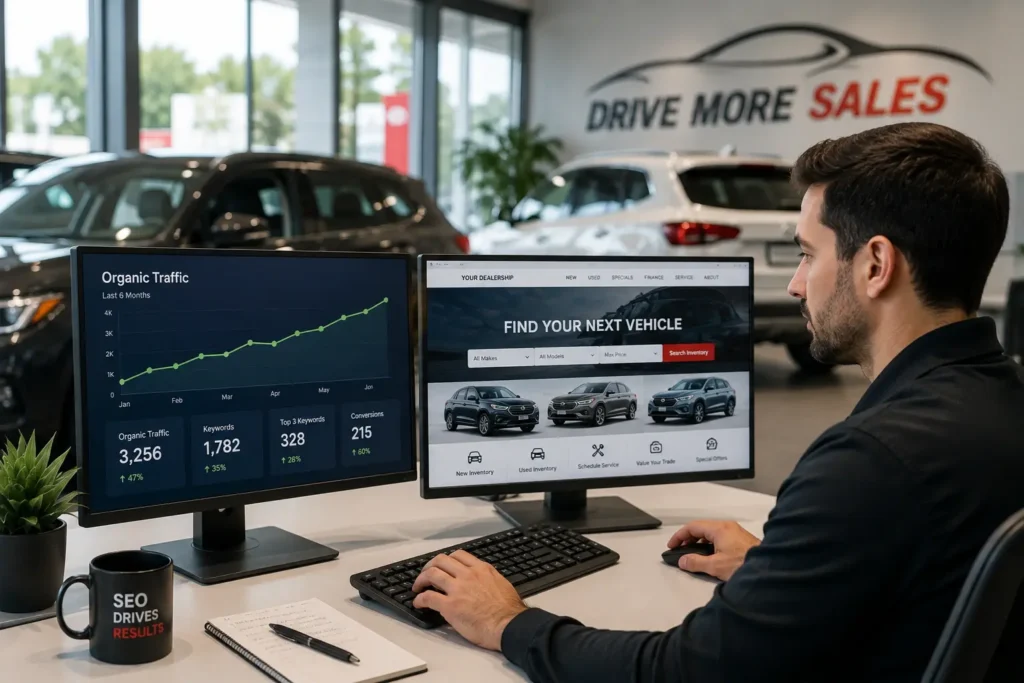
Before a shopper ever calls a dealership, they’ve usually already researched makes and models, cross-shopped prices, checked trade-in value, compared financing options, and read reviews. Service customers search the same way, looking up oil change pricing, brake repair symptoms, or the nearest shop before booking. Automotive Search Engine Optimization exists to make sure a dealership’s inventory, service pages, and location show up for these searches instead of a competitor’s.
Automotive SEO isn’t generic business optimization with “dealership” swapped in. A few things make it distinct:
Local search visibility often decides whether a shopper ever sees a dealership’s site. A complete, accurate Google Business Profile, including correct name, category, address, phone number, hours, and services, supports how a dealership appears in Google Maps and local rankings for “near me” searches. This should be paired with consistent local citations across business directories, genuine customer reviews, and location pages that reflect the dealership’s actual service area rather than mass-produced city pages with no unique content.
The dealership website needs a structure that both shoppers and search engines can navigate: clear inventory sections, model pages, service pages, financing and trade-in pages, and a logical internal linking structure connecting them. Beyond structure, technical basics matter, mobile usability, page speed, and Core Web Vitals all affect whether visitors stay on a vehicle detail page long enough to convert.
Automotive keywords generally fall into four intent categories:
A useful automotive search engine optimization strategy maps content and pages to each of these, rather than chasing one high-volume term.
Optimizing a Google Business Profile means keeping the business name, primary and secondary categories, address, phone number, hours, and services accurate and current, adding real photos, and writing an honest business description. This supports Google Maps optimization and local search visibility, though no single setting guarantees a specific Maps position, Google weighs many local ranking factors together.
Useful content answers the questions car buyers and service customers are already asking: how financing works, what a trade-in is worth, how to compare trims, or how often to rotate tires. Dealership FAQ pages, buying guides, and service content built around real questions tend to perform better than generic blog posts, because they match actual search intent.
Inventory pages are often the highest-converting part of a dealership site, and they deserve the most SEO attention. Each vehicle detail page should include accurate make, model, year, trim, mileage, pricing, availability, photos, and a clear call to action. It helps to separate three distinct page types:
Because inventory turns over constantly, dealerships need a clear process for sold or removed vehicles: redirecting to a relevant model or category page rather than leaving dead links, and avoiding blind indexing of every possible filtered or faceted URL.
Automotive sites face specific technical challenges: duplicate inventory pulled from manufacturer feeds, faceted navigation that generates near-duplicate URLs, and expired vehicle pages that accumulate over time. A technical SEO audit should check crawlability, indexing, canonical tags, redirects, and structured data. Schema markup such as LocalBusiness or breadcrumb schema, can help search engines understand a page, but it doesn’t guarantee a rich result on its own.
Service departments and independent repair shops compete on a different set of searches:
Dedicated service pages with accurate hours, pricing ranges, and appointment booking options give both search engines and customers what they need to convert.
Customer reviews build trust for both vehicle purchases and service work. Genuine Google reviews, along with a habit of responding professionally to feedback, support a dealership’s reputation and local presence. Reviews are one signal among many local ranking factors, not a guaranteed shortcut to a higher position.
Search Engine Optimization connects to revenue through conversion paths like:
organic search → vehicle detail page → inquiry form, or organic search → service page → appointment booking
A dealership can reasonably expect that better-matched content and stronger technical performance improve the odds of a visitor converting, though no responsible SEO provider can promise a specific number of leads.
Ethical off-page SEO for automotive businesses means earning backlinks from relevant sources: local news coverage, dealer associations, community organizations, and legitimate business directories. Purchased links, link farms, and irrelevant directories create more risk than value and should be avoided entirely.
Rankings depend on multiple factors working together:
No agency can guarantee a specific search engine ranking, since Google weighs many signals and conditions change over time.
Organic traffic, keyword rankings, search impressions, click-through rate, and conversion rate all matter, but rankings alone don’t measure success. Test drive bookings, service appointments, and online inquiries show whether SEO is actually producing qualified leads, not just visibility.
Effective automotive SEO services should focus on measurable improvements rather than generic promises. Sir Marketer LLC approaches SEO by addressing the areas that influence search visibility, website performance, and lead generation.
Key areas include:
Effective automotive SEO combines a sound technical foundation, intent-driven keyword research, well-built inventory pages, useful content, local optimization, and honest reputation management. None of it works in isolation, and results build over time rather than overnight.
For dealerships and automotive businesses that want help building this foundation, working with an experienced automotive SEO team can support stronger organic visibility, more qualified traffic, and a better path to leads, without promising guaranteed rankings or a fixed number of results.
Automotive SEO is the process of optimizing a dealership or automotive business website so it ranks better in organic search for relevant terms, covering inventory, local search, content, and technical performance.
Most car buyers research vehicles, pricing, and dealerships online before ever visiting in person, so a dealership's search visibility directly affects how many qualified shoppers find it.
By matching inventory, service, and content pages to real search intent, automotive SEO helps qualified shoppers reach the pages most likely to lead to an inquiry, test drive, or service appointment.
Local automotive SEO focuses on visibility in local search results and Google Maps, using an accurate Google Business Profile, local citations, and location-specific content.
Automotive SEO typically takes several months to build meaningful traction, since it depends on technical fixes, content development, and competitive conditions rather than a single change.
Costs vary widely based on the size of the dealership's inventory, competitive market, and scope of work, so pricing is best discussed directly with an SEO provider.
A mix of transactional, commercial, informational, and local keywords tied to specific makes, models, and services, rather than a single broad term.
Many dealerships use both together, paid advertising for immediate visibility and automotive SEO for sustainable, long-term organic traffic and leads.
Our team will answer all your questions, We ensure a quick response.