
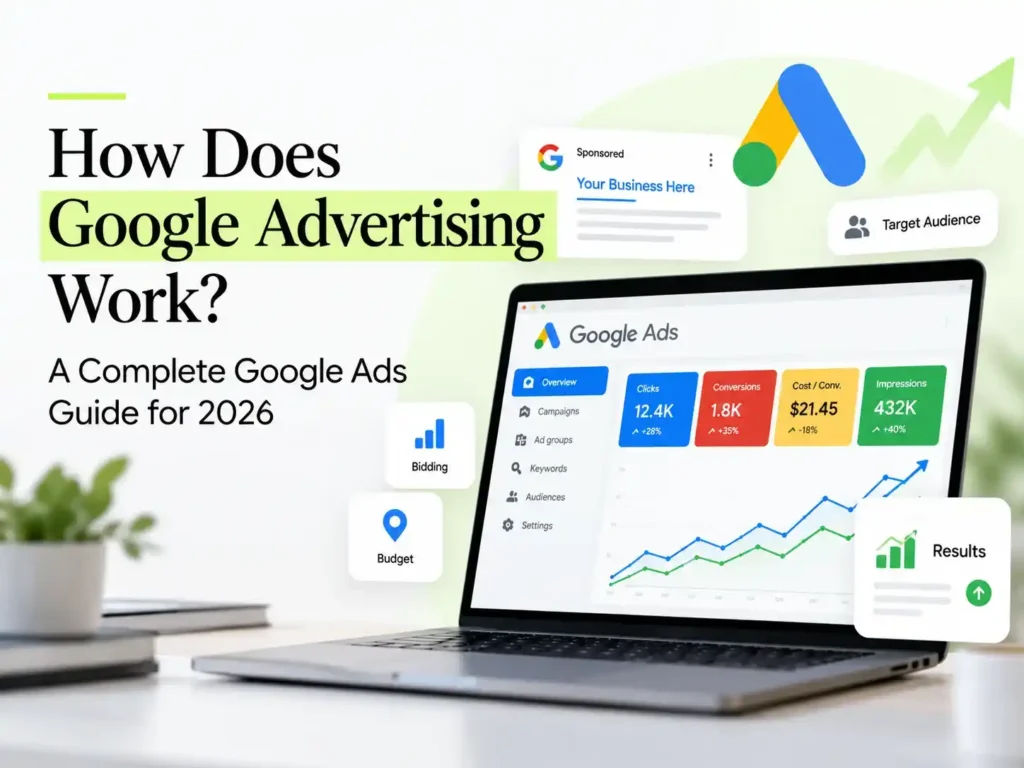

How Google Ads Delivers Results
Businesses create campaigns, choose targeting, budgets, and bidding instructions, and submit ads. When a relevant search or other advertising opportunity occurs, eligible ads enter an auction. Google decides which ads may appear and where, based on bids, ad quality, context, and campaign settings. Advertisers are billed under the campaign’s billing model, and results are measured through clicks and conversions.
What Is Google Advertising?
Google advertising means paying to show ads through Google’s advertising network. In Google Ads, advertisers pick a goal, such as leads or sales, along with targeting and a budget. Google then delivers ads to eligible audiences. Campaign types support different goals, so not every type supports every objective.
Google Ads vs SEO
Factor |
Google Ads |
SEO |
|---|---|---|
Cost
|
Paid advertising
|
Organic traffic; SEO work may cost money
|
Results
|
Can start quickly after approval
|
Usually takes time
|
Visibility
|
Paid search placements
| |
Control
|
Budget, bids, and targeting
|
Limited control over rankings
|
Best For
|
Quick visibility and leads
|
Long-term organic traffic
|
Where Can Google Ads Appear?
How Does Google Advertising Work?
- Set a marketing objective. Decide whether you want qualified leads, online sales, phone calls, website traffic, or brand awareness.
- Create an account. Follow Google’s current setup flow, which includes business details, billing, and conversion measurement planning. Setup screens can vary by account.
- Choose a campaign type. Choose an option that aligns with your campaign objectives and target audience.
- Define targeting. Depending on the campaign format, targeting settings can cover keywords, geographic areas, languages, audiences, devices, and exclusions.
- Set a budget and bidding strategy.
- Create ads and landing pages. Write headlines, descriptions, and ad assets, and send visitors to a page that matches the ad’s promise.
- Enter the auction. Eligible ads compete when a relevant opportunity occurs.
- Google determines which ads may appear. No advertiser has a guaranteed position on every search.
- Users see or click ads. An impression means an ad was displayed, a click indicates user interaction, and a conversion represents a completed desired action.
- Track conversions and improve. Use data to adjust keywords, bids, copy, and landing pages.
How Does the Google Ads Auction Work?
Google Ads runs a live auction to determine which advertisements are eligible to show and how they are ranked.
- Ad Eligibility: Google checks targeting, policies, budget, and bidding settings.
- Ad Rank: Determines ad eligibility and placement based on bids, ad quality, competition, search context, and expected asset impact.
- Highest Bid Doesn't Always Win: Relevant ads with better landing page experiences can outrank higher bids.
- Quality Score: A 1-10 keyword-level diagnostic based on expected CTR, ad relevance, and landing page experience. It helps identify improvements but does not directly guarantee ad position or cost.
- Ad Visibility: Ads may not appear because of policy issues, limited budgets, narrow targeting, low search demand, billing problems, or losing the auction.
- Advertising Costs: Charges depend on the campaign's billing model, such as clicks for click-based campaigns.
How Does Google Ads Bidding Work?
- Manual Bidding: Set your own bids where supported, such as the maximum cost-per-click (CPC) you're willing to pay for a click.
- Automated Bidding: Let Google adjust bids automatically based on your selected campaign goal and available signals.
- Smart Bidding: Uses machine learning and auction-time signals to optimize for conversions or conversion value.
- Target CPA (Cost Per Acquisition): Aims to generate conversions at an average cost per acquisition you specify.
- Target ROAS (Return on Ad Spend): Optimizes your campaigns to reach a specified revenue-to-ad-spend ratio.
- Maximize Conversions: Aims to obtain the highest possible number of conversions within your allocated budget.
- Maximize Conversion Value: Aims to achieve the greatest possible value from conversions while staying within your budget.
- Maximize Clicks: Aims to drive more website clicks rather than directly optimizing for conversions or revenue.
- Choose the Right Strategy: If you lack reliable conversion data, manual or click-focused bidding may be a reasonable starting point. Once tracking is reliable and sufficient conversion data accumulates, conversion-focused strategies may be more suitable.
- Monitor Performance: Set realistic targets based on your goals, budget, and business economics. Keep in mind that bidding strategies help optimize campaign performance but cannot ensure specific outcomes.
How Much Does it Cost?
Google advertising costs have no universal price. Pricing varies by industry, location, competition, keyword intent, campaign type, bidding strategy, and ad quality. Any single “average CPC” can mislead, so this guide does not quote one.
Key Metrics Compared
Metric |
What it measures |
Calculation |
|---|---|---|
CPC
|
Cost ÷ clicks
| |
CPM
|
Cost per 1,000 impressions
|
Cost ÷ impressions × 1,000
|
CPA
|
Cost per conversion
|
Ad cost ÷ conversions
|
ROAS
|
Attributed revenue per ad dollar
|
Revenue ÷ ad spend
|
These metrics answer different questions and should not be used interchangeably.
Types of Google Ads Campaigns
Campaign type |
Typical use |
Key consideration |
|---|---|---|
Search
|
Keyword intent and landing page match
| |
Display
|
Visual reach and remarketing
|
Creative and audience quality
|
Video
|
YouTube and video placements
|
Video assets and goals
|
Shopping
|
Promote retail products
|
Product feed quality, Merchant Center
|
Performance Max
|
Automation across Google inventory
|
Conversion goals, assets, data
|
Demand Gen
|
Visual discovery ads
|
Strong image and video creative
|
Availability and capabilities vary by account and objective. For example, Performance Max appears as an option only for certain objectives. It does not serve as a complete substitute for other available options.
How Keywords and Targeting Work
Keywords connect Search campaigns to customer search queries, but the search term a person types is not always your keyword. Match types control how closely a search must relate to it: broad match keywords reach related searches and intent, phrase match keywords match searches that include the meaning of your phrase, and exact match keywords match searches with the same meaning or intent. See Google’s match type guide for current definitions.
Negative keywords block irrelevant searches. A plumber might exclude “jobs” or “free.” They need regular review and do not catch every variation.
Search intent matters more than word matching. “How does a water heater work” is informational, “best water heater installer” is commercial, and “water heater repair near me” signals purchase intent. Align keyword, ad, and landing page.
Available targeting options, including audiences, locations, demographics, and remarketing, vary based on the campaign format, applicable policies, and data availability. Set locations to match your real service area.
Branding isn’t reserved for large restaurant groups; it benefits nearly every type of food business:
How to Set Up a Campaign
Step 1: Define Your Advertising Goals
Identify your main objective, such as generating leads, increasing sales, or driving website traffic, and define your target audience.
Step 2: Research Relevant Keywords
Use Google Keyword Planner to find relevant keywords that match your products, services, and customer search intent.
Step 3: Choose Your Campaign Type and Budget
Select the appropriate campaign type, set a realistic budget, and choose a bidding strategy that supports your goals.
Step 4: Create Compelling Ad Copy
Write relevant headlines and descriptions with a clear call to action that encourages users to take the desired action.
Step 5: Build an Effective Landing Page
Create a fast, mobile-friendly landing page with clear information, trust signals, and an easy conversion process.
Step 6: Set Up Conversion Tracking
Configure and test conversion tracking to measure important actions, such as purchases, form submissions, and qualified phone calls.
Step 7: Review Campaign Settings
Check your location and language targeting, ad assets, budget, and compliance with Google Ads policies.
Step 8: Launch Your Campaign
Publish your campaign after reviewing all settings and confirming that your ads and landing pages are ready.
Step 9: Monitor and Optimize Performance
Analyze campaign data, review search terms, adjust bids and targeting, and improve ads based on reliable performance results.
How to Optimize Campaigns
- Verify tracking first. Duplicate or unsuitable conversion actions distort every later decision.
- Review search terms and add negative keywords.
- Improve ads and landing pages for relevance, clarity, and speed.
- Use ad assets, such as sitelink assets, where relevant, without assuming they guarantee better placement.
- Reassess bids and budgets against real conversion data.
- Avoid reacting to short-term swings. No universal waiting period fits every campaign.
- Treat recommendations as suggestions to evaluate, not commands.
Benefits and Limitations
- Paid Visibility: Helps businesses appear in relevant Google search results and other advertising placements.
- Targeted Reach: Connects ads with users based on search intent, location, and other available targeting options.
- Geographic Control: Allows businesses to target specific cities, regions, or countries.
- Flexible Budgets: Lets advertisers set budgets according to their business goals and financial capacity.
- Measurable Results: Tracks impressions, clicks, conversions, and advertising costs to evaluate performance.
- Small Business Opportunities: Can help small businesses attract potential customers when targeting, offers, and landing pages are well aligned.
- No Guaranteed Profit: A small budget does not automatically lead to profitable results or a steady flow of leads.
- Potential Budget Waste: Poor keyword selection, weak landing pages, and unclear offers can reduce campaign effectiveness.
- Tracking Challenges: Incorrect conversion tracking can lead to misleading performance data and poor decisions.
- Lead Quality Issues: More clicks and leads do not necessarily translate into sales or revenue.
- Follow-Up Matters: Slow responses or poor lead management can cause businesses to lose potential customers.
When to Consider Professional Help
Running successful Google Ads campaigns requires the right strategy, audience targeting, engaging ads, and accurate performance tracking.
Sir Marketer LLC offers digital marketing services to help businesses improve advertising performance and reach potential customers. Our services include:
- Google Ads Management: Create and optimize campaigns around your goals.
- Keyword Research: Find relevant search terms and reduce irrelevant clicks.
- Budget Optimization: Manage bids and spending efficiently.
- Ad and Landing Page Optimization: Improve relevance and conversion opportunities.
- Performance Tracking: Measure clicks, leads, conversions, and advertising returns.
- SEO Services: Support long-term organic visibility alongside paid advertising.
Whether you’re starting a new campaign or improving existing ads, Sir Marketer LLC can help you develop a strategy suited to your business needs.
Conclusion
It uses an auction system to match your budget, bids, and ads with relevant search queries. shaped by Ad Rank, not by bids alone. Bids, budgets, and actual costs are different things. Targeting and relevance decide who sees your ads, and conversion tracking shows whether clicks lead anywhere. Results are never guaranteed. Strong campaigns align business goals, audience intent, settings, landing pages, and reliable measurement. If you would like professional support, talk to Sir Marketer about your advertising goals.
Frequently Asked Questions
Advertisers set up campaigns, and eligible ads compete in auctions. Winners appear and are billed under the campaign’s billing model.
Pick a goal, set targeting and a budget, write ads, track conversions, and review results.
They can, when the offer, targeting, tracking, and economics line up. Nothing is guaranteed.
Through Ad Rank, which weighs bids, quality, thresholds, context, and expected asset impact.
No. Ad quality and context also matter.
A 1-10 keyword-level diagnostic, not a guarantee of position or price.
Categories


You have different questions?
Our team will answer all your questions, We ensure a quick response.