Google Places SEO is the process of optimizing your Google Business Profile and local web presence to rank higher in Google Maps, the Local Pack, and location-based search results. It matters because 46% of all Google searches carry local intent, and businesses that appear in the top three local results capture the majority of clicks, calls, and direction requests from ready-to-buy customers.
This guide covers everything you need to know about google places seo:
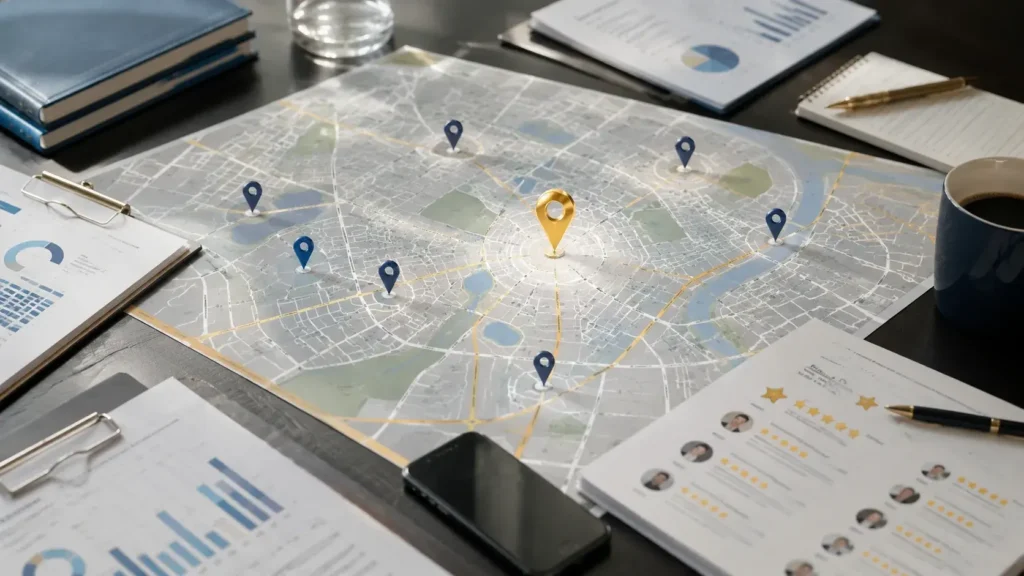
Every day, millions of potential customers open Google and search for a service “near me.” They’re not browsing, they’re ready to act. If your business doesn’t appear in those local search results, you’re invisible at the exact moment someone is looking for what you offer.
Google Maps searches have grown steadily as smartphone use has become universal. Local business visibility on Google now directly influences phone calls, foot traffic, and revenue in a way that no other digital channel can replicate. A strong local pack ranking puts your business in front of high-intent customers before your competitors even have a chance.
Google Places was Google’s original local business directory, eventually rebranded as Google My Business and, most recently, Google Business Profile (GBP). Despite the name changes, the goal has always been the same: connect local searchers with nearby businesses.
Google Places SEO (also called Google Maps SEO or local search optimization) is the practice of optimizing your Google Business Profile and surrounding web signals so Google ranks your business prominently in:
Your Google Business Listing acts as the central foundation of your local online presence. When fully optimized, it connects your storefront, website, reviews, and citations into a unified trust signal that Google uses to decide who ranks.
Google’s local algorithm evaluates every business on three core pillars. Understanding them is the foundation of any effective local SEO strategy.
Relevance: Does your business match what the searcher is looking for? Google assesses relevance through your primary GBP category, secondary categories, services section, business description, and keywords within review text. Choosing the wrong primary category is the single most damaging negative ranking factor.
Distance (Proximity): How close is your business to the person searching? After Google’s Vicinity update, proximity ranking factor weight increased significantly. You cannot change your physical location, but you can strengthen relevance and prominence to outrank closer competitors.
Prominence: How well-known and trusted is your business? This is shaped by Google reviews, citation consistency, website authority, backlinks, engagement signals, and GBP activity. Google Business Profile signals account for roughly 32% of local pack ranking weight, the largest single category.
Together, these three pillars explain nearly every local SEO ranking signal that exists.
The business case for local search optimization is straightforward:
For brick-and-mortar SEO and service area businesses alike, Google Maps ranking is the highest-return local marketing channel available.
Your Google Business Profile is your most powerful local SEO tool. Every field you complete sends a relevance and trust signal to Google.
Core setup checklist:
Google Business Profile optimization tips like these compound over time. Each completed field reduces friction in Google’s understanding of your business.
The local search ranking factors that most influence Google Maps ranking in 2026:
Factor |
Weight |
Notes |
|---|---|---|
GBP signals (completeness, categories, posts, photos)
|
~32%
|
Largest single category
|
Google review signals (quantity, velocity, text richness)
|
~20%
|
Recency now outweighs total count
|
On-page website signals
|
~15%
|
Location pages, schema, content
|
Behavioral signals (clicks, calls, directions)
|
Growing fast
|
Proxy for real-world demand
|
Citation signals (NAP consistency)
|
Moderate
|
Inconsistency weakens trust
|
Link signals (backlinks, local authority)
|
Moderate
|
Caps Maps performance indirectly
|
Review velocity has become the defining differentiator. A business earning 5–10 Google reviews monthly can outrank one with 500 total reviews if those reviews are older. Recency signals ongoing activity, which Google interprets as proof the business is currently operational and trusted.
Being “open now” is now ranked as the #5 local pack ranking factors. Businesses listed as closed during peak hours lose rankings dynamically.
Review Signals: Review quantity, recency, star ratings, and keyword richness within review text all feed relevance and prominence simultaneously.
Citation Signals: Every consistent online mention of your Name, Address, and Phone (NAP consistency) reinforces geographic and category trust signals. Inconsistent formatting creates conflicting data Google cannot confidently use.
On-page Signals: Location-specific landing pages, localized content, and service area pages tell Google exactly where you operate and what you offer.
Link Signals: Local backlinks from community sites, news publications, Chamber of Commerce listings, and industry directories build domain authority local SEO depends on for competitive markets.
GEO Signals: Structured data, local keywords, and GEO-targeted content confirm physical presence and service geography.
Behavioral Signals: Clicks, calls, and direction requests from search results function as real-world engagement metrics. Low engagement after appearing in results sends negative signals.
Trust Signals: Consistent NAP, legitimate business address, and accurate hours all contribute to the trust signals Google needs to rank a business confidently.
On-page local SEO focuses on your website as a local relevance signal:
Off-page local SEO focuses on external signals:
Multi-location SEO
Multi-location SEO requires treating each location as an independent entity with its own GBP, citation profile, location page, and review velocity. Centralizing management while localizing signals is the core challenge for multi-location businesses.
Hyperlocal SEO
Hyperlocal SEO targets neighborhood-level searches, useful for businesses in dense urban markets where “near me” searches resolve to a very tight geographic radius.
Voice Search Local SEO
Voice search local SEO demands conversational keyword optimization. Voice searches are usually longer and framed as questions, such as ‘Where can I find the best [service] nearby?’ Adding FAQ sections and using natural, conversational language on location pages helps capture this type of traffic.
Near me SEO
Near me SEO remains one of the highest-intent query categories in local search. Businesses optimize for “near me” searches not by adding the phrase to their GBP name (which triggers spam penalties) but by building strong proximity signals, accurate address, consistent citations, GEO-targeted content, and active review generation.
Service area business SEO
Service area business SEO poses unique challenges. Hiding your address in GBP (as Google recommends for SABs) demonstrably reduces local visibility. If customers can visit your location even occasionally, keep the address visible. Compensate for proximity disadvantages with strong review velocity, city-specific landing pages, and location-mentioned reviews.
Reviews are the new local SEO currency. The threshold for competitive Local Pack visibility is 200+ reviews, but velocity consistently trumps total count.
Review acquisition best practices:
Review management:
Star ratings impact SEO alongside review text richness. Google extracts service keywords, location mentions, and sentiment from review bodies to refine relevance matching.
All of this makes one thing clear, your reviews don’t just reflect your business, they are your online visibility strategy. That’s where Online Reputation Management becomes essential for turning customer feedback into sustained local SEO growth.
Local citations are online mentions of your business Name, Address, and Phone number across the web. They function as distributed trust signals that help Google verify your business is real, active, and correctly located.
Name address phone consistency must be exact across every platform, same abbreviations, same phone number format, same address formatting. Even minor discrepancies (St. vs Street, Suite vs Ste.) create conflicting signals.
Priority citation platforms:
Citation building strategy:
Your website is the off-GBP component of your local presence. Website local SEO signals directly influence both Local Pack ranking and local organic results.
Schema markup local business: Implement JSON-LD LocalBusiness schema on your homepage and location pages. This structured data SEO tells Google your business name, address, phone, hours, GEO-coordinates, and service area in machine-readable format.
Local business schema elements to include: @type, name, address, telephone, openingHours, geo, url, sameAs (linking to GBP and social media profiles).
Location pages: Each service area deserves a dedicated page with unique content, embedded maps, local testimonials, and area-specific service information. Generic pages with only the city name swapped out are filtered out.
Technical SEO for local search:
A strong local SEO content strategy builds topical authority within your geographic market.
Local keyword research should target three query types:
City-based SEO content answers questions real local customers ask. Neighborhood guides, local resource pages, and community-focused blog posts earn local links naturally while reinforcing GEO signals.
Search intent optimization means matching content format to what the searcher actually wants. Someone searching “best Italian restaurant downtown” wants a list and reviews, not a history of Italian cuisine.
Local SEO content optimization also extends to your GBP: regularly updated posts, answered Q&As, and fresh photo uploads all contribute to the profile activity signals Google rewards.
Technical SEO for local search isn’t glamorous, but it directly affects how Google crawls, indexes, and trusts your local pages.
Mistake |
Risk |
Fix |
|---|---|---|
Keyword stuffing in business name
|
Suspension, forced reverification
|
Name must match legal/storefront branding exactly
|
Wrong primary category
|
Severe ranking penalty
|
Research competitors; choose the most specific accurate category
|
Inconsistent NAP across platforms
|
Trust signal degradation
|
Audit and standardize all citations
|
Buying or incentivizing reviews
|
Review block, rating wipeout
|
Generate reviews organically only
|
Duplicate listings
|
Split authority, confusion
|
Find and merge or remove duplicates
|
Making 5+ edits in one session
|
Immediate suspension (55% of cases)
|
Space edits over 7–10 days
|
Static profile (no updates for months)
|
Ranking decline
|
Post, upload photos, and respond to reviews weekly
|
Generic location pages
|
Filtered from results
|
Create genuinely useful city-specific content
|
Hiding SAB address unnecessarily
|
Ranking collapse
|
Keep address visible when possible
|
Foundation (Week 1)
Engagement Surface (Week 2)
Citations and Reviews (Week 3)
Ongoing (Monthly)
Most business owners understand the value of local visibility, but consistently executing all the moving parts is where results stall. Between managing operations, serving customers, and running daily tasks, GBP optimization becomes reactive at best.
Sir Marketer specializes in Google Places SEO and local search optimization for businesses that need more calls, more foot traffic, and more qualified leads from Google Maps. The approach is built around sustainable, signal-driven growth, not shortcuts that create spam risk.
A professional local SEO engagement typically includes:
The businesses that grow fastest in local search aren’t always the ones with the biggest budgets, they’re the ones feeding Google consistent, accurate, high-quality signals every week.
Google Places SEO is the process of optimizing your Google Business Profile and local web presence to rank higher in Google Maps, the Local Pack, and location-based search results. It helps your business appear when nearby customers search for your services.
Google Places was the original name for Google's local business directory. It was rebranded as Google My Business and then Google Business Profile. Today, "Google Places SEO" and "Google Business Profile SEO" refer to the same practice, optimizing your local presence on Google's ecosystem.
Most businesses see ranking movement within 30–60 days of completing core profile optimization and beginning consistent review generation. Competitive markets may take 3–6 months for significant Local Pack visibility.
Google Maps ranking is determined by three factors: relevance (how well your business matches the search query), distance (your proximity to the searcher), and prominence (how well-known and trusted your business is, based on reviews, citations, and GBP activity).
The top local search ranking factors in 2026 are: primary GBP category selection, Google review velocity and richness, GBP completeness and activity (posts, photos, updates), NAP consistency, proximity to the searcher, and behavioral signals like clicks, calls, and direction requests.
Very important. Review signals account for approximately 20% of local pack ranking weight. Review velocity (how often you receive new reviews) now matters more than total review count. Consistent monthly reviews outperform infrequent large batches. Responding to all reviews also improves click-through rate by 10–15%.
Complete every profile field, choose the most specific accurate primary category, upload regular photos, post 3–5 updates monthly, generate consistent organic reviews, respond to all reviews promptly, and ensure your website's NAP matches your GBP exactly.
Complete every profile field, choose the most specific accurate primary category, upload regular photos, post 3–5 updates monthly, generate consistent organic reviews, respond to all reviews promptly, and ensure your website's NAP matches your GBP exactly.
Our team will answer all your questions, We ensure a quick response.