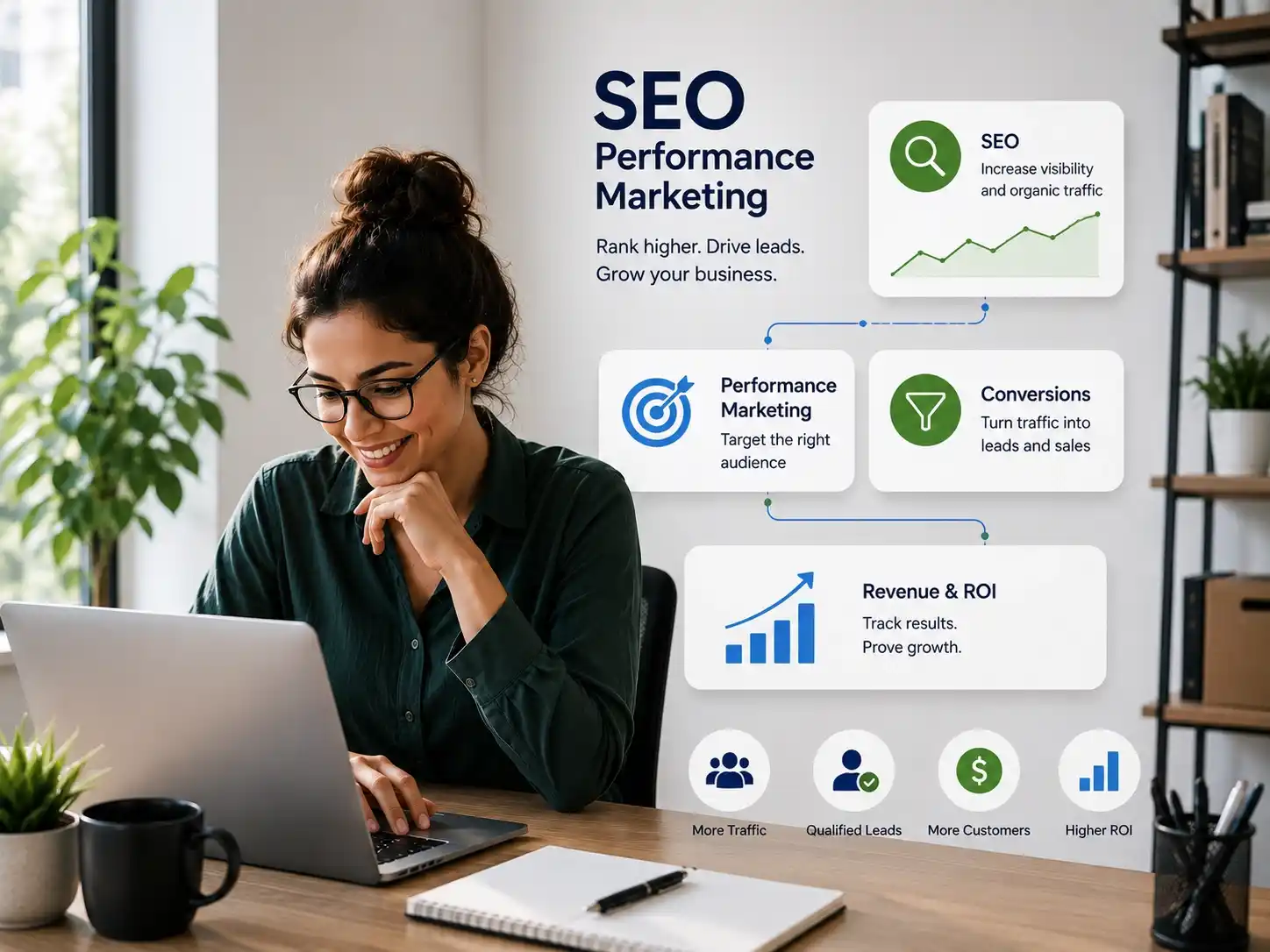
SEO performance marketing is the practice of combining search engine optimization with measurable, revenue-focused marketing goals, turning organic traffic into tracked leads, conversions, and ROI. Instead of chasing rankings alone, it ties every SEO effort to business outcomes like qualified leads, customer acquisition, and marketing ROI. For businesses competing in 2026, that shift from “get ranked” to “get results” is what separates growth from guesswork.
SEO alone is no longer enough. Rankings without conversions don’t pay the bills, and businesses need measurable business outcomes, not vanity metrics. That’s why SEO performance marketing has become the standard for companies serious about business growth: it merges organic search with the data-driven marketing discipline of performance marketing, so every keyword, page, and backlink is judged by what it actually produces, including leads, revenue, and customer lifetime value.
AI search is accelerating this shift. Google AI Overviews, ChatGPT Search, and Perplexity are changing how people find answers, which means SEO strategy now has to account for both traditional search rankings and AI-generated results. Businesses that treat SEO and performance marketing as one connected system, rather than separate departments, build a more sustainable, compounding source of organic traffic and qualified leads.
SEO performance marketing blends search engine optimization with the tracking, testing, and accountability of performance marketing SEO. Traditional SEO focuses on rankings, impressions, and organic visibility. Performance marketing, historically associated with PPC advertising and paid media, focuses on measurable outcomes, such as clicks, conversions, and cost per acquisition (CPA).
SEO and performance marketing converge when organic strategy is held to the same standard as paid campaigns:
The result is organic marketing that behaves like a performance channel, measurable, testable, and accountable to ROI.
Organic traffic built through SEO tends to convert well and cost less over time than paid traffic, but it moves slowly. Performance marketing moves fast but stops the moment budget stops. Together, they create sustainable customer acquisition:
Traditional SEO |
SEO Performance Marketing |
|---|---|
Optimizes for rankings and impressions
|
Optimizes for leads, revenue, and marketing ROI
|
Reports on traffic growth
|
Reports on qualified traffic and sales conversions
|
Rarely tied to CRO
|
Integrated with conversion rate optimization
|
Success = ranking higher in search results
|
Success = measurable business outcomes
|
Factor |
SEO |
Performance Marketing (PPC) |
|---|---|---|
Cost
|
Lower long-term cost
|
Higher, ongoing ad spend
|
ROI
|
Compounds over time
|
Immediate but stops when spend stops
|
Traffic
|
Organic, earned
|
Paid, instant
|
Time to results
|
3–6+ months
|
Days
|
Sustainability
|
High
|
Low without continued budget
|
Risk
|
Algorithm changes
|
Rising CPCs, ad fatigue
|
Scalability
|
Content and authority dependent
|
Budget dependent
|
A successful SEO performance marketing strategy combines search visibility with measurable business outcomes. Instead of focusing only on rankings and traffic, it connects every SEO activity to user intent, conversions, and long-term growth.
Every SEO strategy starts with keyword research mapped to user intent, including informational, commercial, or transactional, so content matches what searchers actually want.
High-quality content organized into topic clusters builds semantic SEO and entity SEO, helping search engines understand topical authority.
Even the best content cannot perform if search engines cannot properly access and understand your website. Technical SEO focuses on crawlability, indexing, site architecture, Core Web Vitals, mobile performance, and page speed to create a strong foundation for higher rankings.
On-page SEO improves how individual pages communicate with search engines and users through optimized titles, headings, meta descriptions, content structure, and internal linking. Off-page SEO strengthens website authority through quality backlinks, digital mentions, and reputation-building activities.
SEO success is not measured only by traffic growth. Conversion optimization ensures visitors take meaningful actions, such as submitting a form, requesting a quote, or making a purchase. Landing page improvements, user experience enhancements, CRO strategies, and A/B testing help turn organic visitors into qualified leads.
SEO success is not measured only by traffic growth. Conversion optimization ensures visitors take meaningful actions, such as submitting a form, requesting a quote, or making a purchase. Landing page improvements, user experience enhancements, CRO strategies, and A/B testing help turn organic visitors into qualified leads.
SEO contributes at every stage of the marketing funnel:
Quick checklist:
Metric |
Why It Matters |
Recommended Tools |
|---|---|---|
Organic traffic & search visibility
|
Shows reach and ranking health
|
GA4, Search Console
|
CTR & impressions
|
Measures SERP performance
|
Search Console
|
Bounce rate & dwell time
|
Signals content and UX quality
|
GA4
|
Qualified leads & conversions
|
Ties SEO to revenue
|
GA4, CRM
|
CPA / CPL
|
Measures acquisition efficiency
|
GA4, ad platforms
|
CLV & ROI/ROAS
|
Measures long-term value
|
CRM
|
Tool |
Best Used For |
|---|---|
Google Analytics 4 (GA4)
|
Traffic, behavior, and conversion tracking
|
Google Search Console
|
Search visibility, indexing, CTR
|
Google Tag Manager
|
Managing tracking without code changes
|
Looker Studio
|
Building marketing dashboards
|
Semrush / Ahrefs
|
Keyword research, competitor analysis, backlinks
|
Moz
|
Domain authority tracking
|
Screaming Frog
|
Technical SEO audits and crawlability checks
|
Keyword Planner
|
Search volume and keyword ideas
|
Content marketing is the engine behind SEO-driven growth. Content optimized around search intent, structured with schema markup, and organized into topic clusters builds the semantic SEO and EEAT signals search engines reward. For AI SEO and generative engine optimization (GEO), that means writing clear, well-structured, fact-based content that LLMs can accurately cite, an increasingly important layer of content strategy.
Google AI Overviews, ChatGPT Search, Perplexity, and Gemini are reshaping how answers reach users. Ranking well in traditional SERPs no longer guarantees visibility in AI-generated answers. AI SEO and GEO require content that’s factually precise, clearly structured, and backed by real expertise- the same EEAT principles Google has emphasized for years, now extended to LLM optimization.
SEO and paid performance marketing work best as complements, not competitors. Google Ads and PPC advertising deliver fast, testable traffic while SEO builds long-term organic visibility. Remarketing and retargeting campaigns can also re-engage organic visitors who didn’t convert on their first visit, making paid media a natural extension of organic marketing rather than a replacement for it.
Current industry trends point toward AI-powered search, increased reliance on first-party data as privacy changes limit third-party tracking, and growing weight on user experience signals in ranking systems. Voice search optimization and entity SEO continue to grow in relevance as search behavior diversifies beyond typed queries. These are current directions, not guarantees; SEO strategy should stay adaptable rather than built around speculation.
Businesses that want SEO tied to real outcomes typically look for a digital marketing agency that treats SEO strategy, technical SEO, AI SEO, and content marketing as one connected system rather than isolated services. Sir Marketer approaches SEO performance marketing this way, combining SEO services, CRO, and performance reporting so clients can see exactly how organic search is contributing to revenue growth, not just traffic growth. The focus stays on measurable business outcomes: qualified leads, sales conversions, and long-term client success, backed by transparent reporting rather than vanity metrics.
Related services worth exploring: SEO Services, Small Business SEO Services, AI SEO Services, Local SEO, Content Marketing, PPC Management, Social Media Marketing, Google Business Profile Optimization, Website Design, and Conversion Rate Optimization.
SEO and performance marketing work best as one strategy, not two. Organic search builds durable, compounding value, while performance marketing principles keep every effort measurable and accountable. Businesses that combine the two, with clean technical SEO, intent-driven content, and honest reporting, build a digital growth strategy that keeps paying off long after the campaign ends.
Ready to see where your SEO stands?
Get a free SEO performance audit from Sir Marketer and get a clear, data-driven look at your SEO strategy, technical SEO, AI SEO readiness, content marketing, and CRO, all measured against real business outcomes, not vanity metrics.
It's the practice of combining SEO with performance marketing principles, tracking, testing, and reporting, so organic search is measured by leads and revenue, not just rankings.
Yes, when SEO efforts are tracked against measurable KPIs like conversions, CPA, and ROI, it functions as a performance marketing channel.
Most businesses see meaningful traffic growth and search visibility improvements within 3–6 months, with compounding results over 12+ months.
Through organic traffic, search rankings, CTR, conversions, CPA, CPL, and CLV, tracked in GA4 and Search Console.
Qualified leads, conversion rate, and ROI matter more than raw traffic or ranking position alone.
Neither is universally better; SEO offers long-term, lower-cost growth; PPC offers immediate, budget-dependent traffic. Most businesses benefit from both.
Yes. Because organic traffic doesn't require ongoing ad spend, well-executed SEO typically improves marketing ROI over time compared to paid-only strategies.
GA4, Google Search Console, and either Semrush or Ahrefs cover most core SEO performance marketing needs.
Yes, though it now requires accounting for AI search and generative engine optimization alongside traditional rankings.
Businesses without in-house SEO expertise, or those needing SEO tied to measurable performance reporting, generally see faster, more consistent results working with an experienced performance marketing agency.
Our team will answer all your questions, We ensure a quick response.