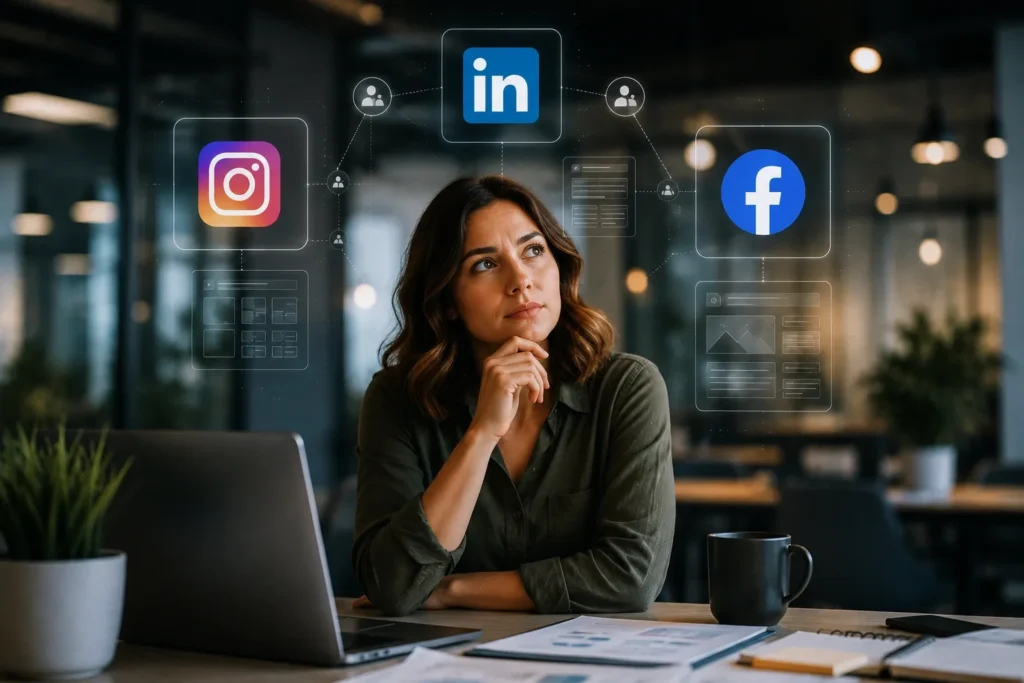
Many businesses spread themselves thin trying to maintain a presence on every social network, only to end up with three half-managed profiles instead of one that actually drives results. The Instagram vs LinkedIn vs Facebook decision is one of the most consequential choices a business makes in its marketing strategy, because it shapes budget allocation, content production, and how customers ultimately find and trust you.
Factor |
Instagram |
LinkedIn |
Facebook |
|---|---|---|---|
Best audience
|
Consumers, younger demographics
|
Professionals, decision-makers
|
Broad, local, community-based
|
Best industries
|
Retail, beauty, fitness, hospitality
|
B2B, consulting, recruiting, SaaS
|
Local services, nonprofits, events
|
Organic reach
|
Moderate, strong for video
|
Strong for thought leadership
|
Limited without ads
|
Paid advertising
|
Highly visual, strong targeting
|
Precise professional targeting, higher cost
|
Flexible budgets, mature ad tools
|
Lead generation
|
Moderate (via DMs, links)
|
Strong for B2B leads
|
Strong via forms and Groups
|
Best content formats
|
Reels, Stories, Carousels
|
Articles, newsletters, posts
|
Posts, Events, Marketplace, Groups
|
Instagram is built for visual storytelling. Reels, Stories, and Carousels favor brands in retail, beauty, food, fitness, travel, and hospitality, anywhere a product or experience benefits from being seen. Shopping features and influencer partnerships make it strong for direct-to-consumer sales, and its engagement rates typically outperform Facebook’s for younger audiences. Instagram search query optimization can support business growth on Instagram by making content easier to discover through relevant keywords, captions, hashtags, and searchable profile elements.
Limitations: Instagram is less effective for complex B2B sales cycles and requires consistent, high-quality visual content to perform.
LinkedIn is the default platform for B2B social media marketing. Company pages, employee advocacy, LinkedIn newsletters, and thought-leadership posts help build authority with decision-makers. Its targeting (by title, industry, company size) makes LinkedIn Ads for business particularly efficient for generating qualified leads, and it doubles as a recruiting channel.
Limitations: Ad costs tend to run higher than Meta platforms, and organic reach favors individual profiles more than company pages.
Facebook remains the most versatile platform for local businesses, community groups, and events. A well-run Facebook business page, paired with Groups and Marketplace, helps businesses build community and drive local awareness. Meta Business Suite also makes managing Facebook and Instagram ads together straightforward.
Limitations: Organic reach for business pages has declined significantly, making paid advertising close to essential for visibility.
Instagram vs Facebook Marketing: Instagram wins on engagement and visual storytelling; Facebook wins on broader reach, events, and community groups. Many consumer brands run both, using Instagram for brand building and Facebook for community and local targeting.
LinkedIn vs Facebook for Business: LinkedIn wins for B2B lead quality and professional networking; Facebook wins for B2C reach, local audiences, and lower-cost testing. B2B companies chasing volume over quality often waste budget by prioritizing Facebook.
Instagram vs LinkedIn Marketing: Instagram builds consumer-facing brand identity; LinkedIn builds professional authority and personal branding. They rarely compete for the same goal, which is why many businesses use both for different purposes.
Instagram Ads perform well for visually driven campaigns, including product showcases, brand awareness, and influencer-style content, with targeting inherited from Meta’s ad platform.
Facebook Ads offer the most mature targeting and campaign-objective options across Meta, along with flexible budgets suited to testing.
LinkedIn Ads cost more per click on average but reach a highly specific professional audience by job title, industry, and seniority, making them efficient for B2B despite the higher spend.
None of the three guarantees a fixed cost or return, results depend on targeting quality, creative, and offer strength.
Current shifts worth planning around include short-form video continuing to outperform static posts across all three platforms, AI-assisted content creation speeding up production without replacing strategy, and social commerce features expanding on Instagram and Facebook. Employee-generated content is also gaining traction on LinkedIn as a lower-cost alternative to traditional company-page posting. These are current directions rather than guarantees, platforms continue to adjust algorithms and features frequently. To improve the impact of your Instagram content strategy, check out our guide on Best Time to Post on Instagram for insights on when your audience is most likely to engage.
Awareness, leads, sales, or recruiting.
Are you selling to consumers or businesses?
Can you sustain visual content, written thought leadership, or community management?
LinkedIn ads cost more but target more precisely; Meta platforms offer more testing flexibility.
Mastering one channel outperforms mediocre effort across three.
Yes, and many established brands do, once resources allow. The key is not spreading effort evenly but assigning each platform a distinct role (e.g., LinkedIn for authority, Instagram for brand, Facebook for community) and repurposing content across them rather than creating everything from scratch three times over.
A successful Instagram presence is built through a combination of strategy, creativity, audience understanding, and continuous improvement. Posting consistently is only one part of the process, businesses need a clear direction, relevant content, and data-driven decisions to grow effectively.
Sir Marketer helps businesses create and manage Instagram strategies by focusing on the key areas that influence visibility, engagement, and long-term growth:
By bringing these elements together, Sir Marketer helps businesses build a more structured approach to Instagram marketing, one that focuses on understanding the audience, improving content performance, and making decisions based on measurable insights.
Sir Marketer LLC helps businesses choose the right platforms, build content strategies, manage accounts, and run targeted campaigns aligned with real business goals.
Contact Sir Marketer to build a smarter social media strategy.
The Instagram vs LinkedIn vs Facebook decision comes down to your audience, goals, and resources, not which platform is objectively “best.” Visual, consumer-facing brands often lean on Instagram; B2B companies lean on LinkedIn; local and community-driven businesses lean on Facebook. Many businesses ultimately use a combination, once each platform has a clear, distinct role.
It depends on your audience, there is no single best platform for every business.
Instagram for visual, younger-skewing brands; Facebook for broader reach and local community.
LinkedIn for B2B lead quality; Facebook for B2C reach and lower-cost testing.
LinkedIn typically generates higher-quality B2B leads; Facebook often generates more volume for local and B2C businesses.
Yes, particularly for local businesses, groups, and events, though organic reach requires paid support.
Only if they sell to other businesses or want to build professional credibility.
Yes, with a clear, distinct purpose assigned to each.
Consistency matters more than frequency, a sustainable, regular cadence outperforms sporadic bursts.
Paid ads accelerate results but work best layered on top of an organic strategy, not as a replacement for it.
Our team will answer all your questions, We ensure a quick response.