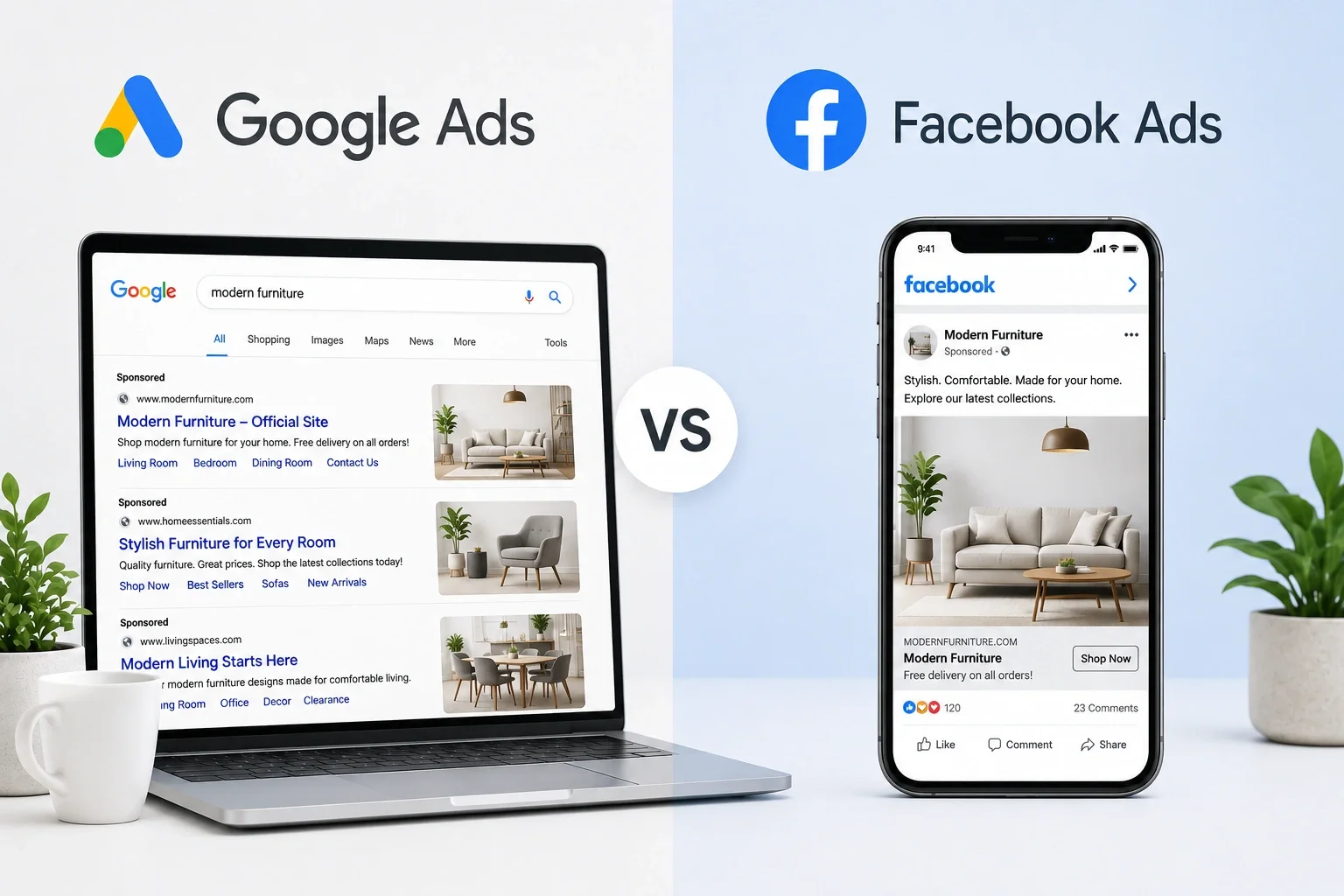
Google Ads captures existing demand through search intent, while Facebook Ads (Meta Ads) creates demand through audience targeting on Instagram and Facebook. Google Ads generally suits businesses with clear purchase intent; Facebook Ads suits brand awareness and discovery. Most businesses get the best return using both platforms together across the marketing funnel.
Paid advertising has become the fastest way for businesses to get in front of the right customer at the right moment. As budgets shift from traditional media to digital advertising, the Google Ads vs Facebook Ads decision comes up constantly among small business owners, eCommerce brands, and marketing managers alike.
A common misconception is that one platform is simply “better.” In reality, Google Ads and Facebook Ads solve different problems. Google Ads platform ads meet people who are actively searching for a solution, while Facebook advertising reaches people based on interests, behavior, and demographics — often before they know they need your product.
This guide breaks down how each platform works, compares cost, targeting, and conversion potential, and explains when running Google ads and Facebook ads together produces the strongest results. You’ll also find comparison tables, a decision tree, and answers to the most common questions business owners ask before committing their advertising budget.
Google Ads is a pay-per-click advertising platform that places your business in front of users actively searching on Google search results, YouTube, and millions of partner sites. Because Google Ads targets users based on search intent, it’s often the most direct path to sales conversions.
Core campaign types include:
Google Ads works well for businesses that want to capture purchase intent right when it happens — think emergency plumbing services or someone ready to buy a product today.
Facebook Ads, part of the broader Meta Ads ecosystem, runs across Facebook Feed Ads, Instagram Ads, Messenger Ads, Stories Ads, Reels Ads, and the Audience Network. Campaigns are managed through Meta Ads Manager.
Instead of keywords, Meta Ads relies on:
Facebook advertising excels at brand awareness and discovery — putting visually engaging ad creatives in front of people who haven’t searched for you yet but match your ideal customer targeting profile.
Feature |
Google Ads |
Facebook Ads |
|---|---|---|
User Intent
|
Active search intent
|
Passive discovery / interest-based
|
Audience
|
Keyword-based
|
Demographic & interest-based
|
Ad Formats
|
Text, shopping, video, display
|
Image, video, carousel, Stories, Reels
|
Cost Model
|
CPC, often higher for competitive keywords
|
CPC/CPM, often lower entry cost
|
Best For
|
Lead generation, eCommerce sales, local business advertising
|
Brand awareness, B2C marketing, community building
|
Reporting
|
Google Analytics, conversion tracking
|
Meta Pixel, Ads Manager reporting
|
Learning Curve
|
Moderate to steep
|
Moderate
|
Costs vary significantly by industry, competition, and campaign quality — always verify current benchmarks using official Google Ads and Meta Business resources rather than relying on fixed averages.
Google Ads campaigns run through an ad auction governed by quality score, bid amount, and expected impact — together producing your ad rank. Advertisers choose between manual bidding, automated bidding, or smart bidding strategies to optimize toward conversions, clicks, or ROAS. Responsive search ads test multiple headlines and descriptions automatically to improve ad relevance and click-through rate (CTR).
Meta’s algorithm uses machine learning optimization to deliver ads to the audience segments most likely to convert. Advertisers upload custom audiences, build lookalike audiences, and install the Meta Pixel to track on-site behavior for retargeting. Creative testing — rotating ad copy, images, and video — is essential since Meta ad performance depends heavily on creative assets rather than keywords.
Targeting Method |
Google Ads |
Facebook Ads |
|---|---|---|
Keyword targeting
|
✅ Core method
|
❌ Not used
|
Audience/interest targeting
|
Limited (in-market, affinity)
|
✅ Core method
|
Demographic targeting
|
✅
|
✅
|
Location targeting
|
✅
|
✅
|
Remarketing / retargeting
|
✅ Via Display Network
|
✅ Via Meta Pixel
|
Example: A B2B software company might use search ads on Google to capture “best project management software” searches, then retarget those visitors with Instagram Ads showcasing a demo video.
Google Ads: search campaigns, display campaigns, shopping campaigns, video campaigns, Performance Max, Demand Gen Facebook Ads: lead ads, feed ads, Stories Ads, Reels Ads, Messenger Ads
Both platforms use auction-based pricing, so cost per click (CPC), cost per acquisition (CPA), and return on ad spend (ROAS) fluctuate based on competition, targeting, and ad quality. Rather than quoting fixed numbers, focus on these controllable factors:
Higher CPCs in competitive niches, a steeper learning curve, and limited brand-building power compared to visual platforms.
Privacy changes and cookie-less tracking have made attribution harder, ad fatigue sets in quickly, and results depend heavily on creative quality.
Business Type |
Recommended Platform |
|---|---|
Local businesses
|
Google Ads (search + local intent)
|
eCommerce stores
|
Both — Shopping ads + Instagram Ads
|
B2B companies
|
Google Ads (LinkedIn often supplements)
|
B2C brands
|
Facebook Ads
|
SaaS businesses
|
Both, funnel-dependent
|
Healthcare & real estate
|
Google Ads for intent, Facebook for awareness
|
Combining platforms across the full marketing funnel typically outperforms relying on one channel alone:
This cross-platform advertising approach uses first-party data from both Meta Pixel and Google Analytics to build a consistent customer journey.
Running successful Google Ads and Facebook Ads campaigns requires ongoing campaign optimization, not a one-time setup. Sir Marketer supports businesses with audience research, creative development, budget allocation, conversion tracking, and continuous optimization to help scale profitable campaigns responsibly — without guaranteeing specific ROAS or sales outcomes, since results always depend on budget, competition, and execution quality.
This flywheel approach allows each channel to strengthen the other — producing compounding returns that neither channel achieves in isolation.
Google Ads and Facebook Ads each play a distinct role in a modern digital marketing strategy. Google Ads captures existing demand through search intent; Facebook Ads builds awareness and nurtures audiences through visual storytelling. Testing both, tracking performance, and adjusting based on data is the path to long-term advertising success. If you need help building or optimizing a campaign, consult an experienced PPC team before committing significant budget.
Grow Faster with Sir Marketer — we build data-driven Google Ads and Meta Ads campaigns, from strategy to ongoing optimization. Contact us to discuss your goals.
Depends on intent — Google wins for active searchers, Facebook for discovery.
Costs vary by industry; neither is universally cheaper.
Google Ads often yields higher-intent leads; Facebook drives more top-of-funnel volume.
Both — Shopping ads plus Instagram Ads typically work well together.
Google Ads, due to location and search intent.
Yes — many businesses see stronger full-funnel results doing so.
Start small based on goals, then scale using performance data.
Our team will answer all your questions, We ensure a quick response.