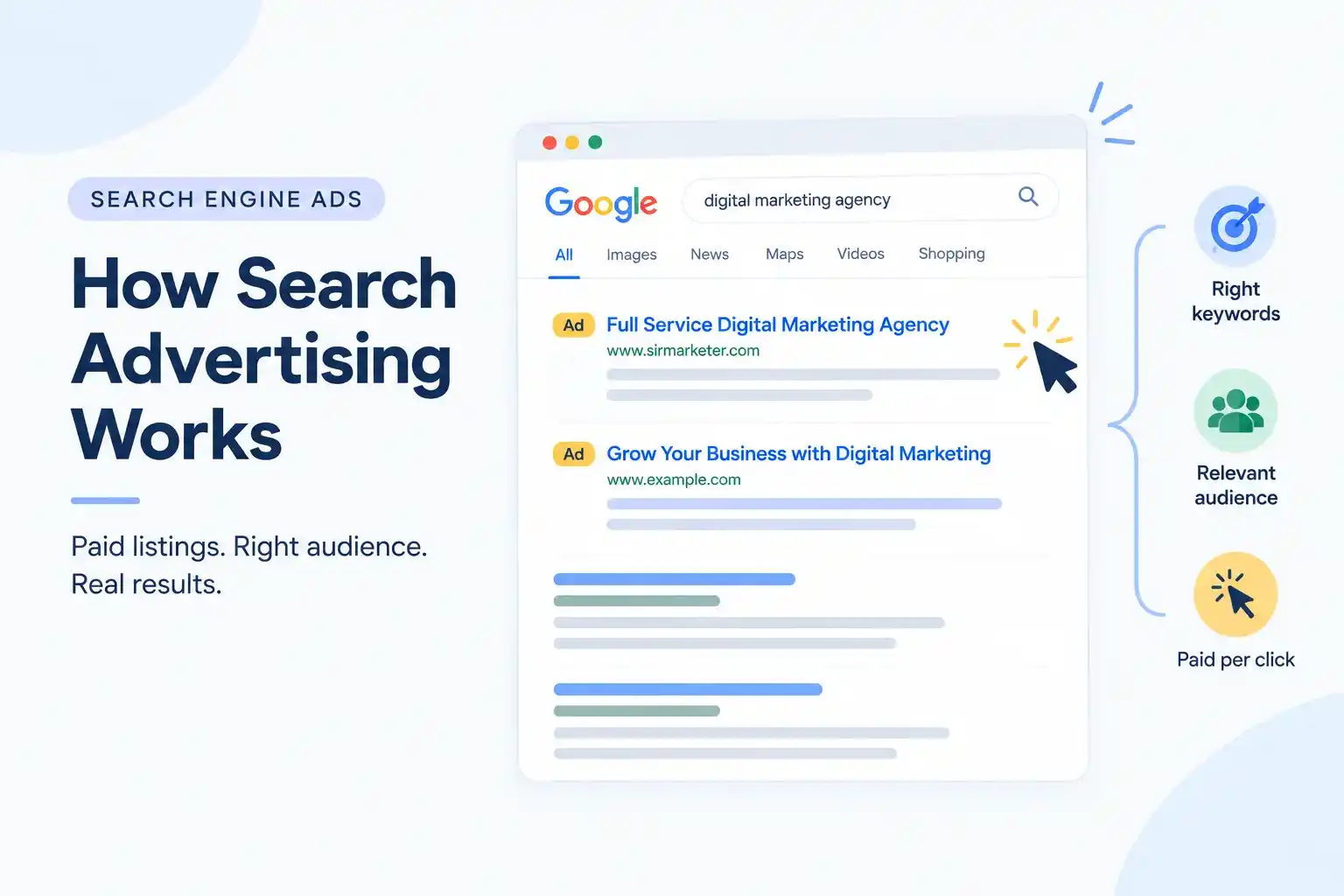
Search engine ads are paid listings that appear on a search engine results page (SERP) when someone searches for a related term. Advertisers compete for specific search terms, and the ads displayed depend on factors such as the bid value and how relevant the ad is to the search. Businesses typically pay per click, making paid search a direct way to reach people actively looking for a product or service.
Search engine ads are paid placements that appear alongside organic search results and are labeled “Ad” or “Sponsored.” Advertisers bid on keywords, and an auction determines which ads appear and where.
They help businesses reach people actively searching for their products or services, making paid search a direct way to generate relevant traffic and leads.
Understanding how search ads work starts with the auction. Here’s the general flow:
Advertisers don’t simply buy the top position. A competitor with a lower bid but stronger ad relevance and landing page experience can outrank a higher bidder. This is what separates a real ad auction from traditional fixed-price advertising.
Example: Someone searches “emergency plumber near me.” A local plumbing company’s ad appears because its keyword targeting matches the query and its bid is competitive. The user clicks, lands on a page with a phone number and service area, and calls. That’s the full journey from search intent to conversion.
Search ads vs SEO comes down to how visibility is earned and how long it lasts.
Factor |
Search Ads |
SEO |
|---|---|---|
Placement
|
Paid listings, labeled "Ad"
|
Organic search results
|
Payment model
|
Pay per click (CPC)
|
No direct cost per click
|
Speed
|
Visibility can start immediately
|
Takes time to build
|
Long-term visibility
|
Stops when spending stops
|
Can persist without ongoing spend
|
Keyword targeting
|
Precise, adjustable in real time
|
Influenced by content and authority
|
Control
|
High (bids, budget, targeting)
|
Lower (depends on algorithm factors)
|
Testing
|
Fast, measurable
|
Slower to test and see results
|
Traffic source
|
Paid traffic
|
Organic search
|
Best use cases
|
Quick visibility, promotions, high-intent terms
|
Long-term brand authority, sustainable traffic
|
These concepts are closely related and are sometimes used interchangeably:
In practice, when someone asks “what is search engine advertising,” they’re usually asking about PPC campaigns run through platforms like Google Ads.
Google Ads is Google’s advertising platform. It lets businesses run search campaigns organized into ad groups, target specific search keywords, and manage bids through manual or automated strategies. Features include responsive search ads, ad extensions, conversion tracking, and budget controls at the campaign level. Because interfaces and features change, always confirm current capabilities in Google’s official documentation before configuring a live campaign.
Microsoft Advertising runs on the Bing network and related partner sites. Core mechanics, including keyword targeting, bidding, ad groups, are similar to Google Ads, but audience size and competition can differ by industry. Some businesses use it alongside Google Ads to extend reach; others test it separately to compare search advertising results. Platform-specific features should be verified against current Microsoft documentation.
Effective keyword research starts with business goals, not just search volume. A high-volume term with weak commercial intent can waste spend. Consider:
Match types control how closely a search query must match your keyword:
No single match type is best; most campaigns use a mix, refined by reviewing actual search terms over time.
User intent drives everything downstream. Someone with informational intent (“how does PPC work”) isn’t ready to buy. Someone with transactional intent (“hire PPC agency“) is. Matching keyword, ad copy, and landing page to that intent is what makes effective search ads convert instead of just generating clicks.
There’s no universal price for search engine ad costs, they vary by industry, competition, geographic market, and campaign quality. Verified factors that influence search advertising costs include:
Rather than assuming a fixed PPC budget, most businesses start with a test budget tied to a specific cost per acquisition (CPA) target, then adjust based on real conversion data.
A practical search ad campaign typically follows this sequence:
Ad copy should lead with a clear benefit, use the target keyword naturally, and match what the landing page actually delivers. A generic homepage rarely converts as well as a page built around the specific offer in the ad, this “message match” is one of the simplest ways to improve landing page optimization.
No single metric tells the full story. Track these together:
Metric |
What It Measures |
Why It Matters |
|---|---|---|
CPC
|
Cost per click
|
Controls spend efficiency
|
CTR
|
Click-through rate
|
Signals ad relevance
|
Conversion Rate
|
% of clicks that convert
|
Reflects landing page and offer strength
|
CPA
|
Cost per acquisition
|
Ties spend to actual results
|
ROAS
|
Return on ad spend
|
Measures revenue impact
|
Impression Share
|
% of available impressions won
|
Shows growth potential
|
A high CTR with a low conversion rate usually points to a landing page or offer problem, not a targeting problem. Reviewing PPC metrics together, rather than in isolation, is what separates real campaign optimization from guesswork.
Ongoing search ad optimization includes reviewing actual search terms, expanding negative keywords, testing ad copy variations, and checking performance by device and location. Common mistakes to avoid:
Search ads for small businesses work best with a focused approach:
Local businesses often benefit from call tracking, while e-commerce advertising campaigns tend to rely more on product-level targeting and remarketing. B2B and professional services campaigns tend to prioritize lead generation over immediate purchases because the sales cycle is longer.
Paid search and organic search aren’t competitors, they’re complementary. Paid campaigns can test which keywords convert, informing SEO priorities, while organic search builds visibility that doesn’t disappear when ad spend pauses.
Measuring real advertising ROI means going beyond clicks and impressions to track customer acquisition cost against actual revenue or lead value. A campaign with a low CPC but poor lead quality isn’t actually efficient, cost per acquisition and downstream conversion quality tell the real story.
Getting results from search engine advertising requires more than simply launching a PPC campaign. The right keywords, ad messaging, targeting, landing pages, and conversion tracking all need to work together to turn paid traffic into valuable leads and customers.
Sir Marketer LLC provides PPC management, Google Ads, SEO, and digital marketing services to help businesses improve online visibility, attract qualified traffic, and generate more leads. Our team can help with:
Whether you need help launching a new search advertising campaign, improving existing PPC campaigns, or combining paid search with SEO, Sir Marketer LLC can develop a strategy based on your specific objectives.
The goal is to help you reach the right audience, use your advertising budget more effectively, and turn search traffic into measurable business results.
Search engine ads put a business in front of people who are already looking, but success depends on matching keywords to intent, writing relevant ad copy, sending traffic to the right landing page, and tracking what actually converts. Costs vary widely by market, and no strategy works the same for every business. A structured, tested approach beats guesswork every time. If you want help building or refining a search advertising strategy, Sir Marketer’s team is available to talk through your specific goals.
It's the practice of paying to display ads on a search engine results page, typically priced per click, targeting people actively searching for related terms.
Advertisers bid on keywords; an auction weighing bid amount and ad relevance determines which ads show and in what order.
Costs vary by industry, competition, and market, there's no fixed rate, so most businesses test with a budget tied to their target cost per acquisition.
Paid search is bought placement with immediate but temporary visibility; SEO is earned organic visibility that builds over time without a per-click cost.
Advertisers create campaigns and ad groups, bid on keywords, write ads, and pay when users click, with performance tracked through conversion data.
Start with business goals and buyer intent, not just search volume, and refine using negative keywords and real search term data.
Our team will answer all your questions, We ensure a quick response.