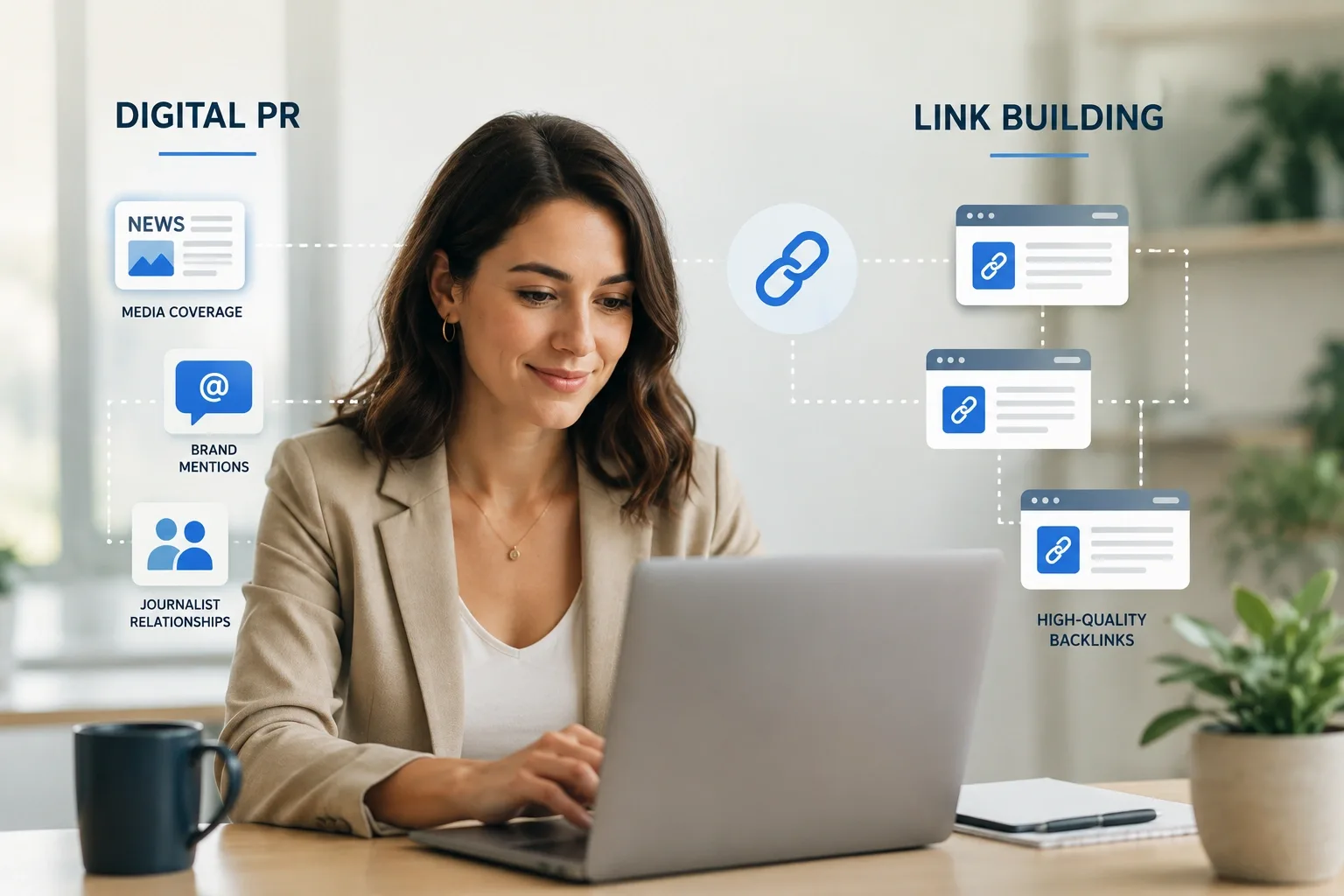
Digital PR is a modern public relations approach centered on earning media coverage, brand mentions, and relationships with journalists and publishers. Link building is the process of earning or acquiring backlinks from relevant, external websites. Digital PR can produce backlinks as a byproduct of media coverage, while link building targets backlinks directly, and in most SEO strategies, the two work best together.
This guide covers everything you need to know about Digital PR vs. Link Building:
On-page SEO is only part of the equation. Digital PR and link building both support off-page SEO, but they serve different purposes. Digital PR focuses on media coverage, brand visibility, and reputation, while link building focuses directly on earning quality backlinks. Understanding the difference helps businesses choose the right strategy, or combine both for long-term SEO growth.
Digital PR is the practice of earning media coverage, brand mentions, and online visibility by creating newsworthy content and building relationships with journalists, publishers, and media outlets. It’s the modern evolution of traditional public relations, adapted for a search-driven, digitally connected media landscape.
A typical digital PR strategy relies on:
The goal of a digital PR campaign isn’t only backlinks. It’s coverage in news websites and online publications, mentions that build brand awareness, and relationships with journalists that can lead to future press coverage. Some campaigns generate strong media coverage and few links. Others generate both. Success in digital PR is measured across more than one dimension.
Link building is the process of earning or acquiring hyperlinks from external websites to pages on your own site. Where digital PR is about the story, link building is about the destination: getting relevant, credible pages to point to your content.
Not all backlinks carry the same value. A link building strategy should prioritize:
A strong backlink profile isn’t about volume. A page with a handful of relevant, editorial backlinks from authoritative websites in its niche typically carries more strategic weight than a page with hundreds of unrelated or low-quality links. Link relevance, referring domain quality, and editorial context matter more than raw link quantity.
Factor |
Digital PR |
Link Building |
|---|---|---|
Primary objective
|
Earned media, brand visibility, reputation
|
Acquiring relevant backlinks
|
Main audience
|
Journalists, publishers, the public
|
Website owners, editors, webmasters
|
Core activity
|
Storytelling, outreach, media relations
|
Link prospecting, outreach, content offers
|
Backlinks
|
Possible outcome, not guaranteed
|
Direct, primary goal
|
Brand mentions
|
Central to success
|
Secondary, if it occurs
|
Media relationships
|
Core asset
|
Not required
|
SEO role
|
Indirect, often supports off-page SEO
|
Direct off-page SEO tactic
|
Brand awareness
|
High priority
|
Lower priority
|
Referral traffic
|
Often significant from coverage
|
Possible, depends on placement
|
Typical content
|
Data studies, expert commentary, press releases
|
Guest posts, resource pages, outreach assets
|
Measurement
|
Coverage, mentions, referring domains, sentiment
|
New referring domains, backlink quality
|
Long-term value
|
Reputation, authority, relationships
|
Link profile strength
|
Digital PR and link building or backlink-focused strategies both contribute to a healthier off-page SEO profile, but they start from different premises. Digital PR: What Makes a Story Worth Covering?
Link building asks, “Which pages deserve a link, and where can we earn it?”
Studying the local dining landscape and customer expectations.
Digital PR strategy typically prioritizes brand awareness, media coverage, brand visibility, earned media, reputation, and relationship building. Link building strategy typically prioritizes backlinks, referring domains, link relevance, backlink quality, and overall SEO performance.
Despite the different starting points, both can contribute to organic traffic, search visibility, website authority, and brand credibility over time. Neither approach guarantees improved search rankings on its own, SEO outcomes depend on content quality, technical SEO, competition, relevance, and many other signals working together.
Digital PR can support SEO, though its value is often indirect. Coverage from news websites and online publications can bring:
Not every media placement includes a link. A journalist may mention a brand by name without linking to the site, and that’s still a legitimate PR win, just not necessarily an SEO one. Digital PR’s SEO benefits should be viewed as a byproduct of good coverage, not the sole objective.
Digital PR can result in backlinks, but it doesn’t guarantee them. Links may come from journalists, publishers, industry blogs, or news websites referencing source material. Whether a campaign earns a link depends on the story, the publication’s editorial practices, the newsworthiness of the angle, and the audience.
A PR campaign can still be considered successful from a public relations standpoint even if it earns limited backlinks, brand visibility and media relationships have value on their own.
The objective is to make the underlying resource genuinely useful enough that publishers want to cite it, not to chase links as the only measure of success.
Yes, but the version that works today looks different from a decade ago. Relevant backlinks from authoritative websites can still support off-page SEO. What’s changed is the emphasis: backlink quality now matters more than link quantity.
Spammy backlinks, toxic backlinks, and participation in link schemes carry real risk and rarely produce sustainable SEO results. A sustainable link building strategy focuses on earning contextual, relevant links through legitimate content and outreach, not on maximizing volume.
Backlinks can help search engines discover new pages and can act as signals of relationships between sites. Relevant editorial links contribute to a broader off-page SEO profile, and quality backlinks can also generate direct referral traffic.
It’s worth being precise here: PageRank is a Google-developed concept for evaluating link relationships, while domain authority is a third-party metric, not an official Google ranking factor. A strong link profile can support long-term SEO, but no single backlink or metric determines search rankings.
Quality Type |
Characteristics |
Typical Risk Level |
|---|---|---|
High-quality backlinks
|
Relevant, editorially placed, from authoritative websites
|
Low
|
Relevant backlinks
|
Topically aligned with the linking page
|
Low
|
Authoritative backlinks
|
From well-established, credible sources
|
Low
|
Editorial backlinks
|
Earned naturally within content
|
Low
|
Contextual backlinks
|
Placed within relevant surrounding text
|
Low
|
Spammy/toxic backlinks
|
Irrelevant, mass-produced, or paid
|
High
|
A single highly relevant editorial backlink from an authoritative website in your niche is typically more useful than dozens of unrelated, low-quality links.
Avoid manipulative link acquisition tactics, they create risk without sustainable SEO ROI.
Tactic |
Digital PR |
Link Building |
Best Use |
|---|---|---|---|
Original research
|
Primary tactic
|
Supporting asset
|
Authority building
|
Journalist outreach
|
Core activity
|
Rare
|
Media coverage
|
Guest posting
|
Occasional
|
Common
|
Relevant backlinks
|
Broken link building
|
Rare
|
Common
|
Link acquisition
|
Resource page links
|
Rare
|
Common
|
Referring domains
|
Press releases
|
Occasional
|
Rare
|
Announcements
|
Competitor backlink analysis
|
Rare
|
Common
|
Strategy planning
|
Neither is universally better, they solve different problems.
Yes. A common strategic framework looks like this: content → digital PR outreach → media coverage → brand mentions → editorial backlinks → referral traffic → long-term SEO.
This is a strategic pattern, not a guaranteed sequence, not every campaign will move through every stage.
Content marketing, digital PR, and link building reinforce each other when they share the same underlying assets, like original research or expert commentary.
Costs vary widely based on agency vs. in-house execution, research depth, outreach volume, and industry. As an illustrative (not benchmark) example, a data-driven digital PR campaign generally requires more upfront research investment than a targeted link building push focused on a handful of resource pages. ROI for either approach depends on execution quality, industry competitiveness, and how performance is measured, it shouldn’t be treated as guaranteed or immediate.
Approach |
Key Metrics |
|---|---|
Digital PR
|
Media placements, brand mentions, referring domains, referral traffic, sentiment
|
Link building
|
New referring domains, backlink quality, organic traffic, search rankings over time
|
PR success shouldn’t be measured by backlinks alone, and link building success shouldn’t be measured by raw link quantity alone.
Digital PR and link building can both play an important role in growing your website’s authority, but getting the right strategy in place requires more than simply earning as many links as possible.
At Sir Marketer, we help businesses build a stronger off-page SEO presence through a combination of digital PR, link building, and content marketing. Our approach includes:
Whether your priority is earning media coverage, strengthening your backlink profile, increasing brand visibility, or combining digital PR with link building, Sir Marketer LLC can help develop a strategy around your specific SEO goals.
Digital PR and link building tackle off-page SEO from different angles: one built around earned media and reputation, the other around direct backlink acquisition. Digital PR can produce backlinks, but that’s not its only value. Link building, done ethically, remains a relevant part of a modern SEO strategy. Backlink quality and relevance matter more than volume in either case. For most businesses pursuing long-term growth, combining both approaches, rather than picking one, tends to build the strongest foundation.
Digital PR is a modern PR approach focused on earning media coverage, brand mentions, and online visibility through journalist relationships and newsworthy content.
Link building is the process of earning or acquiring backlinks from external websites to relevant pages on your site.
Digital PR centers on earned media and reputation; link building centers on directly acquiring backlinks.
It can, mainly through earned backlinks, brand mentions, and referral traffic, though its SEO impact is often indirect
Sometimes, links depend on the story, publisher, and editorial context, and aren't guaranteed.
Yes, when it prioritizes relevant, high-quality backlinks over volume.
Neither is universally better; it depends on whether the priority is brand visibility or direct backlink acquisition.
The right choice depends on business goals, many businesses benefit from using both.
Yes, they can reinforce each other when built around shared content assets.
Our team will answer all your questions, We ensure a quick response.