

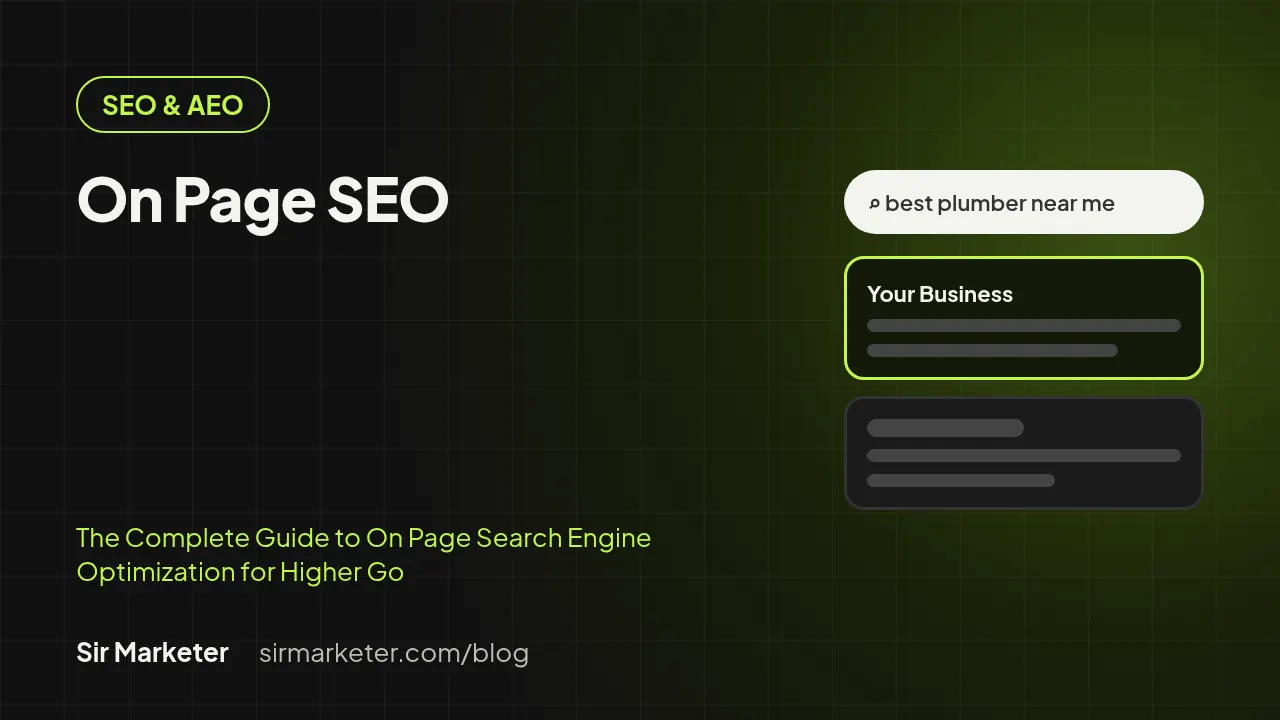
On Page SEO: The Complete Guide to On Page Search Engine Optimization for Higher Google Rankings
What is On Page SEO? (Quick Answer)
On page SEO is the practice of optimizing individual web pages to improve their search engine ranking and organic search visibility. It involves optimizing content, title tags, meta descriptions, header tags, internal linking, and user experience signals, all elements within your direct control on each page on your website.
This guide covers everything you need to know about the On Page SEO:
- What Is On Page SEO?
- Why On Page SEO Is Important
- How Search Engines Understand Your Pages
- On Page SEO vs Off-Page SEO vs Technical SEO
- Key On Page SEO Ranking Factors
- On Page SEO Techniques You Must Use
- Complete On Page SEO Checklist
- On Page SEO Strategies for Higher Rankings
- Image SEO Best Practices
- Schema Markup and Structured Data
- Tools for On Page SEO Optimization
- Common On Page SEO Mistakes to Avoid
- How to Improve Google Ranking: Step-by-Step Workflow
- Best Way to Rank Your Website on #1
- Frequently Asked Questions
Understanding On Page SEO
Every business competing online today needs a strong SEO strategy, and on page search engine optimization is where that strategy begins. On page SEO refers to all the optimization work done directly on your web pages to help search engines understand, index, and rank your content higher on the search engine results page (SERP).
Unlike off-page SEO, which depends on external signals like backlinks, on page SEO optimization puts you in full control. From the title tag and meta description to content structure, keyword placement, and mobile optimization, every decision you make on-page directly shapes your Google ranking, organic traffic, and search visibility.
Search engine optimization has evolved dramatically. Today’s Google algorithm prioritizes user intent, content quality, page experience, and semantic understanding over old-school tactics like keyword density manipulation.
What Is On Page SEO?
On-page SEO is the practice of optimizing the content and HTML elements of individual pages to improve their ranking on search engines. On-page SEO involves everything from keyword optimization and content structure to meta tags, schema markup, and internal linking, all the core on-page elements within your direct control.
Definition Box On-Page SEO: Optimization of page-level elements, such as content, tags, links, and technical signals, to improve a page’s relevance, authority, and search engine ranking for target keywords.
Examples of on-page SEO include: optimizing a product page’s title tag with a primary keyword, restructuring a blog post’s header tags for better content hierarchy, adding image alt text, and improving page speed on a landing page.
Why On Page SEO Is Important
On-page SEO is important because it directly communicates your page’s relevance to both users and search engines. Strong on-page SEO improves your SERP ranking, drives organic search traffic, and enhances user experience, three outcomes that compound over time.
Without solid on page SEO factors in place, even the best off-page SEO efforts struggle to deliver results. Good on-page SEO also reduces bounce rate, improves click-through rate (CTR), and increases dwell time, all engagement metrics that influence Google’s ranking signals.
How Search Engines Understand Your Pages
Before ranking your content, search engines go through three stages:
- Crawling: A search engine crawler (crawl bot) discovers your pages by following links across the web.
- Indexing: The search engine indexes page content, evaluating relevance, content quality, and structure.
- Ranking: The ranking system scores pages based on hundreds of ranking signals, including on-page SEO factors, UX signals, and engagement metrics.
Modern Google algorithms also power AI Overviews, which pull structured, authoritative answers directly from well-optimized pages. On-page SEO that satisfies search intent clearly and completely is more likely to appear in these AI-generated results.
On Page SEO vs Off-Page SEO vs Technical SEO
Understanding where on page search engine optimization fits within the broader SEO strategy is essential.
| Factor | On Page SEO | Off-Page SEO | Technical SEO |
|---|---|---|---|
| Focus | Page content & HTML elements | External signals (backlinks, brand mentions) | Site infrastructure & crawlability |
| Examples | Title tags, content, internal linking | Link building, social signals | Site speed, XML sitemaps, indexability |
| Control | Full control | Partial control | Full control |
| Impact | Direct ranking improvement | Authority & trust signals | Crawlability & indexability |
| Difficulty | Low–Medium | Medium–High | Medium–High |
On page SEO and technical SEO work together to build a strong foundation, while off-page SEO builds domain authority over time.
Key On Page SEO Ranking Factors
The most important on page SEO ranking factors in 2026:
- Title Tag: The meta title is one of the most critical on page SEO factors. Include your primary keyword within the first 60 characters.
- Meta Description: A compelling meta description improves CTR from the SERP, even though it's not a direct ranking signal.
- Header Tags (H1, H2, H3): Proper use of header tags creates content hierarchy and helps search engines understand the topic of the page.
- Keyword Optimization: Strategic keyword placement throughout the content, including the primary keyword in the first 100 words.
- Content Quality: High quality content that satisfies user intent outperforms thin content every time.
- Internal Linking: Internal links distribute link equity, improve crawlability, and connect topically related pages.
- Image Alt Text: Descriptive image alt text improves accessibility and image search visibility.
- URL Structure: Clean, keyword-rich URLs improve both crawlability and user experience (UX).
- Page Speed: Fast-loading pages reduce bounce rate and improve Core Web Vitals scores.
- Mobile Optimization: Mobile friendliness is a confirmed Google ranking signal.
- Schema Markup: Structured data helps search engines display rich results in the SERP.
On Page SEO Techniques You Must Use
Practical on page SEO techniques that drive real results:
1. Keyword Intent Matching
Align your content with the correct search intent. Informational intent pages need educational content; transactional intent pages need clear CTAs and product details; navigational intent pages need clear brand signals. Keyword intent matching is one of the most underused on page SEO techniques.
2. Semantic Keywords and LSI Integration
Use LSI keywords and semantic keywords naturally throughout your content. This signals topical depth to search engines and improves your chances of ranking for secondary keywords and related queries.
3. Content Structure Optimization
Break content into scannable sections using header tags (H1, H2, H3), bullet points, and short paragraphs. Strong content structure improves content readability, reduces bounce rate, and increases dwell time.
4. Internal Linking Strategy
Build a topical cluster model, link pillar pages to supporting content using descriptive anchor text. This strengthens site architecture, improves indexability, and passes link equity across your website structure.
5. Optimize Title Tag and Meta Description
Every page needs a unique title tag and meta description. The title tag and meta description are your first impression in organic search, write them for clicks, not just rankings.
Complete On Page SEO Checklist
Use this on page SEO checklist before publishing any page:
Content & Keywords
- Primary keyword in title, H1, first 100 words, and conclusion
- Secondary keywords and LSI keywords used naturally
- Content satisfies informational, transactional, or navigational intent
- No keyword stuffing or duplicate content
- Content freshness maintained (updated within 12 months)
Technical On-Page Elements
- Title tag optimized (under 60 characters, includes target keyword)
- Meta description written (under 160 characters, compelling)
- URL structure is clean and keyword-relevant
- Header tags (H1, H2, H3) used correctly
- Image alt text added to all images
- Schema markup implemented where relevant
- Internal linking to related pages with descriptive anchor text
- External linking to authoritative sources
Performance & UX
- Page speed tested via Page Speed Insights
- Core Web Vitals pass thresholds
- Mobile optimization confirmed
- User experience (UX) tested across devices
On Page SEO Strategies for Higher Rankings
Beyond the checklist, these on page SEO strategies build long-term search engine ranking improvement:
Content Clustering: Group related pages under a pillar page with strong internal links. This builds topical authority, improves crawlability, and signals expertise to Google’s ranking system.
SERP Optimization: Study the search engine results page for your target keyword. Match the content format (list, guide, comparison) that already dominates the SERP ranking, this is keyword intent matching in practice.
Engagement Optimization: Improve engagement metrics by adding videos, interactive elements, and clear content hierarchy. Higher dwell time and lower bounce rate send positive UX signals to Google’s algorithm.
Content Freshness: Regularly update existing pages with new data, examples, and links. Content freshness is a confirmed SEO ranking factor for time-sensitive queries.
On Page SEO and Technical SEO Working Together
On page SEO optimization and technical SEO are not the same, but they’re deeply connected. Technical SEO ensures your pages are crawlable and indexable; on page SEO ensures those pages are relevant and valuable once found.
| Technical SEO Task | On Page SEO Task |
|---|---|
| XML sitemap submission | Title tag optimization |
| Canonical tags | Duplicate content removal |
| Site speed optimization | Page speed improvements |
| Mobile rendering fixes | Mobile-friendly content formatting |
| Crawl budget management | Internal linking structure |
For a deeper dive into the technical side, explore a dedicated Technical SEO Guide alongside this on page SEO resource.
Image SEO Best Practices
Image optimization is a frequently overlooked on page SEO factor:
- Use descriptive file names before uploading (e.g., on-page-seo-checklist.jpg)
- Write keyword-relevant image alt text for every image
- Compress images to reduce file size and improve page speed
- Use next-gen formats (WebP) for better Core Web Vitals performance
- Enable lazy loading to improve page experience signals
Schema Markup and Structured Data
Schema markup is structured data added to your HTML that helps search engines display rich results, such as star ratings, FAQs, breadcrumbs, and article details, directly in the SERP.
Key schema types for on page SEO:
- Article Schema: For blog posts and guides
- FAQ Schema: Increases SERP real estate with expandable questions
- Organization Schema: Builds brand trust signals
- Breadcrumb Schema: Improves site architecture visibility in search results
Implementing structured data is one of the highest-ROI on page SEO techniques available for both traditional organic search and AI Overviews.
Tools for On Page SEO Optimization
| Tool | Purpose |
|---|---|
| Google Search Console | Monitor indexability, CTR, and search visibility |
| Google Analytics | Track organic traffic and engagement metrics |
| Yoast / Rank Math (WordPress SEO plugins) | On page optimization tools for CMS users |
| Surfer SEO / NeuronWriter | Content optimization tools for semantic SEO |
| PageSpeed Insights | Core Web Vitals and page speed analysis |
| Screaming Frog | SEO audit tool for crawlability and on-page issues |
| Google Keyword Planner | Keyword research and keyword targeting |
For WordPress users, SEO plugins like Yoast and Rank Math make WordPress SEO significantly more manageable by integrating title tag, meta description, and schema markup controls directly into the content management system (CMS).
Common On Page SEO Mistakes to Avoid
- Keyword stuffing: Hurts readability and triggers Google algorithm penalties
- Missing or duplicate title tags: Confuses search engine crawlers and reduces SERP ranking
- Thin content: Pages with insufficient depth fail to satisfy search intent
- Duplicate content: Cannibalizes rankings and dilutes link equity
- Weak internal linking: Leaves pages orphaned with poor crawlability
- Ignoring mobile optimization: Directly impacts Google ranking on mobile devices
- No schema markup: Misses rich result opportunities in the SERP
Want to improve your rankings without cutting corners? Take a look at our White Hat SEO Shortcuts guide for practical strategies that help you grow organic traffic the right way.
How to Improve Google Ranking: Step-by-Step On Page SEO Workflow
- Conduct keyword research: Identify your primary keyword, secondary keywords, and LSI keywords using a keyword planner or SEO audit tool.
- Map search intent: Determine whether the query carries informational intent, transactional intent, or navigational intent.
- Optimize title tag and meta description: Place your target keyword in both; write for CTR.
- Structure your content: Use H1 for the page title, H2 for main sections, H3 for subsections.
- Optimize your content: Integrate semantic keywords naturally; satisfy user intent completely.
- Add internal links: Link to related pages using descriptive anchor text.
- Optimize images: Add alt text, compress files, use modern formats.
- Implement schema markup: Add FAQ, Article, or relevant structured data.
- Test page speed: Fix Core Web Vitals issues before publishing.
- Run an SEO audit: Use an SEO checker to verify all on page SEO checklist items are complete.
Want to improve your rankings without cutting corners? Take a look at our White Hat SEO Shortcuts guide for practical strategies that help you grow organic traffic the right way.
How Sir Marketer Helps You Turn SEO Into Revenue
Most SEO providers focus on checklists. They optimize title tags, add keywords, and deliver reports.
The problem? Rankings alone don’t grow a business.
At Sir Marketer, we approach on-page SEO differently. Every optimization is built around one goal: attracting qualified traffic that can turn into leads, sales, and revenue.
Instead of chasing outdated SEO tactics or vanity metrics, we focus on the factors that actually influence modern search visibility:
- search intent alignment
- topical authority
- content depth
- user experience
- internal linking architecture
- structured data
- AI-ready content optimization
Our process goes far beyond basic keyword placement. We analyze how Google currently ranks pages for your target searches, identify content gaps your competitors haven’t addressed, and build pages designed to become the best answer available for both traditional search results and AI-generated search experiences.
What makes Sir Marketer different is our focus on sustainable rankings. We don’t rely on shortcuts, keyword stuffing, or tactics that stop working after the next algorithm update. We build pages that continue earning visibility because they genuinely satisfy user intent and demonstrate expertise.
Whether you’re competing in a local market, a national industry, ecommerce, SaaS, or professional services, our team creates on-page SEO strategies designed to increase visibility, strengthen topical authority, improve conversions, and deliver measurable business growth.
Because the goal isn’t simply to rank higher.
The goal is to become the result Google wants to recommend, and the business customers choose.
Conclusion
On page SEO is the foundation that every successful search engine optimization strategy is built on. From title tag and meta description optimization to content structure, internal linking, schema markup, and Core Web Vitals, every on page SEO factor contributes to your Google ranking, organic traffic, and long-term search visibility.
Strong on page search engine optimization doesn’t just improve rankings. It builds trust with users, satisfies search intent, and creates the kind of high quality content that both search engines and real people value. Apply the on page SEO checklist, follow the optimization workflow, and treat on page SEO best practices as an ongoing discipline, not a one-time task.
The businesses that win in organic search aren’t just doing SEO. They’re doing on page SEO right, consistently, across every page on their website.
Want Higher Rankings with Expert On Page SEO?
At Sir Marketer LLC, we help businesses improve search visibility through data-driven on page SEO, content optimization, technical SEO, and AI-ready search strategies. Our services include comprehensive SEO audits, keyword research, on page SEO optimization, content optimization, technical SEO, local SEO, SEO content writing, and ongoing SEO management.
Contact SEO Experts today and start ranking higher on Google.
FAQ’S
What is on-page SEO?
On page SEO is the practice of optimizing individual web pages, their content, HTML elements, and user experience, to improve search engine ranking and organic visibility. It includes title tags, meta descriptions, header tags, keyword optimization, internal linking, and schema markup.
Why is on-page SEO important?
On-page SEO is important because it directly controls how search engines understand and rank your pages. Strong on page SEO improves organic traffic, SERP ranking, click-through rate, and user experience, all critical to long-term SEO performance.
What are on-page SEO ranking factors?
The key on page SEO ranking factors include title tag, meta description, header tags (H1, H2, H3), keyword optimization, content quality, internal linking, image alt text, URL structure, page speed, mobile optimization, Core Web Vitals, and schema markup.
How do I improve my Google ranking?
Improve Google ranking by conducting keyword research, optimizing your title tag and meta description, structuring content with clear header tags, building internal links, improving page speed, and ensuring mobile optimization across every page.
What is keyword optimization?
Keyword optimization is the strategic process of researching, selecting, and placing target keywords within your content and HTML elements to improve search engine ranking for relevant search queries. It involves keyword placement, keyword density balance, and keyword intent matching.
What is a meta description in SEO?
A meta description is an HTML tag that provides a short summary of a page's content. While not a direct ranking signal, a well-written meta description improves click-through rate (CTR) from the search engine results page, indirectly supporting SEO performance.
What is schema markup?
Schema markup is structured data added to a page's HTML that helps search engines display rich results, like FAQ dropdowns, star ratings, and article details, in the SERP. It improves search visibility and is one of the highest-impact on page SEO techniques.
How does page speed affect SEO?
Page speed is a confirmed Google ranking signal. Slow pages increase bounce rate, reduce dwell time, and negatively impact Core Web Vitals scores, all of which send poor UX signals to the ranking system. Faster pages rank higher and convert better.
What is search intent in SEO?
Search intent is the underlying goal behind a user's search query. The four types are informational intent, transactional intent, navigational intent, and commercial investigation. Matching your content to the correct search intent is one of the most important on page SEO strategies.
How do title tags affect rankings?
The title tag is one of the most important on page SEO factors. It tells search engines the primary topic of the page and appears as the clickable headline in the SERP. Including your primary keyword in the title tag improves both ranking relevance and organic CTR.
Related articles
Google Business Profile Optimization Guide: Complete Local SEO Strategy to Rank Higher on Google Maps in 2026
Google Places SEO: The Complete Guide to Ranking Higher in Google Maps & Local Search in 2026
 AI & Automation
How Semantic SEO Improves Rankings: The Complete Guide for Google & AI Search in 2026
Want help putting this into practice?
A 30-minute call to understand your goals and whether we’re a good fit. No obligation.