Zero-click searches happen when Google answers a query directly in the search results, so the user never visits a website. They matter because they still generate impressions, brand exposure, and authority. Businesses can gain visibility without a click by optimizing for featured snippets, People Also Ask, local packs, and AI Overviews.
This guide covers everything you need to know about Zero-Click Searches SEO:
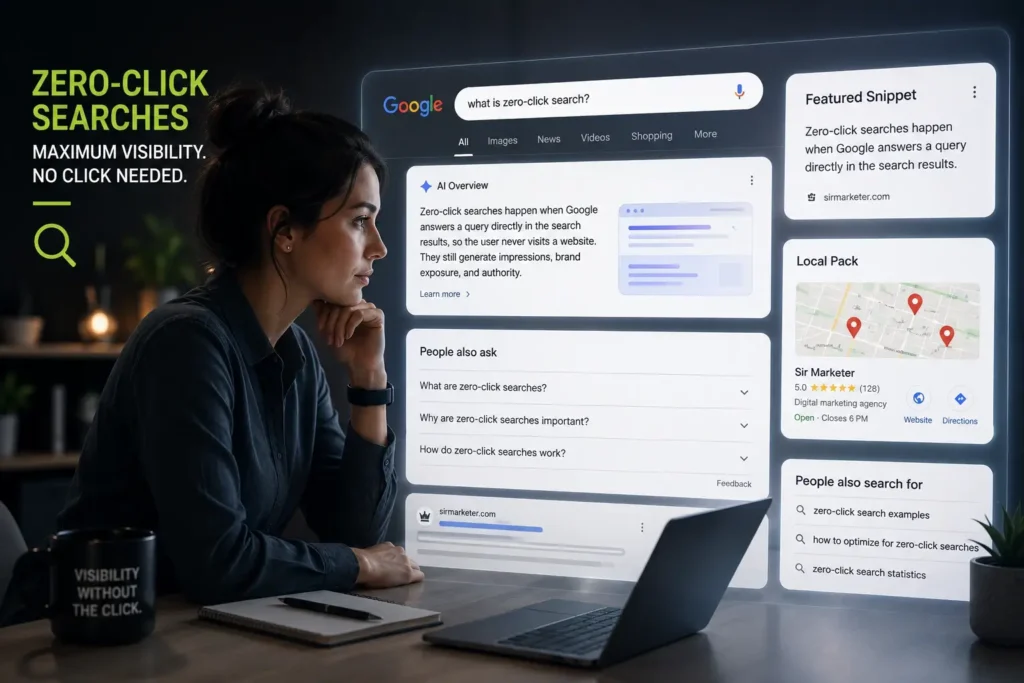
Google Search doesn’t work the way it did five years ago. Instead of ten blue links, the search results page (SERP) is now filled with featured snippets, knowledge panels, local packs, and AI-generated answers that satisfy the searcher before they scroll past the fold. This shift is why zero-click searches have become impossible to ignore.
Fewer clicks doesn’t automatically mean less SEO value. A brand can appear prominently in search results, build recognition, and stay top-of-mind without a single visit to its website that day. The smarter way to think about modern SEO strategy is in terms of visibility, presence, and influence, not traffic alone. That’s the foundation of zero-click SEO.
A zero-click search is any query where the user gets their answer directly on the SERP and doesn’t click through to any website. Google might answer with a definition, a quick fact, a map, or a short AI-generated summary.
For example, someone searching “what time zone is Wyoming in” typically gets an instant answer at the top of the page. There’s no need to click anything, the search experience ends there.
It helps to separate a few related metrics:
A zero-click outcome isn’t automatically bad. If your business name, definition, or local listing appears prominently, you’ve gained brand exposure even without a click.
Search visibility and website traffic are related but not identical. A page can rank well, appear in a featured snippet, and build brand authority while its click-through rate declines simply because the answer is now visible on the SERP itself.
This is why modern SEO performance should be measured on two tracks:
Search presence built through SERP features still supports brand awareness, brand recognition, and user trust, all of which influence whether someone eventually chooses your business, even later in their customer journey.
Several SERP features are designed to give direct answers instead of sending users elsewhere:
Whether a query becomes zero-click often comes down to query intent. Simple, factual, or definitional queries are answered instantly. Complex, comparative, or transactional queries are more likely to still drive a click, since the user needs more detail than a snippet can provide.
SERP Feature |
What It Does |
Best Content Type |
Optimization |
|---|---|---|---|
Featured
|
Pulls a direct answer into a highlighted box
|
Definitions, lists, steps
|
Concise, well-structured answers near the top of the page
|
People Also Ask
|
Shows related questions with expandable answers
|
Q&A, FAQ content
|
Answer real user questions clearly and directly
|
Knowledge panels
|
Displays entity facts (business, person, topic)
|
Structured, factual content
|
Consistent entity information across the web
|
Local pack
|
Shows nearby businesses on a map
|
Local business pages
|
Google Business Profile accuracy and reviews
|
Rich results
|
Adds visual detail (ratings, prices, events)
|
Product, review, event pages
|
Accurate schema markup matching visible content
|
Google AI Overviews
|
Summarizes an answer using multiple sources
|
Authoritative, well-organized content
|
Clear structure, factual accuracy, topical depth
|
Appearing in any of these features cannot be achieved through a single strategy. Success depends on relevance, the quality of the content, and how closely the page aligns with the user’s search intent.
Traditional SEO Focus |
Zero-Click SEO Focus |
|---|---|
Website clicks
|
Search visibility
|
Organic traffic
|
SERP presence
|
Rankings
|
SERP features
|
CTR
|
Impressions and visibility
|
Website sessions
|
Brand exposure
|
Conversion paths
|
Search journey
|
These aren’t competing strategies. Traditional SEO still drives the traffic and conversions your business needs, while zero-click SEO extends your reach into the moments users never leave Google. A complete SEO strategy accounts for both.
Not all queries are equally likely to trigger a direct answer:
Matching content to the right intent, not just the right keyword, is what determines whether you show up at all.
Research your target queries and identify searches that already trigger featured snippets, People Also Ask results, knowledge panels, or AI Overviews.
Create content that directly satisfies the user’s search intent rather than focusing only on including target keywords.
Answer the main question clearly within the first one or two sentences, then provide additional context and supporting details.
Use real questions from your audience and organize your content around the information users are actively searching for.
Use definitions, numbered steps, bullet points, short paragraphs, and tables where appropriate to make important information easy for search engines to understand.
Research relevant People Also Ask questions in the SERPs and provide direct, useful answers within your content.
Cover related entities, concepts, keywords, and subtopics comprehensively to demonstrate depth around the primary topic.
Create connected, comprehensive content around your subject instead of relying on isolated pages. Use internal links to establish relationships between relevant topics.
Add appropriate schema markup when it accurately represents the visible content on the page and follows search engine guidelines.
Demonstrate experience and expertise through qualified authorship, reliable sources, accurate information, original insights, and clear credentials where relevant.
Optimize your Google Business Profile, maintain accurate local citations, and encourage genuine customer reviews to strengthen local search visibility.
Write clearly structured, factually accurate content that makes key information easy to understand and reference. While optimization can improve the likelihood of being referenced, inclusion in AI-generated answers is never guaranteed.
Google AI Overviews generate a synthesized answer using multiple sources, rather than pulling one snippet from a single page. This makes source quality, factual accuracy, and topical authority more important than exact keyword matching.
Content that tends to perform well in AI-powered search shares common traits: clear structure, accurate claims, strong entity recognition, and genuine depth on the subject. There’s no confirmed method to guarantee appearing in Google AI Overviews, but authoritative, well-organized content gives you a realistic shot at being one of the sources referenced.
Semantic SEO focuses on meaning and relationships rather than exact-match phrases. Search engines use entity recognition to understand people, places, brands, and concepts, and how they connect through the Knowledge Graph.
Strong entity optimization helps Google understand what your business is, what it does, and where it fits within a topic. This is what supports topical authority: comprehensive, interconnected content that demonstrates depth on a subject rather than one thin page trying to rank for everything.
Local search visibility often depends more on your Google Business Profile, customer reviews, ratings, and local citations than on your website alone. A well-optimized profile can put you in the local pack for “near me searches” even before a user visits your site — directly influencing decisions during the customer journey.
Since clicks aren’t the full picture, use Google Search Console and complementary tools to track:
Visibility metrics and traffic metrics should be reviewed together, not as a replacement for one another.
Sir Marketer LLC helps businesses build stronger search visibility and turn organic search into a reliable source of qualified traffic. We look beyond rankings to understand how your audience searches, what your competitors are doing, and where your business has opportunities to stand out.
Our SEO approach can help you:
SEO is no longer only about clicks. Search behavior has shifted toward direct answers, and SERP features and AI search are reshaping how people discover information. The businesses that adapt will optimize for both traffic and visibility, treating search presence as an asset in its own right. Strong content, real expertise, and consistent trust signals remain the foundation, no matter how the SERP evolves.
Sir Marketer can help identify where you’re already visible, where you’re losing opportunities, and what you can do next to improve your search presence.
Zero-click searches are queries where Google answers directly in the search results, so the user doesn't click through to a website.
They still generate impressions, brand exposure, and authority, even without a click, which is why visibility should be tracked alongside traffic.
They can lower click-through rate on certain queries while still supporting brand awareness and long-term search presence.
Write concise, direct answers, structure content around real questions, and strengthen topical authority around your subject.
Research the actual related questions Google surfaces for your target queries and answer them clearly within your content.
Use clear definitions, numbered steps, or short tables placed near the top of a page that directly answers the query.
There's no guaranteed method, but clear, factually accurate, well-structured content on topics you have real authority in gives you a better chance of being referenced.
Track search impressions, impression share, branded search growth, and SERP feature rankings in Google Search Console alongside your traffic and conversion data.
Our team will answer all your questions, We ensure a quick response.