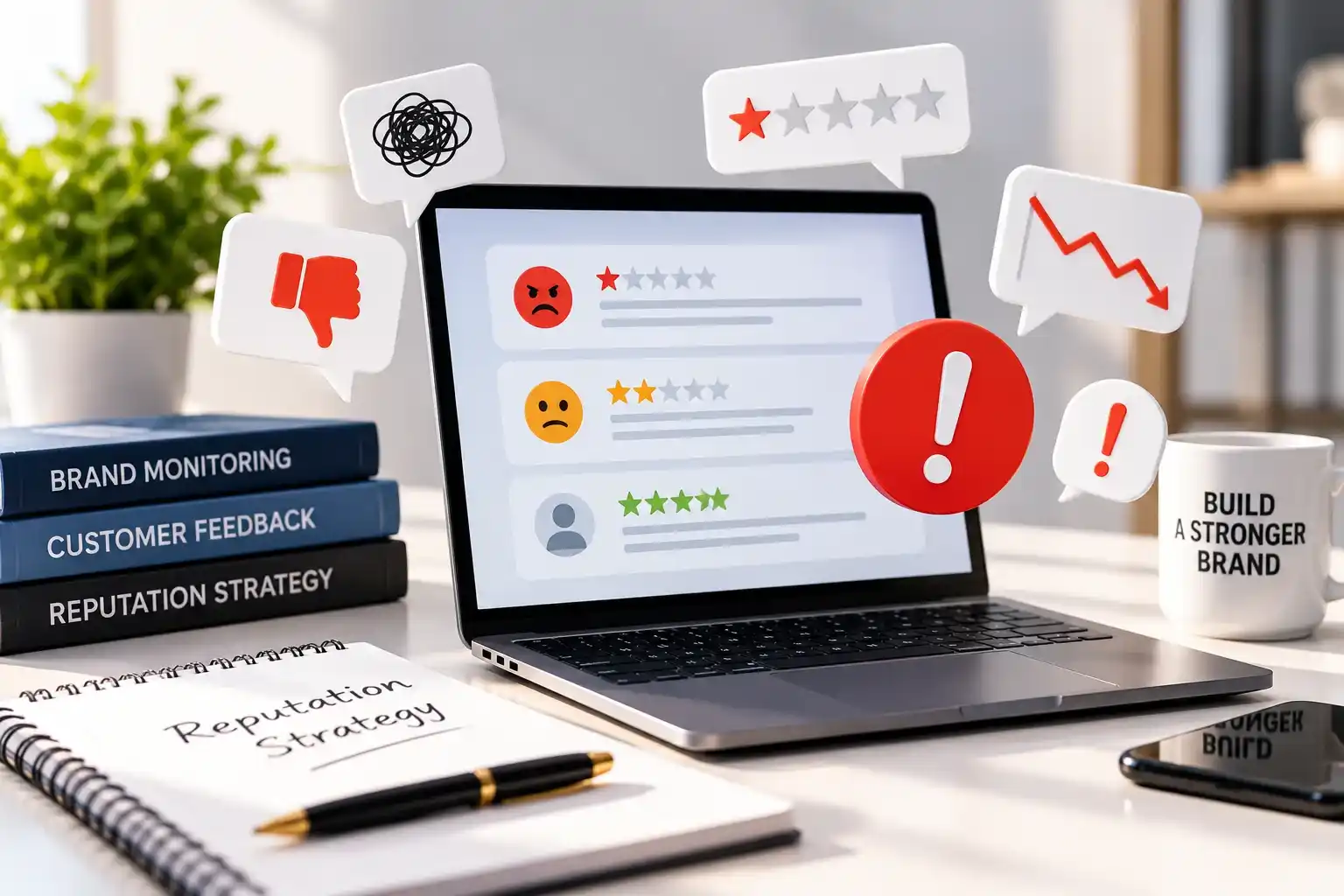
The most common online reputation management mistakes include ignoring negative reviews, responding emotionally, failing to monitor brand mentions, using deceptive review tactics, neglecting customer service, maintaining inconsistent business information, and having no crisis plan. Avoiding them means listening, responding professionally, fixing real problems, and staying honest.
Online Reputation Management (ORM) involves tracking a business’s online image, shaping public perception, and taking steps to maintain or improve how people view the brand. It includes review management, social listening, complaint resolution, search-result awareness, crisis communication, and customer experience improvement.
Legitimate ORM never hides truthful criticism. It helps accurate, useful information become visible while the business fixes what customers actually complain about.
A strong reputation builds customer confidence and can determine whether potential customers choose to consider your business. A typical chain looks like this:
Online reputation → trust → consideration → purchasing decision → customer experience → reviews → future reputation.
Reputation is never the only factor in buying decisions. Price, convenience, and need matter too. But a weak digital presence can make a good offer harder to choose, and strong customer relationships can support loyalty and word of mouth over time.
Mistake |
Why It Hurts |
Better Approach |
|---|---|---|
Ignoring negative reviews
|
Signals indifference
|
Respond and resolve
|
Arguing with customers online
|
Makes disputes more visible
|
Stay calm and professional
|
Fake or manipulative reviews
|
Erodes credibility, breaks platform rules
|
Ask real customers honestly
|
Not monitoring mentions
|
Problems grow unseen
|
Set up alerts and routines
|
Neglecting customer service
|
Creates new complaints
|
Fix the root cause
|
Inconsistent business information
|
Confuses customers
|
Keep listings accurate
|
Ignoring social media
|
Complaints go public
|
Monitor and engage
|
Only reacting to crises
|
Higher risk, slower response
|
Be proactive
|
No crisis plan
|
Chaotic response
|
Prepare in advance
|
Hiding instead of fixing
|
Trust erodes further
|
Take accountability
|
Ignoring negative reviews often happens because owners are busy or hope criticism fades. Silence can read as indifference and leaves customer concerns unresolved. Other readers see that no one answered.
Do instead: Respond publicly to most reviews, move sensitive details to a private channel, escalate serious issues internally, and follow up after resolution. Don’t paste the same template everywhere.
Online disputes with customers often arise when businesses respond defensively to criticism they perceive as unjust. But hostile or defensive responses make a public argument more visible and can hurt customer trust far more than the original review.
Fake reviews, buying reviews, asking staff to pose as customers, and misleading testimonials damage credibility if discovered. Review gating, meaning only inviting happy customers to review, is also a risk because platform and legal rules differ. Check the policies of each platform and your local regulations.
Do instead: Ask all genuine customers for honest feedback, and make it easy for them to respond.
Without reputation monitoring, you may learn about a problem only after it spreads. Track your business name, brand and product names, key executives, major locations, review platforms, social media, and Google search results for your brand. A proactive approach catches small issues early.
The chain is simple: customer experience → feedback → complaint → resolution → review → reputation. Poor customer service creates reputation problems that no amount of public relations work can offset indefinitely. Treat complaints as feedback that points to fixable issues.
Inaccurate business listings, outdated hours, or a wrong phone number create customer confusion. Ensure your business name, address, and phone number match across your Google Business Profile, online directories, and official website.
Hypothetical example: A dental clinic’s hours differ between its profile and website. When patients find the clinic closed unexpectedly, they may share their frustration through negative online reviews.
Unanswered social media complaints, inappropriate posts, and emotional replies can fuel backlash. A consistent brand voice, transparent communication, and prompt, professional replies reduce unnecessary problems.
Proactive |
Reactive |
|---|---|
Monitors signals early
|
Responds after damage is visible
|
Improves customer experience
|
Focuses on cleanup
|
Keeps information accurate
|
Corrects errors under pressure
|
Builds authentic feedback over time
|
Seeks quick fixes
|
Most businesses need both, but a proactive approach is generally more sustainable.
Without a plan, teams improvise under pressure. A basic framework is: detect → verify → assess → respond → resolve → update → monitor → recover. Not every crisis follows this exact path, so adapt it. Prepare for scenarios such as viral complaints, service failures, data incidents, and misleading public information.
Excuses, overpromising, underdelivering, and failing to follow up cost credibility. Reputation work should never conceal legitimate business problems. Accountability and a customer-first approach build trust that lasts.
Use this loop: monitor → detect → assess → respond → resolve → learn. Automated monitoring and reputation alerts help, but software cannot replace human judgment.
Signal |
What to Monitor |
Action |
|---|---|---|
Reviews
|
New ratings and comments
|
Respond and resolve
|
Social media
|
Comments and tags
|
Reply, escalate if needed
|
Search results
|
Branded searches
|
Fix inaccurate information
|
Listings
|
Name, address, phone, hours
|
Correct errors
|
Searches like “[brand] reviews” or “[brand] complaints” shape public perception. SEO and reputation management are related but different. SEO helps accurate, useful pages become easier to find, which can influence what customers see. Reviews can matter in local search, but rankings depend on many factors. Neither SEO nor ORM can promise to remove legitimate negative content.
For local businesses, watch your Google Business Profile, Google reviews, directory listings, and hours. For small businesses with limited time, follow this simple workflow: weekly review check → feedback → response → resolution → monthly reputation check.
Ethical |
Unethical |
|---|---|
Asking genuine customers for honest feedback
|
Buying reviews
|
Responding professionally
|
Threatening reviewers
|
Correcting inaccurate information
|
Creating fake positive content
|
Resolving real complaints
|
Hiding legitimate criticism
|
Reputation management should build real trust, not manufacture it.
Diagnose the cause, verify the facts, and fix the underlying service problem. Respond to legitimate complaints, correct inaccurate information, and encourage authentic feedback. Then publish accurate brand information and keep monitoring. Negative content can’t always be removed, so focus on what you can improve.
The biggest reputation management mistakes come down to silence, emotion, deception, and neglect. Strong ORM combines monitoring, review management, customer experience improvement, ethical practice, and preparation.
If you’d like support, Sir Marketer LLC is a digital marketing agency that can help with reputation strategy, monitoring, review management, local SEO, and social media reputation management. We can’t guarantee rankings or outcomes, but we can help you build a clearer, more trustworthy online presence.
Ignoring reviews, arguing online, using fake reviews, skipping monitoring, poor customer service, inconsistent information, and lacking a crisis plan.
Generally yes. A calm, specific response shows accountability.
Businesses usually can't delete legitimate reviews, and trying to suppress them improperly is risky. You can flag reviews that violate platform rules.
No. It can breach platform rules and damage credibility.
Monitoring signals and improving customer experience before problems escalate.
When it lacks time, tools, or expertise for monitoring, strategy, or crisis communication.
Yes. A strong brand identity helps new restaurants make a clear first impression and stand out from day one, rather than building recognition from scratch after opening.
Branding defines who a restaurant is, while marketing promotes that identity to reach and convert customers. Marketing works best when it's built on a strong brand foundation.
What are the top ORM mistakes?
An experienced agency brings strategic insight, design expertise, and consistency that can be difficult to achieve with limited in-house resources, helping restaurants build brands that support long-term growth.
Our team will answer all your questions, We ensure a quick response.