SEO for doctors is the process of optimizing a medical practice’s website and online presence so it ranks higher on Google for the health-related terms patients search. Done well, healthcare SEO improves online visibility, builds patient trust, and supports steady, long-term patient acquisition, without relying solely on paid ads or referrals.
This guide covers everything you need to know about the SEO for Doctors:
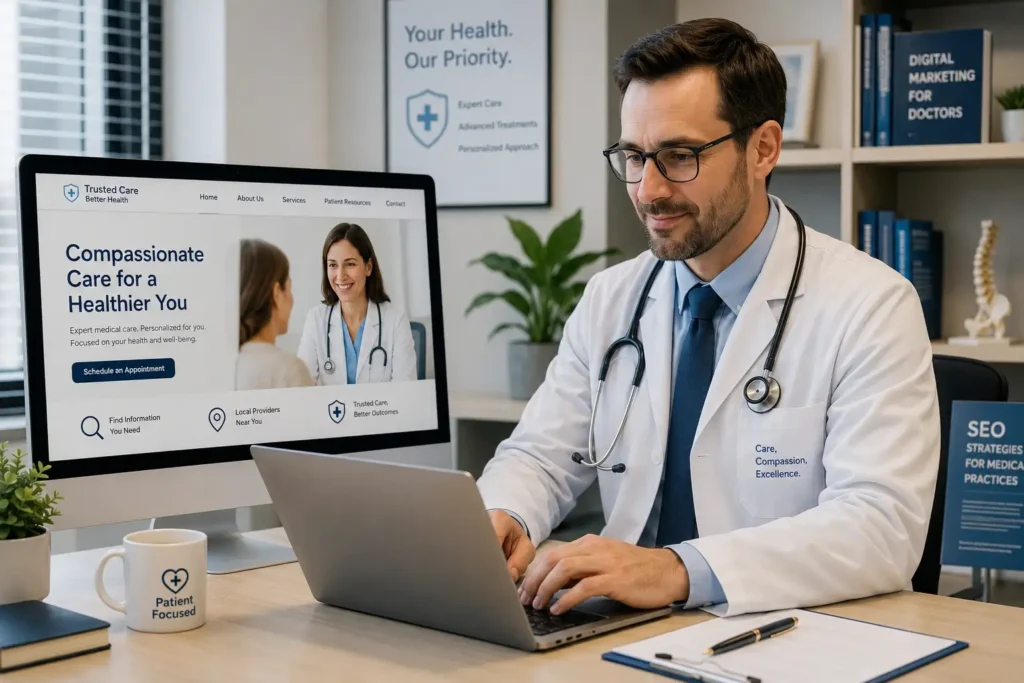
Before a patient ever calls a clinic, they search. They type a symptom into Google Search, check Google Maps for a doctor “near me,” compare reviews, and look at a practice’s website before deciding whether to book. This shift in patient behavior means a medical practice’s digital presence now carries as much weight as its reputation in the community.
The healthcare industry has also become more competitive online. Hospitals, specialty practices, and multi-location clinics are all investing in content and local visibility, which makes it harder for a single-location practice to be found through traditional marketing alone, including print ads, referrals, and signage simply don’t reach patients at the moment they’re actively searching.
This is where medical SEO comes in. Search engine optimization helps a medical practice appear in front of patients exactly when they’re looking for care, building organic traffic that compounds over time rather than disappearing the moment an ad budget runs out.
SEO for doctors refers to optimizing a physician or clinic’s website, Google Business Profile, and content so it ranks for relevant searches, think “pediatric dermatologist near me” or “what causes lower back pain.” Medical SEO combines local SEO, technical SEO, and content strategy tailored to a healthcare provider’s specialty and service area.
A patient searching “urgent care open now” or “best orthopedic surgeon in [city]” is demonstrating clear intent to book care soon. Doctor website SEO ensures the practice’s site, not just a directory listing, shows up at that moment.
Patient behavior has changed permanently. Most patients now research a provider online before ever calling the office, comparing credentials, reviews, and services. A few realities driving why doctors need SEO:
The patient journey typically follows a predictable path:
Each stage is an opportunity SEO can strengthen, from ranking for the right medical keywords to making the appointment booking process frictionless. Weak visibility or a confusing website loses patients at any one of these steps, regardless of how skilled the physician is.
Patients rarely rely on one channel. Common discovery paths include:
A practice that only appears in one of these channels is invisible in the others. A comprehensive online presence for doctors spans the website, Google Business Profile, and third-party directories consistently.
Local SEO for doctors is often the single highest-impact strategy, since most healthcare searches have local intent. Core components:
Because healthcare is a YMYL (Your Money or Your Life) topic, Google holds medical content to a high bar. Demonstrating Google E-E-A-T (Experience, Expertise, Authoritativeness, and Trustworthiness) matters more here than almost any other industry.
Practical ways to build E-E-A-T on a medical website:
On-page SEO starts with keyword research for doctors, identifying the health-related keywords and long-tail keywords patients actually use, then reflecting search intent in meta titles, meta descriptions, and internal linking between service and content pages.
Technical SEO covers the foundation: website security, structured data, and medical schema markup that helps Google and AI systems understand physician credentials, services, and locations. Reviewing Google Search Console and Google Analytics regularly helps a practice catch indexing or performance issues early.
Medical content marketing, such as patient education content, condition explainers, and treatment overviews, builds topical authority while genuinely helping patients. Healthcare content strategy should prioritize accuracy and clarity over keyword density.
Reputation management runs in parallel. Online reputation management through prompt, professional responses to patient reviews reinforces trust signals for both patients and search engines. Healthcare reputation management is not optional, it’s one of the clearest trust signals a practice controls directly.
Patients increasingly get answers from AI Overviews, ChatGPT, Gemini, Perplexity, and similar tools, not just traditional search results. Optimizing for AI citation means writing clear, well-structured, factually accurate content with strong medical schema, the same fundamentals that support traditional rankings also help a practice get cited in AI-generated answers.
Strategy shifts slightly by specialty:
Factor |
Traditional Marketing |
Medical SEO |
|---|---|---|
Cost structure
|
Ongoing spend per campaign
|
Upfront investment, compounding value
|
Long-term value
|
Stops when spend stops
|
Continues driving organic traffic
|
Patient targeting
|
Broad, less precise
|
Matches specific search intent
|
Measurement
|
Limited attribution
|
Trackable via Google Analytics/Search Console
|
Factor |
SEO |
Google Ads |
|---|---|---|
Time to results
|
Weeks to months
|
Immediate
|
Sustainability
|
Long-term, compounding
|
Stops when budget stops
|
Lead quality
|
Often high-intent, trust-driven
|
Variable, click-driven
|
Scalability
|
Grows with content and authority
|
Grows with budget
|
Many practices use both together, ads for immediate visibility while SEO builds sustainable, long-term rankings.
Look for a healthcare SEO company with:
At Sir Marketer, we work with doctors, clinics, and healthcare providers on SEO strategy development, local SEO, medical content creation, technical SEO audits, and Google Business Profile optimization, all built around sustainable growth rather than short-term tricks. We don’t promise guaranteed rankings or a fixed number of new patients, because results depend on competition, existing site quality, and consistent execution. What we do offer is a structured, transparent approach to healthcare SEO, reputation management, and analytics reporting so practices can track real progress over time.
Voice search, AI-powered search results, and evolving patient behavior are reshaping how care is discovered. What isn’t changing is the underlying requirement: authoritative, accurate, patient-first content earns visibility, in traditional search and in AI-generated answers alike.
Healthcare SEO isn’t a single tactic, it’s the combination of local SEO, technical SEO, E-E-A-T-driven content, and reputation management working together over time. Practices that invest in sustainable SEO, rather than short-term tricks, build lasting visibility and patient trust. If you’re ready to strengthen your practice’s online presence, a healthcare SEO audit is a practical first step toward sustainable growth.
It's the practice of optimizing a medical website and online presence to rank higher for health-related searches and attract patients organically.
Because most patients research providers online before booking, and strong visibility builds trust and drives consistent patient inquiries.
Timelines vary by competition and starting point; most practices see gradual improvement over several months rather than instantly.
It's optimizing a Google Business Profile, citations, and location-based content so a practice ranks in local and "near me" searches.
Costs vary widely by agency, market, and scope, there's no universal figure, and any guaranteed pricing claim should be treated with caution.
Yes, over time. Though results depend on factors like competition, website quality, and consistency of effort.
It manages keyword research, technical SEO, content creation, local SEO, and reporting on behalf of a practice.
Yes, it's often the first thing patients see and a major factor in local search visibility.
Structured data that helps search engines understand a physician's credentials, specialty, and location.
Yes, AI Overviews and tools like ChatGPT and Gemini increasingly surface healthcare answers, making clear, well-sourced content more important than ever.
Our team will answer all your questions, We ensure a quick response.