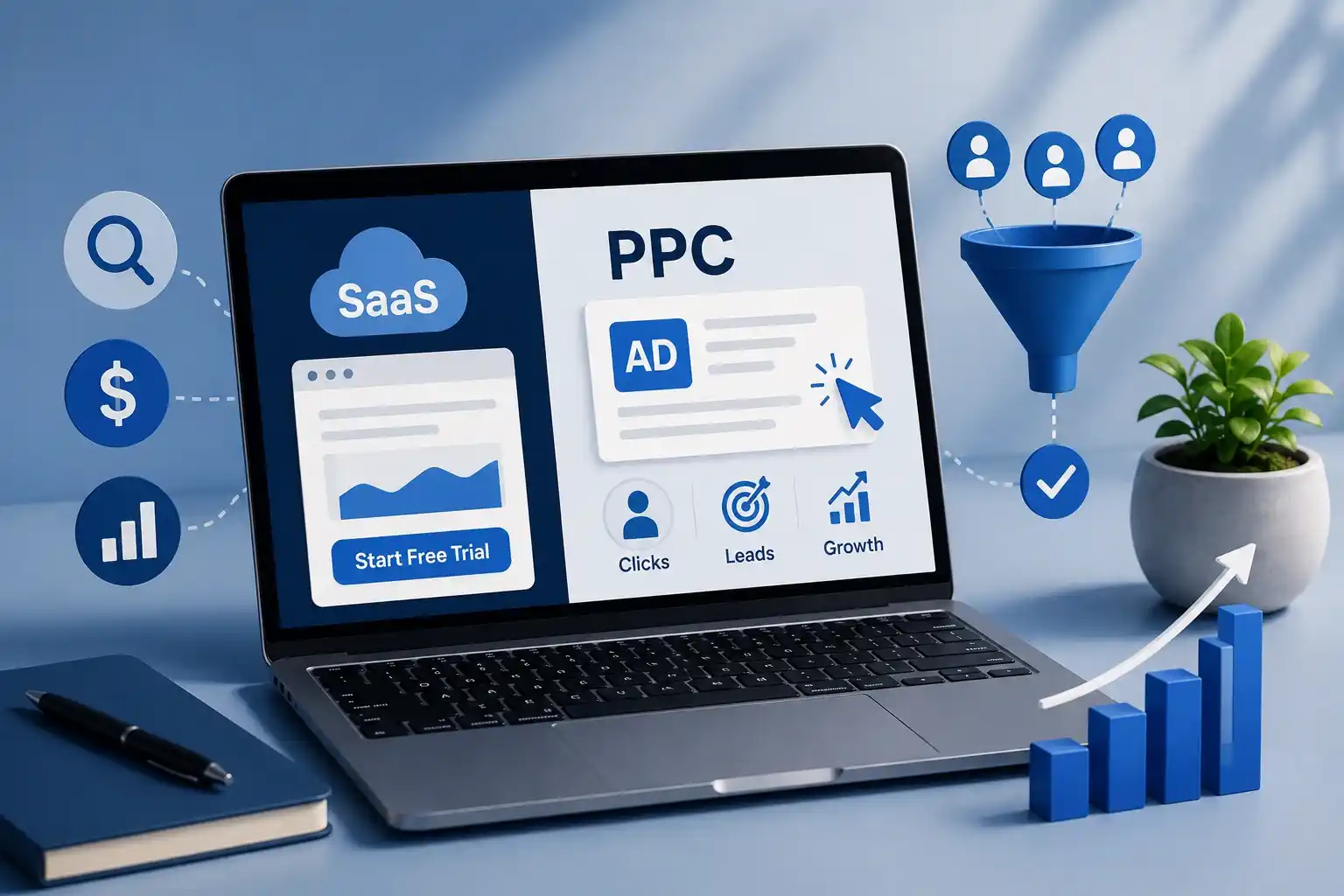
Running paid ads for a SaaS company is different from ecommerce or local advertising. Instead of optimizing for a single purchase, SaaS PPC focuses on trials, demos, qualified leads, conversions, and recurring revenue.
A campaign can generate cheap leads but still fail if those leads don’t activate or become paying customers. That’s why SaaS PPC requires a full-funnel approach from the first click to customer acquisition and revenue.
This guide covers everything you need to know about SaaS PPC:
SaaS PPC is paid advertising built around the goals of a subscription software business: trial signups, demo requests, qualified leads, and ultimately paid customers and recurring revenue is not one-time purchases.
It spans several channels:
What separates SaaS PPC from traditional paid media is the connection it has to draw between ad spend and business outcomes further down the funnel pipeline, activation, and revenue, rather than stopping at the click or the form fill.
A typical SaaS PPC funnel looks like this:
Awareness → Research → Consideration → Free Trial or Demo → Sales Qualification → Customer → Expansion
Different keywords serve different stages:
Campaigns should map to intent, not just volume. A high-volume informational keyword rarely converts as well as a lower-volume bottom-of-funnel search, even though it looks more attractive in a keyword research tool.
Factor |
Traditional PPC |
SaaS PPC |
|---|---|---|
Conversion goal
|
Purchase
|
Trial, demo, or qualified lead
|
Sales cycle
|
Often immediate
|
Days to months
|
Revenue model
|
One-time
|
Recurring (MRR/ARR)
|
Attribution window
|
Short
|
Extended, often multi-touch
|
Key metric
|
ROAS on the sale
|
CAC vs. LTV, payback period
|
Tracking needs
|
Purchase event
|
Trial, activation, pipeline, closed revenue
|
Because revenue can materialize long after the click, SaaS PPC generally needs deeper conversion tracking and CRM integration to see whether a campaign is actually profitable, not just whether it produced leads.
It depends. PPC tends to work well when there’s existing search demand, a competitive but not saturated keyword landscape, a strong landing page, and a conversion-worthy offer. It struggles when the category has little search volume, when competitors are bidding aggressively on the same terms, or when the funnel behind the ad (landing page, follow-up, sales process) is weak.
No platform or tactic guarantees results, performance depends on the product, audience, average contract value, LTV, sales cycle, and execution quality.
Prioritize keyword categories by buying stage:
Use exact and phrase match for high-intent terms to control relevance, and build a negative keyword list early to filter out unqualified traffic: job seekers, free-tool searchers, and irrelevant industries are common budget drains in SaaS PPC.
A relevant ad means little if the landing page doesn’t follow through. A strong SaaS PPC landing page should:
A low CPC or cheap lead volume isn’t automatically good news, it can just as easily signal poor lead quality. There are no universal “good” CAC or ROAS benchmarks that apply across every SaaS business; the right number depends on ACV, LTV, and sales cycle.
Basic formulas:
CPA = ad spend ÷ conversions
CAC = total acquisition cost ÷ new customers
ROAS = revenue ÷ ad spend
LTV:CAC = customer lifetime value ÷ CAC
The complication in SaaS PPC is timing, a click today might not become revenue for months. First-touch and last-touch attribution each tell an incomplete story; multi-touch attribution, tied to CRM and pipeline data, gives a more accurate picture of which campaigns actually drive revenue rather than just leads.
SaaS PPC costs vary with keyword competition, industry, ACV, geographic targeting, and campaign complexity, there’s no fixed market rate worth quoting as fact. Separately from ad spend, budget for SaaS PPC management (in-house or agency) and landing page work.
To reduce costs without hurting growth: tighten negative keywords, filter by search intent, improve Quality Score through landing page relevance, and shift budget toward what’s actually converting downstream, not just what’s cheapest per click. Improving conversion quality is often more valuable than chasing a lower CPC.
A SaaS PPC agency can be worth it when internal bandwidth, attribution tooling, or SaaS-specific experience is limited. Before hiring one, ask:
Sir Marketer’s PPC and SaaS marketing services are built around these questions, tracking pipeline and revenue impact, not just click volume.
SaaS PPC demands a different lens than traditional paid search, the goal isn’t the click or even the lead, it’s a paying customer whose lifetime value justifies what it cost to acquire them. That means mapping keywords to real search intent, building campaigns around a clear ICP, and tracking CAC, LTV, and pipeline all the way to revenue, then optimizing continuously as that data comes in.
If you’re evaluating how PPC fits into your SaaS growth strategy, Sir Marketer works with SaaS companies on PPC strategy, campaign management, and conversion-focused landing pages, happy to talk through what your funnel and numbers actually need
Paid advertising designed around SaaS acquisition goals, including trials, demos, and qualified leads, rather than one-time purchases.
It can be, depending on search demand, competition, landing page quality, and offer strength, results aren't guaranteed.
It varies by keyword competition, market, and ACV; there's no universal figure
Google Ads typically leads for high-intent capture; LinkedIn Ads is strong for B2B targeting; Microsoft and Meta play supporting roles.
Often useful for capturing comparison shoppers, but check trademark policies and relevance first.
Compare ad spend to CAC, LTV, and ideally closed revenue via CRM-integrated tracking, not just leads generated.
Our team will answer all your questions, We ensure a quick response.