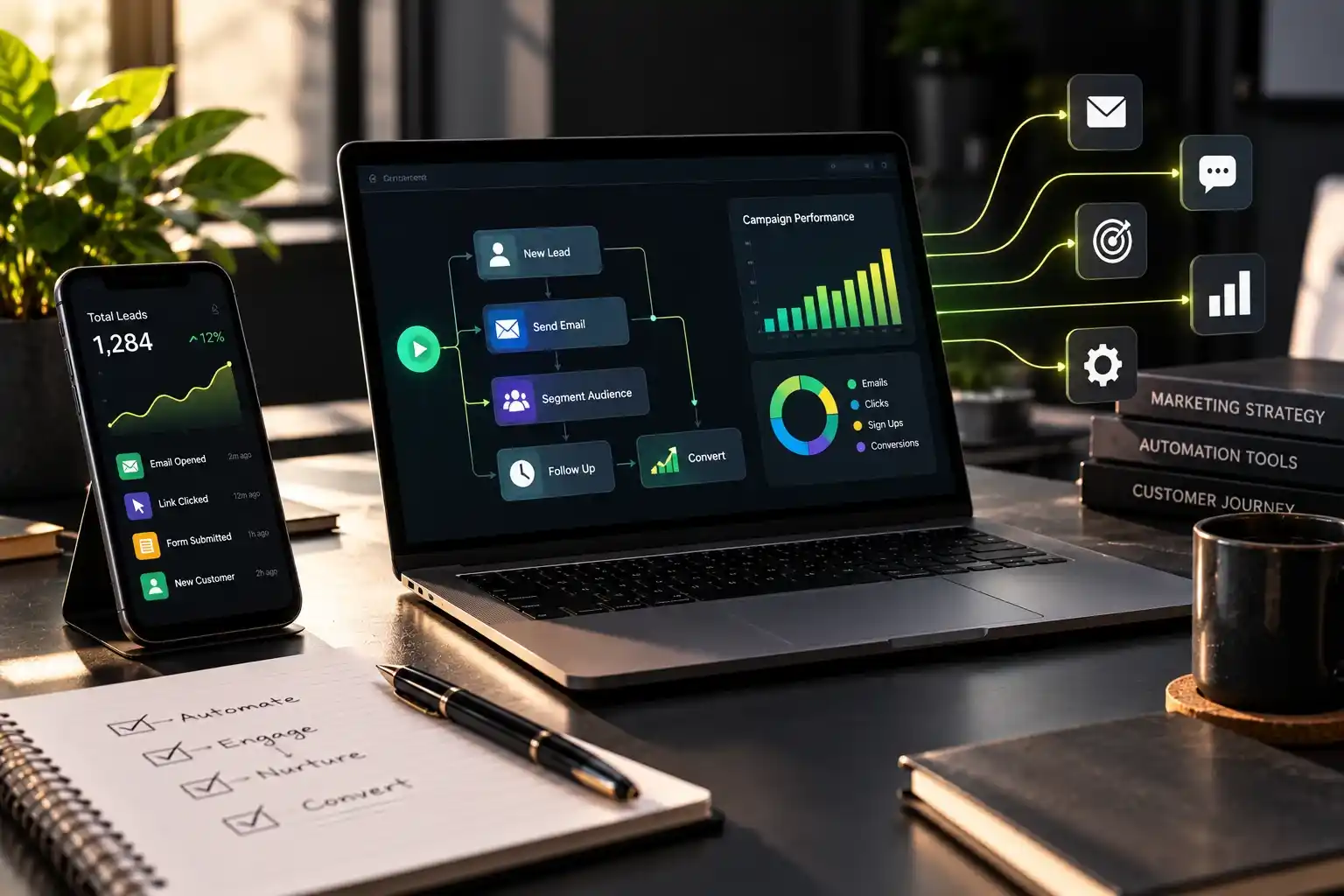
Digital marketing automation uses software to run repetitive marketing tasks, such as emails, lead follow-ups, segmentation, and reporting, based on triggers and customer behavior. Businesses use it to send timely, personalized messages at scale and move leads through the customer journey while people stay in charge of strategy and judgment.
Marketing automation is the use of software to execute marketing actions automatically when a defined event occurs, using customer data to decide who receives what.
Its core components are:
A simple flow looks like this:
Trigger (visitor downloads a guide) → Condition (matches a target segment) → Action (welcome email) → Follow-up (next email if the first is opened) → Measurement (clicks, replies, conversions)
How marketing automation works comes down to a repeatable marketing automation process:
Example: A visitor downloads a guide, enters the CRM, and gets a welcome email. Engagement tracking records a pricing page visit, the lead score rises, and a follow-up email goes out. The lead is then routed to sales, and the outcome is measured.
Area |
Traditional Digital Marketing |
Digital Marketing Automation |
|---|---|---|
Lead follow-up
|
Manual, depends on staff availability
|
Automated follow-ups on defined triggers
|
Segmentation
|
Occasional list pulls
|
Dynamic, data-based segments
|
Email
|
One-off sends
|
Triggered and sequenced emails
|
Lead nurturing
|
Ad hoc
|
Staged, behavior-based
|
Campaign management
|
Manual scheduling
|
Rules-based orchestration
|
Personalization
|
Basic (name, company)
|
Based on behavior and history
|
Reporting
|
Compiled manually
|
Dashboards and automated reports
|
Repetitive tasks
|
Done by hand
|
Handled by workflows
|
Customer lifecycle
|
Hard to cover consistently
|
Mapped to lifecycle stages
|
Scalability
|
Limited by team size
|
Scales with consistent rules
|
Automation does not replace human-led marketing. Strategy, creative, and relationship-building still need people. Automation executes that thinking consistently.
The main marketing automation benefits are practical:
Small businesses often gain the most, since limited staff can cover follow-ups, reminders, and reporting that would otherwise be missed. Results depend on strategy, data quality, and execution, and automation does not guarantee more sales.
These digital marketing automation examples show the pattern from trigger to outcome. They are illustrative scenarios, not case studies.
Business Type |
Trigger |
Automation |
Customer Action |
Business Outcome |
|---|---|---|---|---|
B2B company
|
Whitepaper download
|
Nurture sequence, lead scoring
|
Visits pricing page
|
Qualified lead sent to sales
|
B2C brand
|
Newsletter signup
|
Welcome series
|
Clicks an offer
|
Early engagement
|
Ecommerce store
|
Cart abandoned
|
Reminder email
|
Returns to checkout
|
Recovered sale
|
SaaS company
|
Free trial starts
|
Onboarding emails
|
Uses key feature
|
Higher trial-to-paid potential
|
Local service
|
Quote request
|
Instant confirmation, reminder
|
Books a call
|
Faster response
|
Professional services
|
Consultation inquiry
|
CRM task, intake email
|
Completes intake
|
Organized sales pipeline
|
These terms overlap, but they are not identical:
When comparing marketing automation tools, look at the workflow builder, automation rules, CRM integration, API integration, and other third-party integrations, audience segmentation, lead scoring, and campaign analytics. Platforms differ widely in features and pricing, so confirm current details on each vendor’s official site. No single option fits every business.
A sound digital marketing automation strategy starts with the business, not the software.
Marketing automation works best when the right tools, workflows, and strategies align with your business goals. Sir Marketer LLC helps businesses simplify repetitive marketing tasks, improve customer communication, and build more efficient marketing processes.
Our services can support businesses with:
Whether you’re a small business starting with basic automation or an established company refining existing workflows, Sir Marketer can help you take a practical, goal-oriented approach. Start with one measurable objective, evaluate the results, and expand as your business grows.
Digital marketing automation for small businesses works best when it is focused. Prioritize these first:
Do not automate everything at once. Add one workflow, check that it works, then expand.
E-commerce marketing automation turns purchase behavior and browsing activity into relevant messages. Common workflows include abandoned cart automation, product recommendations, purchase follow-ups, upselling, cross-selling, and loyalty campaigns. Remarketing automation and retargeting automation bring back visitors who left without buying, using ad audiences built from user behavior.
Keep messages helpful rather than repetitive, and limit frequency.
Email automation is often the first workflow businesses build. Email marketing automation covers triggered emails and automated email campaigns, including:
Timing, segmentation, relevance, and frequency decide whether these feel helpful or intrusive.
Customer relationship management (CRM) software stores contacts, interactions, and deal stages. CRM automation updates records, assigns tasks, and moves leads through the pipeline. With CRM integration, marketing platforms read the same customer data, so messages reflect real customer interactions. Capabilities vary by CRM, so verify what yours supports.
AI marketing is changing how teams work. Established uses include predictive analytics for lead scoring, machine learning for send-time and audience analysis, and generative AI for drafting content. AI personalization and AI-powered marketing automation are growing, though results depend on data quality.
Emerging possibilities, such as highly autonomous campaign optimization, should be tested carefully. AI supports marketers rather than replacing them. Review its output, especially customer-facing content.
Reliable marketing automation best practices include:
For marketing automation implementation, audit current processes, pick technology, connect your CRM, define segments, build and test workflows, launch gradually, then optimize. Integrated technology depends on data synchronization between systems.
Marketing Automation Implementation Checklist
Professional marketing automation services can help when you have a complex CRM, multiple channels, high lead volume, poorly connected systems, or no internal technical expertise.
Sir Marketer is a digital marketing agency that supports strategy, workflow design, CRM integration, campaign management, analytics, and ongoing optimization. We make no guarantees about specific results, because outcomes depend on your market, data, and offer.
Digital marketing automation works best as a connected system: data feeds segmentation, which drives triggers and workflows, which support engagement, conversion, and retention, with analytics closing the loop. Strategy matters more than the software you buy, and the customer experience should stay central.
Start with one measurable use case. If your current processes feel complicated, a short review with an experienced partner such as Sir Marketer can help you decide where to begin.
It is software that carries out marketing tasks automatically based on triggers, rules, and customer data, such as sending emails or updating CRM records.
It applies automation to online channels like email, SMS, social media, and web campaigns to deliver timely, relevant communication at scale.
It collects customer data, applies segments and triggers, runs workflows, and measures results so teams can refine them.
Emails, lead scoring, follow-ups, CRM updates, social scheduling, abandoned cart messages, onboarding, and reporting.
A CRM manages contact and sales data. Marketing automation uses that data to run campaigns and workflows. Many businesses use both together.
Yes, when started simply. Basic follow-ups and email sequences can save time without a large budget.
Our team will answer all your questions, We ensure a quick response.