Small business reputation management is the ongoing practice of monitoring, influencing, and responding to what customers say about your business online. It combines review generation, review responses, brand monitoring, and customer experience improvements to build trust, strengthen local search visibility, and turn satisfied customers into your most persuasive marketing asset.
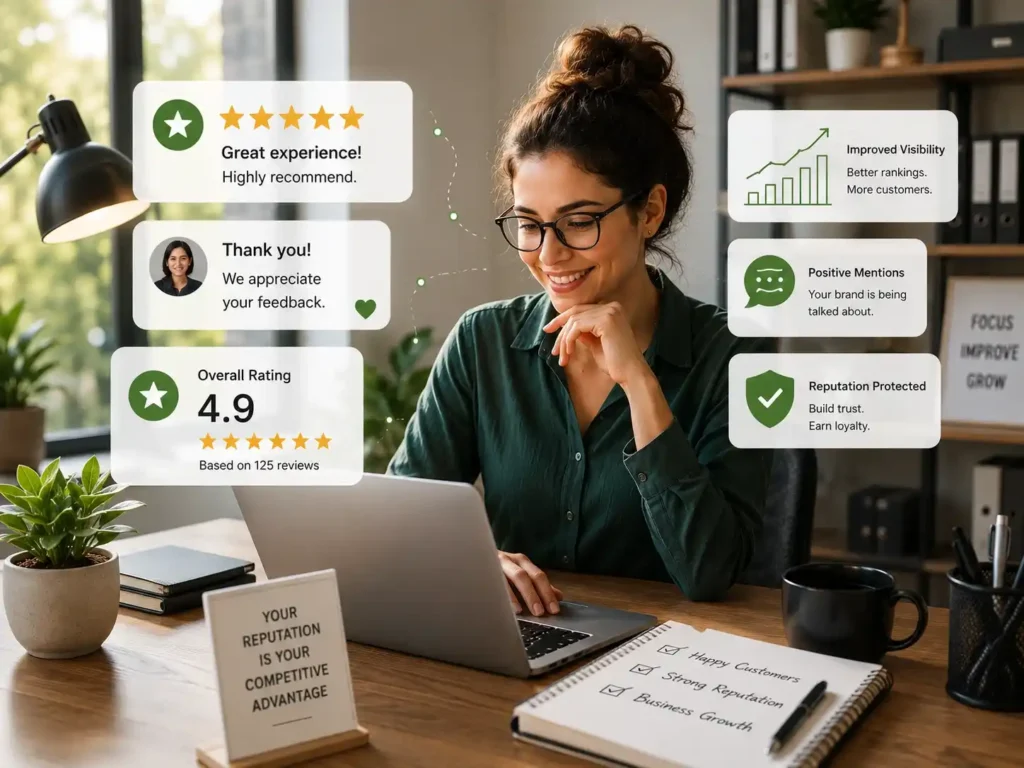
Your business’s online reputation is often the first impression a potential customer forms, long before they ever call, visit, or make a purchase. Today, most people research a business online first, reading customer reviews, checking star ratings, and scanning Google Business Profile listings before deciding who to trust.
That’s why small business reputation management has become a core part of running a successful company rather than an optional extra. Online reviews shape buying decisions, and businesses with consistent, positive reviews tend to earn more clicks, calls, and foot traffic than competitors with a thin or inconsistent review profile. Reputation and visibility are also connected: businesses with more recent, relevant reviews tend to stand out more in local search results and on Google Maps.
Online reputation management (ORM) for small businesses is the process of shaping how your company is perceived across the internet, on Google, social media platforms, review sites, and search engine results pages. It covers both online and offline reputation, since real-world customer experience is what generates the reviews, testimonials, and word-of-mouth that live online.
At its core, business reputation management involves:
Your digital footprint, everything Google and customers find when they search your business online, directly affects business credibility. A business with strong brand trust, consistent five-star reviews, and a well-optimized Google Business Profile has a real revenue advantage over one that ignores its online presence.
Consumer behavior has shifted dramatically toward researching businesses online before ever making contact. According to BrightLocal’s Local Consumer Review Survey, the vast majority of consumers now read online reviews before visiting a local business, and a growing share say they check reviews every time they search for one.
This shift matters because of a few converging trends:
Key takeaway: Consumer confidence is built (or lost) online before a customer ever picks up the phone. A positive online reputation is now a business growth lever, not a vanity metric.
Google has not confirmed that individual reviews are a direct ranking factor, but review signals clearly correlate with local search performance. According to Google’s own Business Profile guidance, high-quality, relevant reviews from customers can help your business stand out and can influence how prominently you appear on Google Maps and in local search results.
Reviews influence local SEO indirectly through:
Factor |
How It Helps |
|---|---|
Review volume & recency
|
Signals an active, trustworthy business
|
Star ratings
|
Improves click-through rates in search results
|
Review responses
|
Shows engagement and customer communication
|
NAP consistency
|
Keeps business listings accurate across directories
|
Keyword-rich reviews
|
Reinforces topical relevance for local search
|
An optimized Google Business Profile, combined with consistent local citations and business listings, strengthens local search rankings and search engine visibility over time.
Effective reputation management strategies rest on five pillars:
Customer Experience → Review Request → Review Posted → Monitoring → Response → Reputation Analytics
Each stage feeds the next. Weak customer experience produces negative reviews; strong customer experience, paired with consistent review requests, produces the social proof that fuels business growth.
Positive reviews build consumer confidence and shorten the buying decision. A five-star review from a real customer often carries more weight with potential customers than any ad. Negative reviews, left unanswered, can quietly erode business credibility, but a thoughtful response can rebuild customer trust just as effectively.
Fake reviews, on the other hand, create real risk. Review platforms like Google and Yelp actively remove reviews that violate their policies, and businesses caught buying fake reviews risk penalties and lasting reputational damage. Authenticity, not review volume alone, is what separates a trustworthy business from one that merely looks good online.
Example: A local HVAC company that responds professionally to a bad review about a delayed appointment, offers a resolution, and follows up often earns more credibility than a competitor with zero negative reviews and no visible customer engagement.
Building a strong online reputation starts offline. Deliver excellent service consistently, then make it easy for satisfied customers to leave a review. Maintain transparency about how you handle complaint resolution, and use customer testimonials on your website to reinforce social proof. Reliability, authenticity, and clear communication compound over time into genuine online credibility.
A calm, professional review response strategy can turn a negative review into proof of excellent customer service.
Step-by-step framework:
Example response: “Thank you for sharing this feedback. We’re sorry your visit didn’t meet expectations, please reach out at [contact] so we can make this right.”
Common mistakes: arguing publicly, ignoring the review, offering generic copy-paste replies, or deleting legitimate criticism instead of addressing it.
Tool |
Best For |
Pricing |
|---|---|---|
Free listing management & reviews
|
Free
| |
Basic brand mention monitoring
|
Free
| |
Local SEO + review tracking
|
Paid, tiered plans
| |
All-in-one review management software
|
Paid, custom quote
| |
Review requests via text messaging
|
Paid, tiered plans
| |
Multi-platform review monitoring
|
Paid, custom quote
| |
Listings management across platforms
|
Paid, tiered plans
|
Pricing changes frequently, always confirm current rates directly with each provider before choosing reputation management software.
Factor |
DIY |
Agency |
|---|---|---|
Cost
|
Lower upfront, higher time cost
|
Predictable monthly investment
|
Time
|
Significant owner time required
|
Frees up owner's time
|
Expertise
|
Learning curve
|
Established review response strategy
|
Tools
|
Often free/basic
|
Professional-grade software
|
Scalability
|
Harder as review volume grows
|
Built to scale
|
Reporting
|
Manual tracking
|
Structured reputation analytics
|
Professional reputation management services help small businesses through consistent review monitoring, faster review response times, and reputation repair when a crisis hits. Agencies also bring local SEO expertise that connects reputation work directly to search engine visibility, along with sentiment analysis and reporting that most owners don’t have time to build themselves. This isn’t about guaranteed results, it’s about experienced support that makes reputation management more consistent and sustainable.
Sir Marketer LLC works with local businesses that want a more structured, ethical approach to managing their reputation online. Rather than chasing shortcuts, the focus is on sustainable review generation, transparent reporting, and long-term brand reputation management.
Services include:
The goal is straightforward: help small businesses look good online, build customer trust, and turn satisfied customers into their strongest source of new business, without gimmicks or unrealistic promises.
A strong online reputation doesn’t happen by accident. It’s built through consistent review generation, thoughtful review responses, and genuine attention to customer experience, all reinforced by accurate business listings and active reputation monitoring. Businesses that build this discipline into their routine consistently outperform those that treat reputation as an afterthought.
If you’re ready to take a more proactive approach, Sir Marketer offers a free reputation audit covering your Google Business Profile, review strategy, and local search visibility, with practical, honest recommendations for improving what customers see when they search your business name.
It's the ongoing process of monitoring, generating, and responding to customer reviews and brand mentions to build trust and visibility online.
They're often the first thing potential customers see and strongly influence purchase decisions and click-through rates.
Only if they violate a platform's policies (fake reviews, hate speech, spam). Legitimate negative reviews generally can't be removed, they should be addressed instead.
Weekly at minimum; daily is ideal for businesses with high review volume.
Indirectly, yes, review signals influence click-through rates and local search visibility, though reviews aren't a confirmed direct ranking factor.
Google Business Profile, Google Alerts, BrightLocal, Birdeye, Podium, and ReviewTrackers are commonly used, depending on business size and budget.
There's no fixed number, but consistent, recent reviews matter more than a one-time burst.
ORM stands for online reputation management, the practice of shaping how a business is perceived online.
Yes, beyond ethical concerns, platforms can penalize businesses that use fake reviews, damaging long-term credibility.
Both matter, quality (recent, detailed, positive) reviews build more trust than a large number of vague ones.

Our team will answer all your questions, We ensure a quick response.