Gemini 4 Hydrogen in Google Search: What Query Fan-Out Means for Small Business SEO (November 2026)
Quick answer: On 12 November 2026 Google made Gemini 4 Hydrogen the default model in AI Mode and started using it for the hardest AI Overview questions. It splits complex questions into more sub-searches and links to more sites. Small businesses should answer every part of a customer’s question on clear, indexable pages and track the change in Search Console.
What Google changed on 12 November
On 12 November 2026 Google rolled out Gemini 4 Hydrogen to Google Search for all users worldwide and called it “the biggest model upgrade to Search yet” (Google, 12 November 2026). Robby Stein, VP of Product for Google Search, said on X that Hydrogen is the default model in AI Mode and is also “being used for your hardest questions in AI Overviews” (Search Engine Journal, 12 November 2026).
Google lists four improvements in Search (Google):
- Better understanding of intent. Search handles questions with several parts, hard-to-read typos and very specific requests, and tries to answer each part.
- Improved query fan-out and linking. Search runs simultaneous queries across the subtopics of a question and links to “a broader range of helpful links than before”, including sites people might not have found themselves.
- More visual responses. More images, structured responses, comparison tables and custom tools in answers.
- Richer language understanding across every language AI Mode supports.
Hydrogen is the fast, efficient model in the Gemini 4 family. Google positions Gemini 4 Carbon and Argon for longer, deeper reasoning (Google, Introducing Gemini 4 Hydrogen), and Search Engine Journal notes that those two were earlier added to AI Mode only as options for paid Google AI Pro and Ultra subscribers (Search Engine Journal). Hydrogen is the one every searcher now gets by default.
The timing matters. The switch came two days into the November 2026 core update, which Google started on 10 November and said could take up to two weeks (Google Search Status Dashboard). Any ranking or AI visibility change you see this month may come from either one.
What query fan-out is, in plain English
Google’s own documentation says AI Overviews and AI Mode may use a “query fan-out” technique: “issuing multiple related searches across subtopics and data sources” to build a response, then showing a wider and more diverse set of supporting links than a classic web search (Google Search Central). Hydrogen makes that step smarter and more thorough (Google).
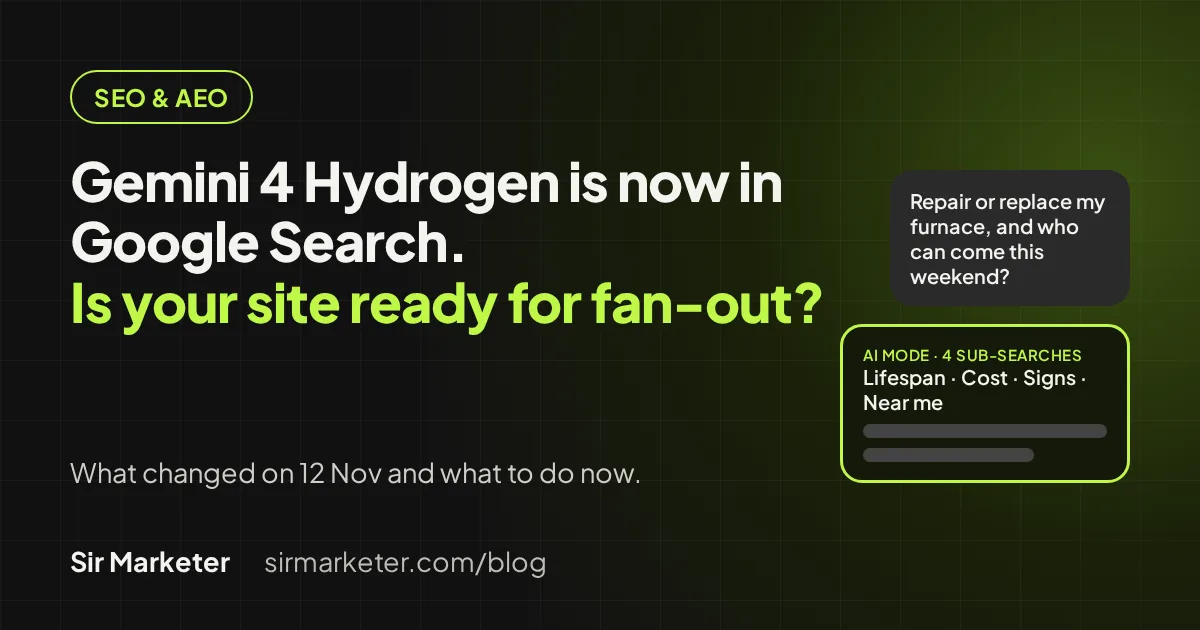
Here is an illustrative example of how a real customer question might be split. Someone types: “Is it worth fixing a 12-year-old furnace or replacing it, and who near me can come out this weekend?” To answer, Search may look up separate sub-questions such as:
- average lifespan of a gas furnace
- repair vs replace cost for an older furnace
- signs a furnace needs replacing
- HVAC companies nearby with weekend or emergency service
Each sub-search can surface a different page. A national guide may answer the lifespan question, while a local HVAC company that clearly states “weekend call-outs in [your town]” on its service page is the kind of page that fits the last one. Google doesn’t publish exactly which sub-queries it runs, so treat this as a way of thinking, not a formula.
What it means for small businesses
Multi-part questions reward pages that answer every part
Customers rarely ask one thing. They ask about price, timing, location, trust and the next step in the same breath, and Hydrogen is built to keep all of those parts (TechCrunch). A service page that only says “we do furnace repair” covers one part. A page that also explains when repair stops making sense, which areas you cover, your hours and how to book covers four.
“More links” is an opening, not a promise
Google says the upgrade connects people with sites they might not have discovered before (Google). That is the best news here for smaller sites. But neither Google’s post nor Stein’s thread gives any figures for how many more links or sites appear (Search Engine Journal), and it is too early to know how it will affect organic clicks. Plan for the opportunity; don’t bank on a traffic jump.
Answers get more visual
Google says responses now include more comparison tables and structured layouts (Google). Information you already present in a clean, scannable way, such as a price range table, a list of service areas or a step-by-step process, is easier to read for people and for any system that builds those summaries.
Local results keep changing too
In a separate test seen the same week, Google showed an AI Overview version of the local pack without the call, directions and website buttons, reviews or photos, and on mobile the traditional local pack was missing when it appeared (Search Engine Roundtable, 10 November 2026). It is a test, but it is a reminder that your own website and Business Profile details have to carry your message wherever Google shows them.
What Google says you do not need to do
Before anyone sells you a “Hydrogen optimization” package, read Google’s own guidance. Google says the best practices for SEO remain relevant for AI features and that there are no additional requirements or special optimizations needed to appear in AI Overviews or AI Mode (Google Search Central). To be eligible as a supporting link, a page must be indexed and eligible to show in Search with a snippet (Google Search Central).
Google also says you don’t need new machine-readable files, AI text files or special schema.org markup for these features (Google Search Central). Structured data is still useful for regular rich results, but Google asks that it match the visible text on the page.
What Google does list is practical: allow crawling in robots.txt and in your CDN or hosting, link important pages internally, keep a good page experience, put important content in text, support it with good images and video, and keep your Merchant Center and Business Profile information up to date (Google Search Central).
Map your customers’ questions to your pages
The simplest way to prepare for fan-out is to list the questions customers really ask you on the phone and check which page answers each part. Here is a starting template.
| Part of the question | What the customer wants to know | Where to answer it |
|---|---|---|
| Cost | A realistic range and what changes it | Service page, with a short “what affects the price” section |
| Location | Do you serve my suburb, town or postcode? | Service area section and Business Profile |
| Timing | How soon, evenings, weekends, emergencies | Service page, hours on the site and on Google |
| Comparison | Repair vs replace, option A vs option B | A comparison table or a short guide linked from the service page |
| Trust | Licences, guarantees, reviews, who does the work | About page and service page |
| Next step | How to book or get a quote now | Clear call, message and booking options on every page |
If a row has no good answer anywhere on your site, that is your next page or section to write. Write it in your own words, from your own experience, for the places you actually serve in the US, Canada, the UK, Australia or Singapore.
How to measure the change without fooling yourself
Use the Generative AI performance report
Search Console’s Generative AI performance report shows how often links to your site were shown in AI Overviews and AI Mode, and lets you group impressions by page, country, date and device. Google says it rolled out to all websites worldwide as of 31 August 2026 (Search Console Help). It reports impressions, and the help page doesn’t describe click, query or position data, or a split between AI Overviews and AI Mode.
Mark three dates
- 9 to 11 November: Google confirmed a logging error that lowered impressions in this report. It affects data logging only, not your real visibility (Search Engine Land).
- 10 November: the November 2026 core update began (Google Search Status Dashboard).
- 12 November: Hydrogen became the AI Mode default (Search Engine Journal).
Compare a clean week before 9 November with a full week after the core update finishes. Search Engine Journal suggests logging the core update and the Hydrogen switch separately so you don’t read the month as one change (Search Engine Journal).
Check your analytics, too
On 12 November Google published a new guide to identifying Google Search traffic in analytics and server logs. Visits from Google Search carry a Referer of https://www.google.com/ or a local Google domain, plus an Android app value, and the header never includes the search query (Google Search Central). The guide lists no separate value for AI Mode, so expect AI Mode visits to appear as ordinary Google organic traffic. It also explains why analytics will never match Search Console exactly, from privacy settings to redirects (Google Search Central).
Checklist: what to do this week
- Write down the 10 questions customers ask most, including the multi-part ones.
- Check each service page answers cost, location, timing, comparison, trust and next step.
- Add a clear comparison or price-factor table where customers weigh options.
- Make sure key pages are indexed and can show a snippet: use the URL Inspection tool in Search Console.
- Confirm robots.txt and your host or CDN don’t block Googlebot.
- Check that your structured data matches what the page actually says.
- Update your Google Business Profile hours, services and links for Thanksgiving, Black Friday and the holidays.
- Note 9–11, 10 and 12 November in your reports, and wait for the core update to finish before judging results.
Want a quick read on how answer-ready your pages are? Try our free answer engine tools, and see our AEO 101 guide and AI Overviews guide for the bigger picture.
Turn better AI answers into enquiries
Being cited is only half the job. When someone clicks through from AI Mode or calls from your profile, the page and the phone have to do the rest.
- Pages that answer every part. Our small business SEO service covers service pages, local SEO and answer engine optimization. We also wrote about how ads now show in AI Mode if you run Google Ads.
- A site that converts. If your website is slow or thin, we can build a free live website preview so you can see the improved version before you pay anything.
- Answer every call and message. An AI receptionist picks up around the clock, so a customer who found you through AI search doesn’t hit voicemail.
Not sure your pages are ready for AI search? Sir Marketer helps small businesses in the US, Canada, the UK, Australia and Singapore make their websites clear, complete and easy to cite. Book a free call and we will review your key service pages with you.
Frequently asked questions
What is Gemini 4 Hydrogen in Google Search?
It is the Gemini 4 model Google made the default in AI Mode on 12 November 2026. Google also uses it for the hardest AI Overview questions. It is built to understand multi-part questions, improve query fan-out and give more visual answers.
What is query fan-out?
It is how AI Overviews and AI Mode build an answer: Search runs several related searches across the subtopics of a question and data sources, then shows a wider set of supporting links. Hydrogen makes this step more thorough.
Do I need to optimize my website for Gemini 4 Hydrogen?
Not in a special way. Google says there are no extra requirements or special optimizations for AI Overviews and AI Mode. Pages must be indexed and eligible for a snippet. Clear, complete, helpful pages are what count.
Do I need an llms.txt file or special schema for AI Mode?
Google says you don’t need new machine-readable files, AI text files or special schema.org markup to appear in its AI features. Structured data can still help regular rich results, as long as it matches the visible page.
How can I see if my site appears in AI Mode?
Open the Generative AI performance report in Search Console. It shows impressions for AI Overviews and AI Mode together, grouped by page, country, date or device. It doesn’t show clicks, queries or position.
Why did my AI impressions drop around 10 November 2026?
Google confirmed a logging error lowered impressions in the Generative AI performance report for 9 to 11 November 2026. It affected reporting only. The November core update also started on 10 November.
Will Gemini 4 Hydrogen send more traffic to small business websites?
Google says it connects people with a broader range of links, including sites they might not have found. It hasn’t shared figures, so check your own Search Console and analytics data after the core update finishes.
Sources
- Google: Google Search gets a major upgrade with Gemini 4 Hydrogen (12 November 2026)
- Google: Introducing Gemini 4 Hydrogen
- Search Engine Journal: Google Makes Gemini 4 Hydrogen The Default Model In AI Mode (12 November 2026)
- TechCrunch: Google’s latest Search upgrade promises better answers to your most complicated questions (12 November 2026)
- Google Search Central: AI features and your website
- Search Console Help: Generative AI performance report (Search)
- Search Engine Land: Google Search Console performance report data bug Nov 9–11
- Google Search Central: Identify Google Search traffic in your web analytics or server logs
- Search Engine Roundtable: Google AI Overview Local Pack Dropping Action Buttons (10 November 2026)
- Google Search Status Dashboard: November 2026 core update
Written by Utkarsh Arora. Published 2026-11-14. Details are taken from Google’s announcements, Google’s documentation and the cited reports on that date. Google has not published figures for the new links, and AI features in Search change often.