
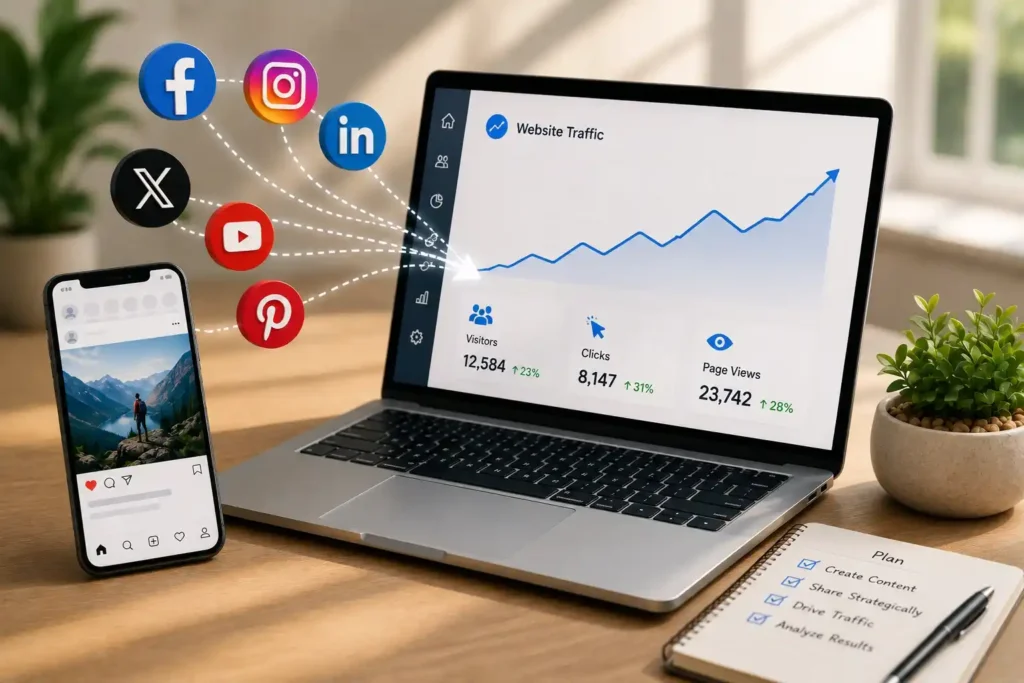

Turning Social Media Into a Reliable Source of Website Traffic
Social media can be one of the most reliable ways to increase website traffic when you treat it as a system rather than a habit. In short: pick the platforms your audience actually uses, publish content built around a clear call to action, link that content back to your website, and track the results so you can improve over time.
This guide covers everything you need to know about How Social Media Can Increase Website Traffic:
- Organic vs. Paid Social Traffic
- How to Develop Content That Brings More Visitors to Your Website
- Building a Content Calendar and Posting Consistently
- Optimizing Your Social Profiles and Landing Pages
- Tracking Traffic and Measuring Results
- Should You Hire a Digital Marketing Company?
- Social Media Website Traffic Checklist
- Conclusion
- FAQs
What Is Social Media Traffic?
Social media traffic is the portion of your website visitors who arrive by clicking a link from a social media platform, a post, a bio link, a story, an ad, or a shared piece of content. In analytics tools like Google Analytics, this usually shows up as referral traffic or social traffic, separate from organic traffic (visitors from search engines) and direct traffic (visitors who typed your URL directly).
Understanding what social media traffic is matters because it tells you which channels are actually contributing to website growth, not just which ones get the most likes.
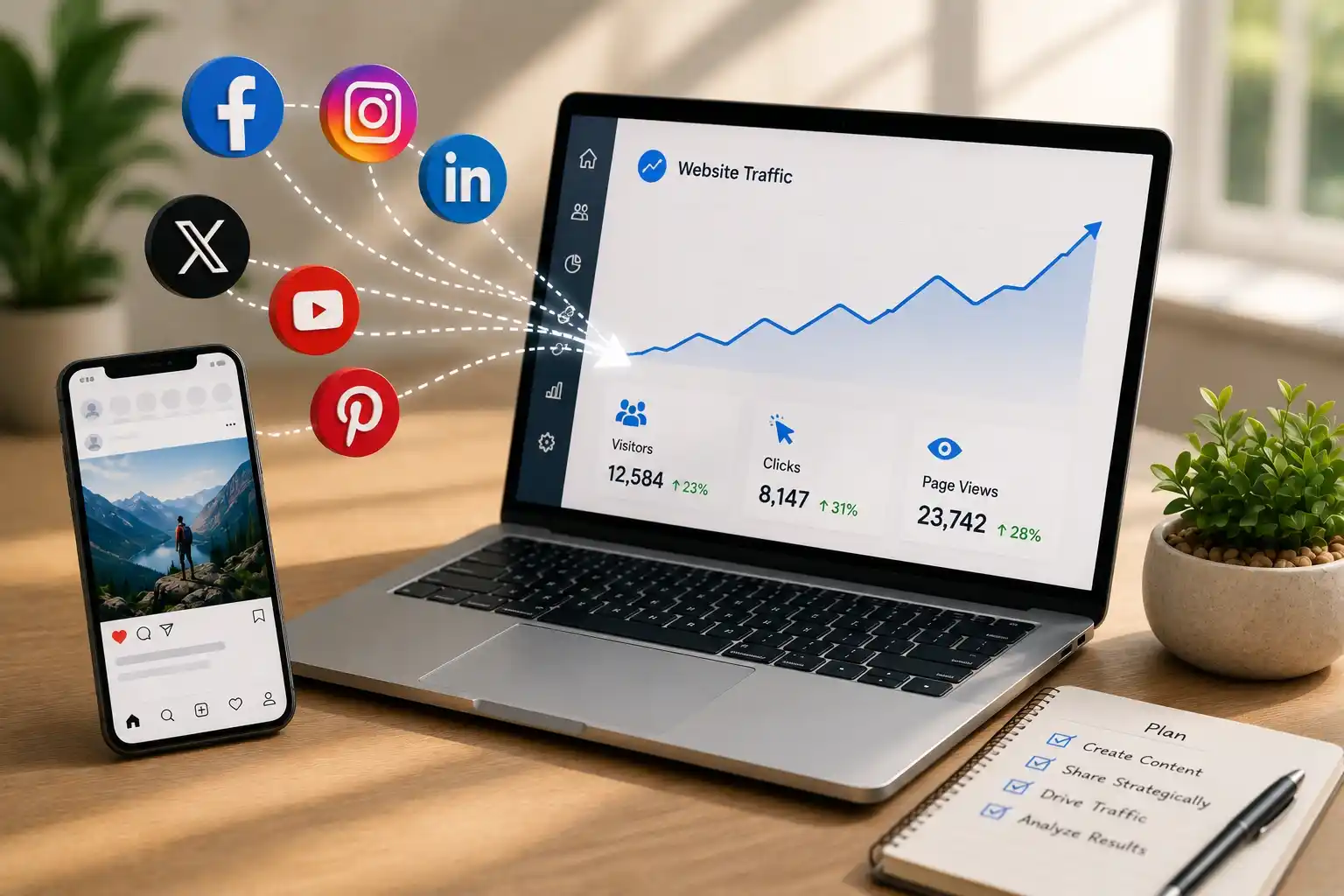
How Social Media Drives Website Traffic
Social platforms don’t send visitors to your website by accident. Traffic through social media follows a fairly predictable path:
- Someone sees your content in their feed (reach and impressions).
- They engage with it, like, comment, share, or save (social media engagement).
- They click a link in your post, your bio, or a story (social media clicks).
- Visitors are directed to your website or a dedicated landing page.
- They take an action, reading, subscribing, or converting.
This is sometimes called a social media funnel. Each stage narrows the audience, so the goal of a social media strategy isn’t just to create content people enjoy. It’s to move people through that funnel toward your website.
Funnel Stage |
What Happens |
What to Optimize |
|---|---|---|
Reach
|
People see your post
|
Posting frequency, hashtags, timing
|
Engagement
|
People interact with it
|
Content quality, relevance to target audience
|
Click
|
People visit your link
|
Clear CTA, link in bio, landing page
|
Conversion
|
People take action
|
Landing page design, offer clarity
|
Choosing the Right Social Media Platforms
Not every social media platform works the same way, and treating them identically is one of the most common mistakes businesses make. Each platform has different strengths for generating website traffic.
Platform |
Best For |
Traffic Style |
|---|---|---|
Instagram
|
Visual content, brand discovery, Reels
|
Link in bio, story links
|
Facebook
|
Communities, pages, groups, sharing
|
Direct post links, paid social media
|
LinkedIn
|
B2B audiences, thought leadership
|
Article links, professional content
|
Pinterest
|
Visual discovery, long-lasting content reach
|
Pin links that continue driving traffic over time
|
TikTok
|
Short-form video, discovery-driven content
|
Bio link, trending content
|
YouTube
|
Video search, tutorials, long-form content
|
Description links, video content
|
Reddit
|
Topic-based communities and discussion
|
Genuine participation, not promotional posting
|
X (formerly Twitter)
|
Timely conversation, commentary
|
Direct link sharing
|
A good social media strategy usually focuses on two or three platforms where your target audience already spends time, rather than spreading effort thin across every social platform available.
Organic vs. Paid Social Traffic
Businesses often ask whether they should rely on organic traffic or paid traffic from social media. The honest answer is that both play a role, and they work differently.
Factor |
Organic Social Traffic |
Paid Social Media |
|---|---|---|
Cost
|
Free to post, requires time investment
|
Requires ad spend
|
Speed
|
Builds gradually
|
Can generate traffic quickly
|
Reach
|
Limited by the platform's algorithm
|
Reach determined by audience targeting and budget
|
Sustainability
|
Compounds through content marketing
|
Traffic stops when spend stops
|
Best for
|
Long-term brand awareness and community engagement
|
Time-sensitive campaigns, product launches
|
Many businesses use a mix: organic social media for ongoing brand visibility and community engagement, and social media advertising for specific campaigns or promotions that need faster results. Neither approach guarantees a specific traffic increase the results depend heavily on your content, audience, and offer.
How to Develop Content That Consistently Attracts Website Visitors
Getting more traffic from social media starts with content people actually want to click through on. A few principles that consistently work:
- Develop content that gives your audience a compelling reason to click through. A post that fully answers the question in the caption gives people no reason to visit your site. Leave something for the website content to complete.
- Use visual content strategically. Visual content, including short-form video and video content, tends to perform well for reach on most platforms, which increases the number of people who could potentially click through.
- Make your CTA specific. Instead of "learn more," try "read the full guide," "get the checklist," or "see pricing." A strong CTA tells people exactly what they'll get.
- Repurpose what already works. Content repurposing is turning a blog post into several social posts, or a video into short clips, which helps maintain consistent posting without constant new ideas.
- Lean into evergreen content. Evergreen content keeps generating clicks long after the original post date, especially on platforms like Pinterest and YouTube.
Building a Content Calendar and Posting Consistently
A content calendar keeps your social media content organized and prevents last-minute scrambling. At minimum, plan:
- What you'll post (content strategy)
- Where you'll post it (which social media platforms)
- When you'll post it (posting schedule)
- What action you want the audience to take (CTA)
Consistent posting matters more than posting frequency for its own sake. There’s no verified “best time to post” that works for every business. Testing what works for your specific target audience is more reliable than following generic advice.
Optimizing Your Social Profiles and Landing Pages
Before you focus on generating traffic, make sure your social profiles are set up to convert it:
- Add your website URL to your profile bio, not just your homepage. A specific landing page tied to your current offer often performs better.
- Keep social profile links current when you launch new content or campaigns.
- Use social sharing buttons on your website so visitors can share your content back on social media, extending organic reach.
- Point traffic toward a conversion-focused landing page rather than a generic homepage whenever the post has a specific goal.
Metric |
What It Tells You |
|---|---|
Sessions/page views
|
Overall volume of website visitors
|
Referral traffic
|
How many visitors came from social platforms
|
Click-through rate (CTR)
|
The percentage of people who view your content and proceed to click on it.
|
Bounce rate
|
Whether visitors stay or leave immediately
|
Conversion rate
|
How many visitors complete a desired action
|
New vs. returning visitors
|
Whether you're growing your audience or re-engaging it
|
Google Analytics and Google Search Console are the standard tools for this. Adding UTM parameters to your links allows for more precise campaign tracking, so you can see exactly which post, platform, or campaign sent a given visitor, useful for comparing performance metrics across channels and calculating social media ROI over time.
Should You Hire a Digital Marketing Company?
Some businesses manage social media content and traffic tracking well in-house. Others find it hard to keep up, especially when content creation, posting schedules, paid social campaigns, and analytics all compete for the same limited time.
It’s worth considering outside support if your team:
- Doesn't have time to manage multiple social media channels consistently
- Struggles to produce engaging content on a regular schedule
- Isn't tracking link clicks, referral traffic, or conversions
- Wants to run paid social media campaigns but lacks the experience to manage budget and targeting
- Needs a connected digital marketing strategy that ties social activity to actual website conversions, not just engagement numbers
This is the kind of work agencies typically support, building out a social media strategy, producing content, and connecting it to measurable website results. It’s not a requirement for every business, but it’s a reasonable option once social media becomes too time-consuming to manage well internally.
How Sir Marketer LLC Can Help
Sir Marketer helps businesses turn their digital marketing efforts into a clear, measurable strategy that supports real business growth. Instead of managing social media, content, advertising, and analytics separately, we bring these activities together to create a more connected approach.
Our team can support your business with:
- Social media management: Creating engaging content and maintaining a consistent posting schedule across relevant platforms.
- Content creation: Developing content that reflects your brand, connects with your audience, and supports your marketing goals.
- Paid social campaigns: Managing targeted advertising campaigns while focusing on effective budget allocation and audience targeting.
- Performance tracking: Monitoring website traffic, link clicks, leads, conversions, and other important marketing metrics.
- Digital strategy: Connecting social media, content, advertising, and website activity into one focused marketing strategy.
Whether you need ongoing social media support or a complete digital marketing solution, Sir Marketer provides the expertise and strategy to make your online presence more consistent, effective, and results-driven.
Social Media Website Traffic Checklist
- Define your target audience
- Choose the right platforms
- Optimize social profiles
- Add the correct website link
- Create valuable content
- Build a content calendar
- Use clear CTAs
- Promote useful website content
- Track link clicks
- Add UTM parameters
- Monitor referral traffic
- Measure conversions
- Test different content formats
- Improve campaigns using analytics data
Conclusion
Increasing website traffic through social media isn’t about posting more. It’s about posting with intent. Choose platforms that match your target audience, create content with a genuine reason to click, send that traffic to a page built to convert, and track the results so you know what’s actually working. Done consistently, social media becomes a dependable source of website traffic rather than a guessing game.
FAQ’S
It's website traffic that comes from someone clicking a link on a social media platform, tracked separately from organic and direct traffic in most analytics tools.
It generally refers to the visitors, clicks, or engagement a piece of social content generates, some of which convert into actual website visits.
Post content with a clear CTA, link back to your website or a landing page, focus on the platforms your audience uses, and track clicks and conversions so you can adjust your approach.
The right approach varies based on your target audience and the nature of your industry. Platforms like Pinterest and YouTube can generate traffic over a longer period, while Instagram and Facebook often drive quicker referral traffic. Testing is more reliable than assuming.
No. Organic traffic from social media can work well, particularly for content-driven businesses. Paid social simply speeds up reach and is useful for time-sensitive campaigns.
Brand identity design typically includes a logo, color palette, typography, brand assets, and guidelines that keep everything consistent.
Yes. A strong brand identity helps new restaurants make a clear first impression and stand out from day one, rather than building recognition from scratch after opening.
Branding defines who a restaurant is, while marketing promotes that identity to reach and convert customers. Marketing works best when it's built on a strong brand foundation.
An experienced agency brings strategic insight, design expertise, and consistency that can be difficult to achieve with limited in-house resources, helping restaurants build brands that support long-term growth.
Categories

You have different questions?
Our team will answer all your questions, We ensure a quick response.