Manufacturers face a marketing challenge most industries don’t: long sales cycles, technical buyers, and search queries so specific that generic advertising rarely converts. When a procurement manager evaluates CNC machining capabilities or an engineer assesses industrial coating suppliers, they’re typically preparing to move toward an RFQ, not simply exploring options. PPC for manufacturers exists to meet that moment. Done well, manufacturing PPC puts a company’s products or services in front of prospects at the exact point they’re searching, turning ad spend into qualified leads rather than wasted clicks.
This guide covers everything you need to know about the PPC for Manufacturers:
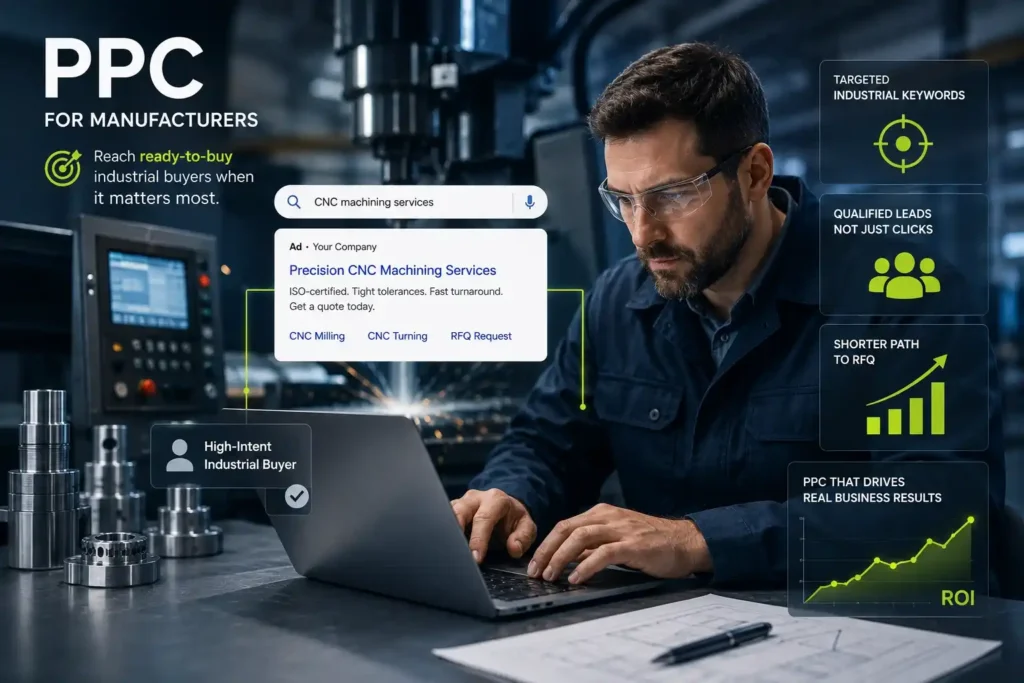
PPC, or pay-per-click advertising, is a model where a business pays only when someone clicks their ad. For manufacturers, PPC ads appear in search results when a buyer types in a relevant query, a part number, a material spec, an equipment category, or a service like “contract manufacturing near me.” Because advertisers bid on keywords tied to real search intent, PPC for manufacturers puts visibility directly in front of people already looking for a solution, rather than hoping the right audience stumbles across an ad. That intent-driven visibility is what separates PPC from most traditional advertising.
Manufacturing PPC succeeds because it aligns with how industrial buyers actually search and buy.
Effective PPC strategies for manufacturers start with structure. Search campaigns should separate product lines, services, and industries into distinct ad groups so messaging stays relevant to each search. Long-tail and product-specific keywords, model numbers, materials, or application terms tend to convert better than broad industry terms because they reflect specific intent.
Geographic targeting matters for manufacturers serving defined regions or shipping zones, while negative keywords for manufacturing PPC prevent budget waste on irrelevant searches (job seekers, students, DIY hobbyists). Remarketing for manufacturing companies re-engages the engineers and buyers who visited but didn’t convert during a long evaluation period. Display advertising for manufacturers can support brand awareness, and LinkedIn Ads for manufacturers work well when targeting by job title or company size adds precision that search alone can’t.
Google Ads for manufacturers centers on matching search intent to keyword selection, bid strategy, and ad copy. Search ads appear when someone types a query matching a manufacturer’s chosen keywords, and bid management determines how competitively a company shows up against others targeting the same terms.
Strong ad copy speaks directly to the searcher’s need, specifications, capabilities, certifications, or turnaround time, rather than generic marketing language. Geographic targeting narrows visibility to relevant service areas, and conversion tracking shows which searches actually turn into form fills, calls, or RFQs. Manufacturing Google Ads management works best when budgets are allocated toward proven keywords rather than spread thin across untested terms.
Manufacturing keyword research should map to how buyers actually describe their needs: product keywords, service keywords, application keywords, material keywords, and equipment keywords all represent different search intents. Problem-based searches, where a prospect searches for a solution rather than a product name, often carry high commercial intent and lower competition.
Broad, generic keywords tend to attract unqualified traffic and waste ad spend, since they don’t reflect the specificity of B2B manufacturing searches. Long-tail keywords, while lower in search volume, typically convert at a higher rate because they match a more defined target audience and buying stage. Negative keywords filter out irrelevant searches before they cost anything.
A generic homepage rarely converts PPC traffic. Manufacturing landing pages need message match; the page should reflect exactly what the ad promised, whether that’s a specific product, service, or capability. Beyond message match, effective landing pages include:
B2B landing page optimization directly affects conversion rate; the same PPC click can produce very different results depending on where it lands.
PPC campaign optimization is ongoing, not a one-time setup. Reviewing search terms regularly reveals which queries are actually triggering ads, allowing for better negative keyword lists and bid adjustments. Ad copy testing identifies which messaging resonates with technical buyers, while landing-page performance data shows where conversions are being lost.
Manufacturing conversion tracking should extend beyond form fills to track geographic performance, device performance, and audience performance, so budget shifts toward what’s actually producing qualified leads. PPC analytics turn a campaign from a static setup into a system that improves over time.
Manufacturing advertising costs vary based on keyword competition, industry, geographic targeting, product value, and search volume. A highly competitive industrial keyword will carry a different cost per click than a niche, long-tail term, and neither figure is fixed across the industry.
It’s worth separating a few cost components: ad spend (what’s paid directly to the platform per click), management fees (if working with an agency), cost per lead (spend divided by leads generated), and cost per acquisition (spend divided by closed deals). A manufacturer assessing its PPC budget should evaluate these factors alongside expected ROI rather than judging them individually.
Manufacturing marketing ROI depends on connecting PPC data to actual sales outcomes, not just click volume. Key metrics include clicks, click-through rate, conversions, conversion rate, cost per lead, and cost per acquisition, but the most meaningful number is how many qualified manufacturing leads eventually turn into sales opportunities and revenue.
Tracking ad spend against closed deals, rather than against leads alone, shows whether a campaign is genuinely profitable. A data-driven approach connects CRM records to PPC reporting so return on investment reflects real business impact.
Factor |
PPC |
SEO |
|---|---|---|
Speed
|
Faster visibility
|
Longer-term
|
Cost model
|
Pay for clicks
|
Investment in organic visibility
|
Intent targeting
|
Strong
|
Strong
|
Long-term traffic
|
Requires ongoing spend
|
Can compound
|
Testing
|
Fast
|
Slower
|
Lead generation
|
Immediate potential
|
Long-term potential
|
A practical framework: Research → Target → Advertise → Convert → Track → Optimize.
Start with business goals and buyer intent, then move into keyword research and campaign structure. Ad copy and landing pages should work together to convert clicks, while conversion tracking and lead qualification determine which campaigns are worth scaling. ROI analysis closes the loop, guiding where budget goes next.
Professional PPC management may make sense when a manufacturer has high advertising budgets, a complex product catalog, multiple locations, or highly competitive keywords to manage. It’s also worth considering when campaigns aren’t performing, when conversion tracking isn’t in place, or when there’s no internal bandwidth for the ongoing optimization long B2B sales cycles require. A manufacturing PPC agency brings dedicated time and specialized keyword knowledge that’s hard to sustain in-house alongside other marketing priorities.
Manufacturers considering PPC management want a partner who understands industrial buying cycles, not just generic ad platforms. Sir Marketer builds manufacturing PPC campaigns around how technical buyers actually search, product specs, application terms, and industry-specific language, rather than applying a one-size-fits-all approach borrowed from consumer advertising.
Sir Marketer positions PPC as one part of a broader manufacturing marketing strategy, working alongside SEO and content to build both immediate visibility and long-term growth.
PPC for manufacturers is pay-per-click advertising built around industrial and B2B search behavior, targeting buyers actively searching for manufacturing products, components, or services.
Yes. PPC works well for manufacturers because it targets high-intent searches from technical buyers and decision-makers, rather than relying on broad brand awareness.
Costs vary by keyword competition, industry, and geographic targeting. There's no fixed industry-wide rate; budgets should be set based on goals and evaluated against ROI.
Product, service, application, material, and problem-based keywords tend to perform best, since they reflect specific buyer intent rather than generic industry terms.
By combining precise keyword targeting, dedicated landing pages, and conversion tracking so ad spend goes toward buyers most likely to convert.
Google Ads captures active search intent, while LinkedIn Ads adds precision through job title and company targeting. Many manufacturers benefit from using both.
Neither replaces the other. PPC delivers faster visibility, while SEO builds long-term organic traffic; combining manufacturing SEO and PPC typically produces stronger results than either alone.
Our team will answer all your questions, We ensure a quick response.